The Guelph Treasure is a former medieval church treasure named after the House of Guelph, which owned it since 1671. Forty-four of the former 82 objects are now owned by the SPK.
What is now known as the Guelph Treasure was the reliquary treasure of the former collegiate church of St. Blasius in Braunschweig (today: Braunschweig Cathedral). It is one of the most important German church treasures of the Middle Ages, with works of treasure art from the 11th to 15th centuries. In 1671, it came into the possession of the House of Guelph. In 1929, the House of Welf sold the treasure, consisting of 82 objects, to a consortium of art dealers – just three weeks before the start of the Great Depression.
In 1935, the Prussian state acquired 42 works from the consortium, some of whose members were Jewish, through Dresdner Bank for the Schlossmuseum, now the Museum of Decorative Arts of the Staatlichen Museen zu Berlin – Stiftung Preußischer Kulturbesitz (Prussian Cultural Heritage Foundation). Two further works were added in 1935 and 1937 through exchange. Today, 44 works from the Guelph Treasure are owned by the Stiftung Preußischer Kulturbesitz. They were on display at the Museum of Decorative Arts at the Berlin Kulturforum until 2025 and are currently being prepared for a new presentation in the central special exhibition hall at the Kulturforum.
Most of the remaining objects from the Guelph Treasure are now in various museums in the USA, Sweden, and Germany. Three works that were in the Roselius House in Bremen were destroyed in 1945. The whereabouts of four other objects that came into private American ownership in 1930/31 remain unknown.
Cultural Property of National Significance
The Kunstgewerbemuseum currently holds 44 of the original 82 pieces in the Guelph Treasure. That makes this remaining portion the largest German ecclesiastical treasure owned by a public institution. In light of this circumstance, the State of Berlin designated the Guelph Treasure as cultural property of national significance on February 6, 2015, after a several-month research process. Under the German Act to Protect German Cultural Property against Removal (Kulturgutschutzgesetz), removing the pieces from Germany – even for exhibition purposes – is now only possible with authorization from the German Federal Government Commissioner for Culture and the Media.
The Most Important Items of the Treasure
The Guelph Treasure contains many outstanding objects, including magnificent crosses, reliquaries, and portable altars. Some of the best-known works are described below.
The Cupola Reliquary
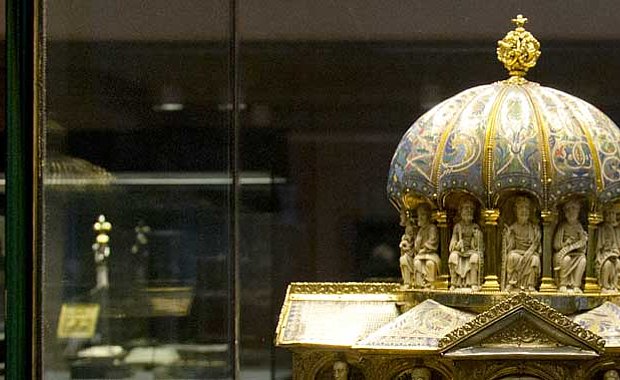
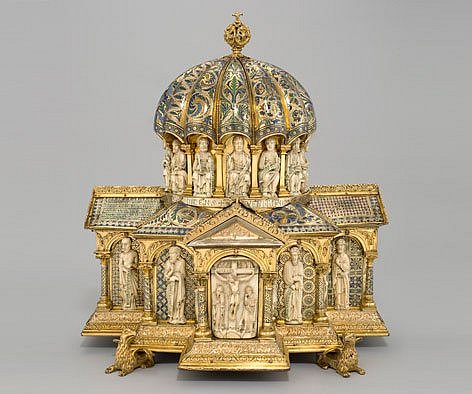
The Cupola Reliquary, glowing golden and standing almost half a meter high, is the most important piece of the Guelph Treasure. Its form is reminiscent of a Byzantine cross-in-square church and it is richly ornamented. The reliefs on the ends beneath the pediments show the Holy Family, the journey of the Magi, the Crucifixion, and the women at the tomb. Under the other arcades are figures of the prophets. The Apostles are enthroned at Christ’s side on the drum of the dome. The inscription at the base of the drum contains the beginning of the Confession of Peter (Mt 16,13-16, “When Jesus came into the coasts of Caesarea Philippi, he asked his disciples”). In 1482, the cupola reliquary held the relic of the skull of St. Gregory of Nazianzus. The lack of any images or inscriptions pointing to its use as a reliquary, as well as other factors, have recently led experts to conclude that the piece was originally intended as a tabernacle for keeping sacramental bread.
The Guelph Cross
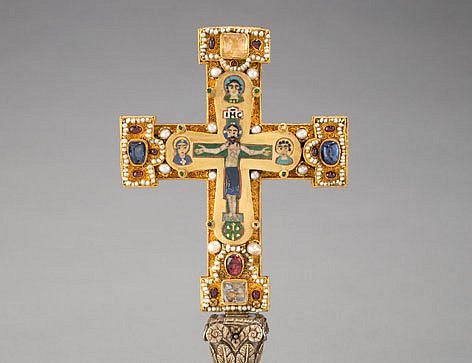
The Guelph Cross is an uncommonly exquisite reliquary cross. It is one of the chief works of art in the Guelph Treasure. Behind a square piece of rock crystal at the foot of the cross, it contains a fragment of the True Cross. According to the engravings in niello on the back, it also contains relics of St. Peter, St. Mark, St. John the Baptist, and St. Sebastian. The cross is decorated with extremely fine filigree work. An enkolpion, originally used as a pectoral cross, is attached to the front. It shows Byzantine influence and is presumably significantly older than the other parts of the cross. On its front are Christ on the cross, portraits of Mary and John the Evangelist to the left and right, and (most likely) the archangel Michael above. The base of the cross adopts Classical elements that impressively emphasise the role of the Guelph Cross as a repository of relics.
The Portable Altar of Eilbertus
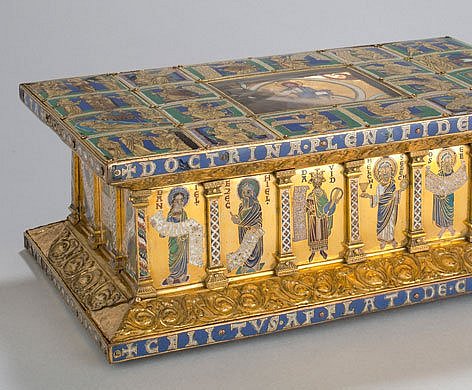
The Guelph Treasure includes the largest number of medieval portable altars to survive in a single church treasure. They include, to name just a few, the Portable Altar of Eilbertus, the Portable Altar with the Cardinal Virtues, and the Portable Altar with the Rock Crystal Columns. The Eilbertus portable altar is a major work of Romanesque treasury art and is named after its creator, the Cologne goldsmith Eilbertus. Exhibiting exceptional technical skill and great artistic maturity, it exploits the possibilities offered by a variety of copper enameling techniques in order to execute a complex theological iconography. Figures of the prophets appear on the sides, placed between columns, along with their prophecies. They act as Old Testament supports for the altar. Each end of the mensa (the top panel), left and right, bears four plaques depicting scenes from the lives of Mary and Christ . Representations of the twelve Apostles holding scrolls with text surround the altar stone of rock crystal. Visible beneath the rock crystal is a miniature painting of Christ as Judge of the World, along with the symbols of the four Evangelists.
The Arm Reliquary of Saint Sigismund
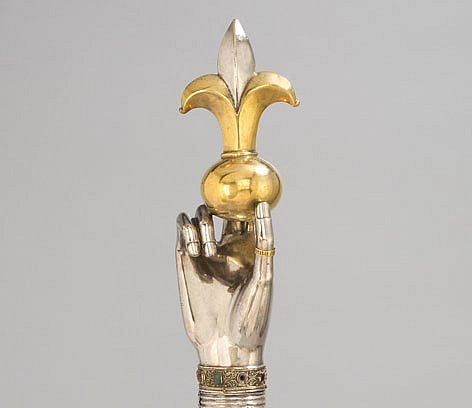
The Arm Reliquary of Saint Sigismund is among the oldest surviving examples of a common type of reliquary called a “talking” reliquary. According to an inscription carved into the underside of the base (which was not inscribed before around 1300), it holds relics of St. Sigismund, King of the Burgundians (d. 524). The arm reliquary stands on a square base which rests on lions' paws and features a chased design of foliage on its top. The sleeves and hand were originally made of chased rolled silver. In the late 13th or early 14th century, the hand was replaced by one of cast bronze. In three fingers, it holds an orb surmounted by a fleur-de-lis. This was seen to be a shortened representation of a lily-crowned scepter. When the hand was replaced, the sleeve was made narrower, causing this arm reliquary to have unusually slender proportions. The thumb ring with the inscription “ciismundus” (Sigismund) in Gothic minuscule script was presumably added at some time afterwards.