Karl Friedrich Schinkel has also left a remarkable legacy in the collections of various SPK institutions: from architectural drawings and paintings of his buildings to his own artistic works. A selection.
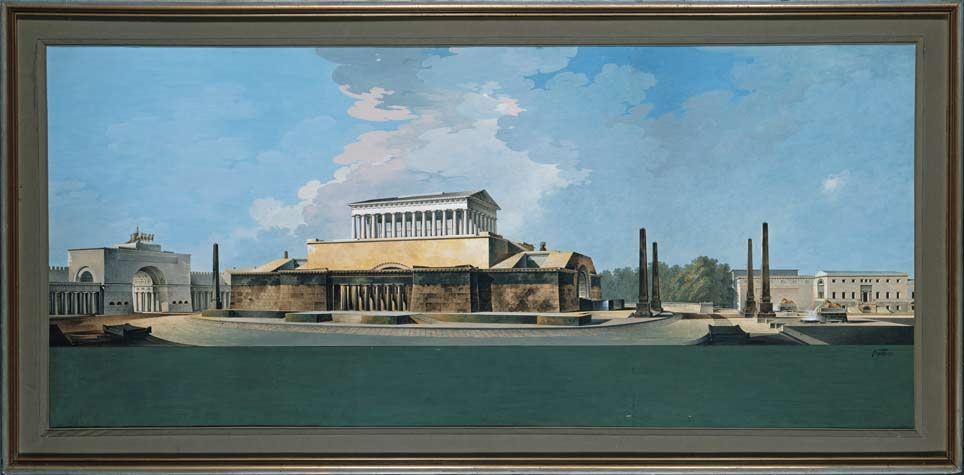
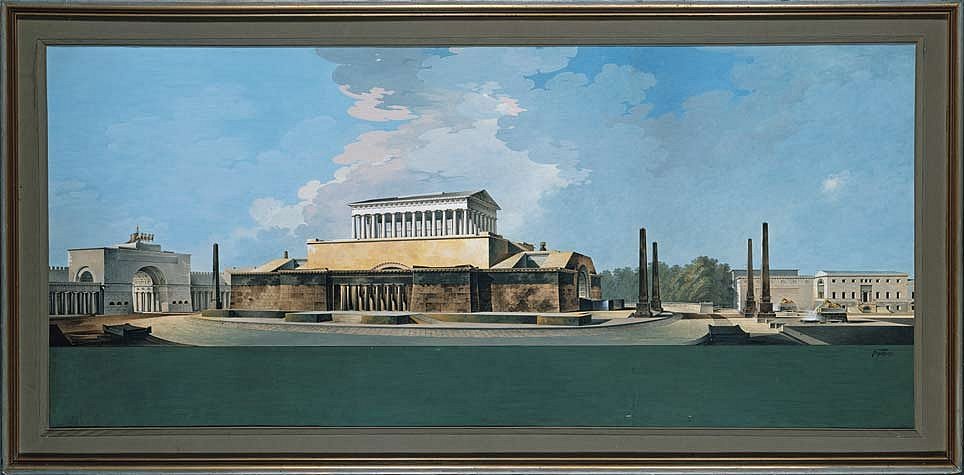
In 1797, the young Karl Friedrich Schinkel (1781–1841) saw Friedrich Gilly’s groundbreaking design for a monument to Frederick the Great on Leipziger Platz at the Berlin Academy exhibition. Gilly was famous at the time for his buildings influenced by French Revolutionary architecture, and his design for the monument to Frederick the Great is regarded as a key image of post-Baroque, modern architecture in Berlin around 1800. The work made a profound impression on Schinkel and became the defining image of his own career as an artist and architect. A year later, he left grammar school to become Gilly’s pupil.
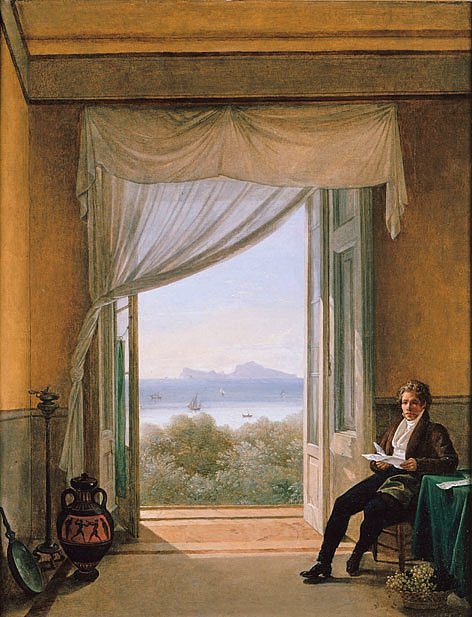
In 1803, the 22-year-old Karl Friedrich Schinkel set off for Italy for the first time. Twenty years later, he once again set foot on ‘classical soil’ in southern Italy. On his return journey, Schinkel commissioned a portrait of himself from Franz Ludwig Catel in Rome as a Christmas present for his wife.
The quarter depicted in the painting was popular with many travellers to Italy at the time – and later served as a model for Schinkel’s pavilion in the Charlottenburg Palace Park, commissioned by King Frederick William III.
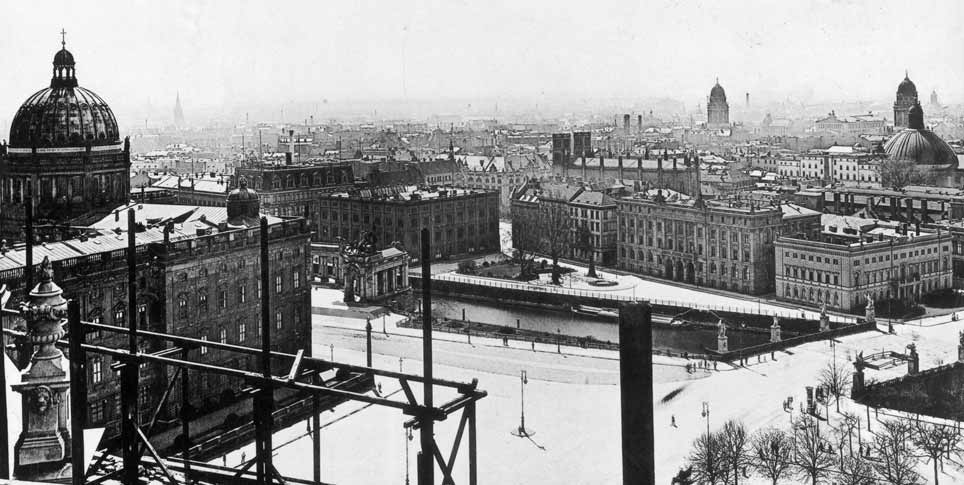
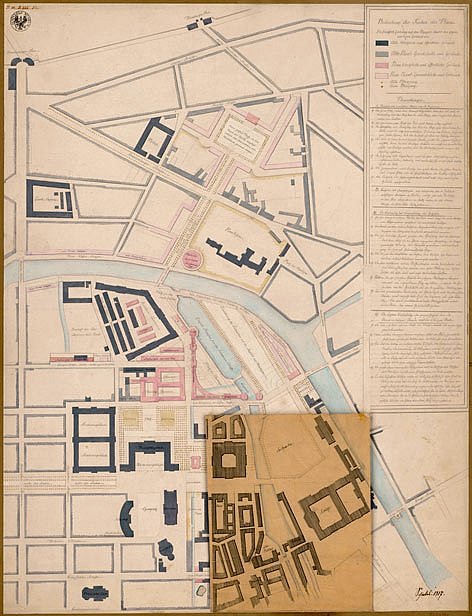
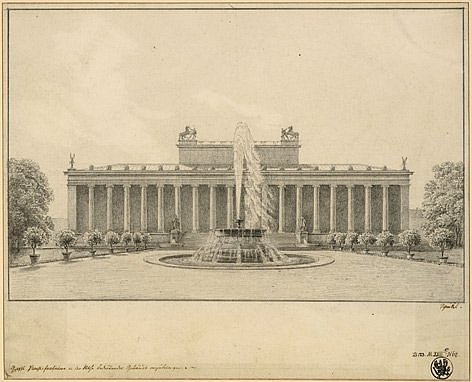
As an urban planner, Karl Friedrich Schinkel focused on Berlin’s historic centre. He pursued his numerous urban redevelopment projects with the aim of permanently improving Berlin’s appearance. With the construction of the Altes Museum, he sought to ‘beautify a very unremarkable area situated near Berlin’s most beautiful buildings through a stately structure’.
From 1823, Schinkel built the Altes Museum on the Lustgarten, Prussia’s first museum – and an icon of Classicism. In his design, he drew inspiration from the architectural ideas of ancient Greece. Thus, the 18 fluted Ionic columns, the wide-spanning portico, the open staircase and the rotunda adorned with ancient sculptures all evoke the Roman Pantheon.
Today, the building houses the Collection of Classical Antiquities of the Staatliche Museen zu Berlin, which presents its permanent exhibition on the art and culture of the Greeks, Etruscans and Romans here.
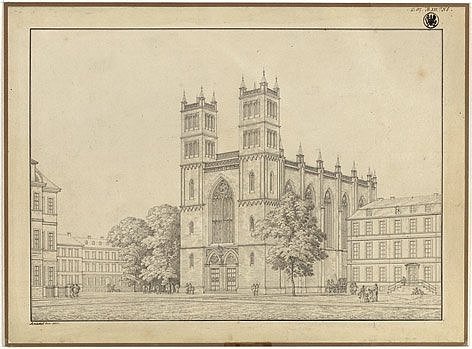
Designed by Karl Friedrich Schinkel and built between 1824 and 1830, almost simultaneously with the Altes Museum, the Friedrichswerder Church adorns the Werderscher Markt in Berlin. As a branch of the Alte Nationalgalerie, it housed a selection of sculptures from the first half of the 19th century until 2012. At the same time, it also provided space for contemporary art.
During the construction of a luxury apartment block just three and a half metres away, the listed and extensively restored church was severely damaged. Due to the risk of collapse, the historic building had to be evacuated in 2012 and has been inaccessible ever since.
The Bauakademie: The starting point for Prussia’s creative endeavours in the 19th century
Due to the lack of training opportunities for architects, who were faced with new challenges in the wake of industrialisation, the ‘Allgemeine Bauschule’ (General School of Architecture) was founded in 1799, initially housed at Werderscher Markt.
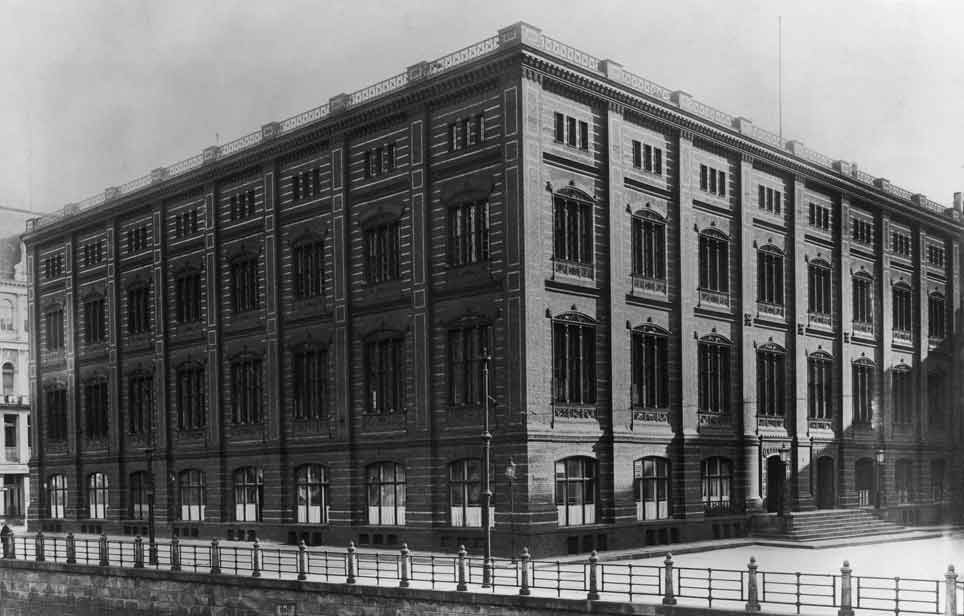
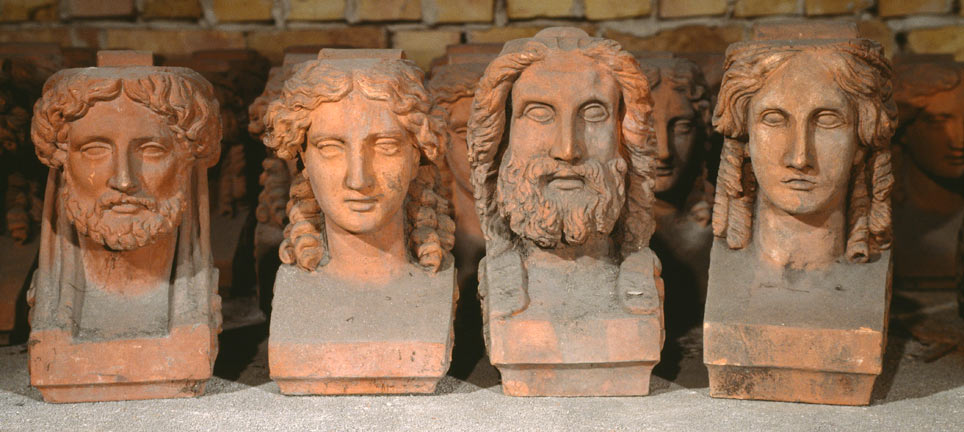
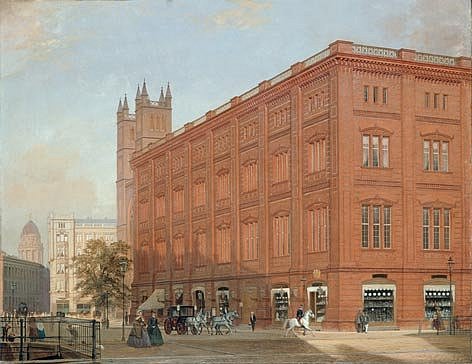
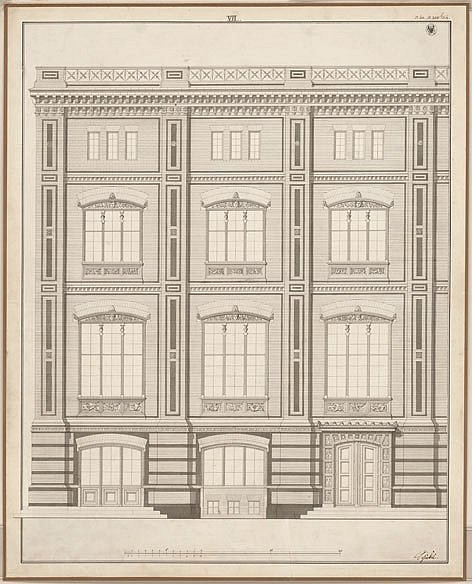
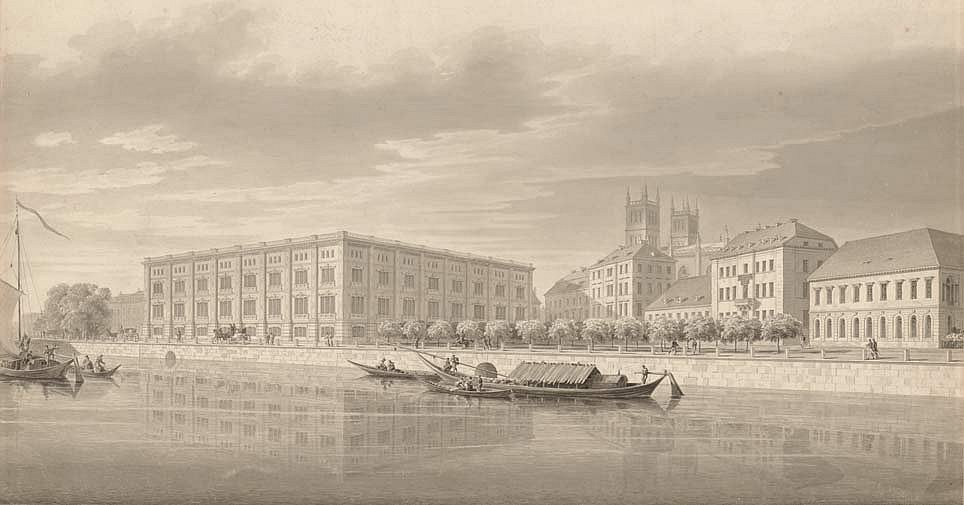
Between 1832 and 1836, a purpose-built building for the Bauakademie was erected on the site of the old Packhof on the Spree, based on designs by Karl Friedrich Schinkel. The building, decorated with ornamental bricks and terracotta, set new standards: Schinkel employed a highly modern technique by using an ‘exposed brickwork’ method to incorporate unplastered bricks into a load-bearing framework. The original design of the building and the urban landscape of Berlin in the first half of the 19th century can still be experienced today through the paintings of the Berlin architectural artist Eduard Gaertner.
Schinkel submitted the first plans for the Bauakademie in 1831, immediately after Peter Christian Beuth was appointed as the new director of the ‘Allgemeine Bauschule’. Construction began a year later. A characteristic feature of the building was the brick façade with friezes, cornices, pilaster strips and reliefs.
The drawing below shows the Bauakademie from the perspective of the Schloßbrücke. Behind the Bauakademie rise the striking towers of the Friedrichswerder Church, also built of brick by Schinkel, crowned with pinnacles.
Architect – Graphic Designer – Set Designer
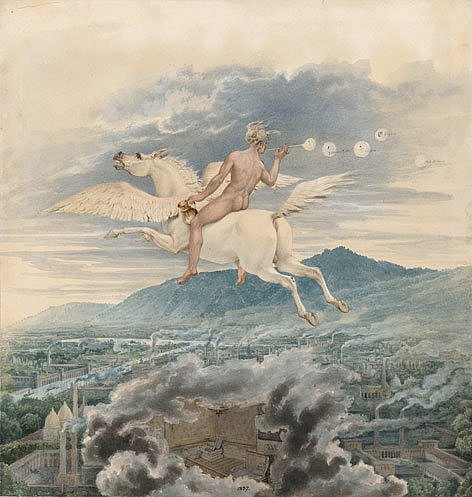
Schinkel was a jack-of-all-trades: he could not only build and design, but also paint. In 1837, he dedicated an almost surreal-looking painting to his friend Christian Peter Wilhelm Beuth, director of the General School of Architecture in Schinkel’s new Bauakademie building.
It depicts an androgynous female figure on a winged horse, intended to represent Beuth’s diligence, power of inspiration, and both realised and shattered visions. In the foreground lies a sprawling industrial landscape with block-like factories, blast furnaces, smoking chimneys and a heavily trafficked canal connected to the river. Its edge is surrounded by a wreath of smoke, identifying it as a fictional insertion. The viewer’s gaze is directed towards a corner of Beuth’s study containing files from the Trade Association and the Berlin Art Association. Schinkel was inspired by a trip to Great Britain and the advancing industrialisation he observed there.
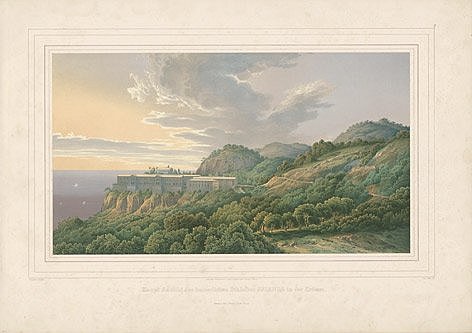
Oriander Palace in Crimea is one of Schinkel’s designs that remained unbuilt. In 1837, Schinkel designed a summer residence for the Russian Tsarina in a classical style similar to the Charlottenburg Palace in Sanssouci. The building was to be erected on a rocky plateau 500 metres above the Black Sea. Schinkel devised two distinct concepts for the house in the ‘Muscovite’ and ‘Antique’ styles. Ultimately, the project was never realised – officially due to a lack of water supply.
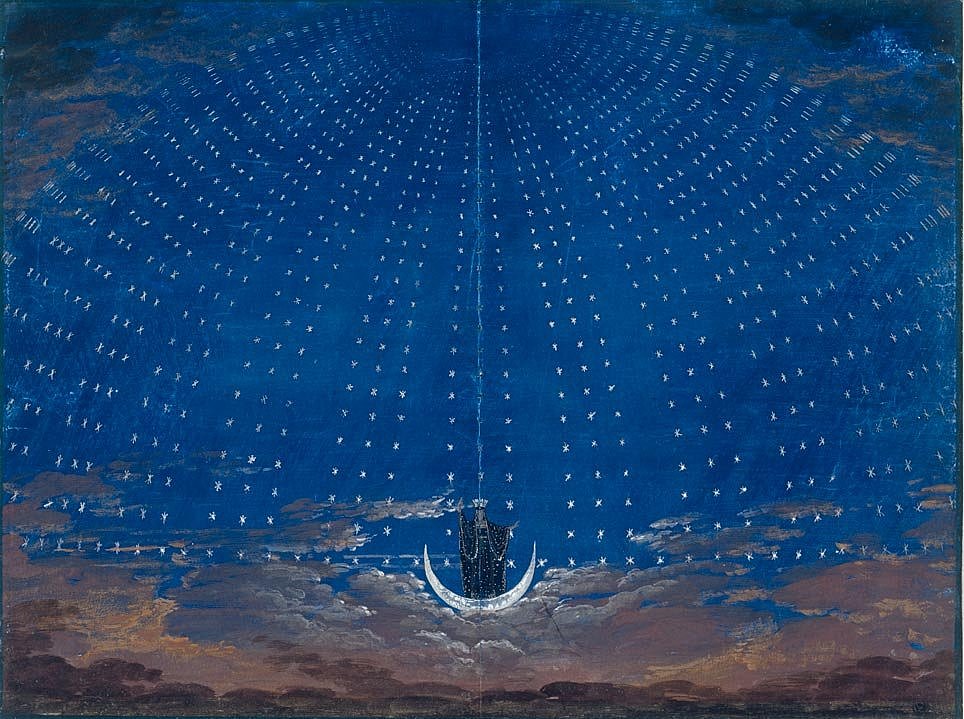
It is arguably the most famous stage set in the world and, at the same time, one of the most impressive visual creations of the 19th century: Karl Friedrich Schinkel’s ‘Hall of Stars of the Queen of the Night’. In hardly any other of Schinkel’s works is the dualism of nature and architecture, which he repeatedly reflected upon, brought to the fore with such a high degree of abstraction: on the one hand, the scene evokes a section of the nocturnal cosmos, against which deeply layered, naturally lit dark cloud formations rise in the lower third and in the upper spandrels; on the other hand, Schinkel constructs a domed hall halved in longitudinal section, whose vault ribs consist of three-rowed chains of stars tapering upwards and vanishing into the apex. The lower edge is formed by a continuous horizontal row of stars lying like a tambour upon the cloud zone. The central figure of the Queen cuts through this ring precisely at the centre of her form, thus mediating between the earthly sphere and the delicate tectonics of her enchantingly luminous cathedral.