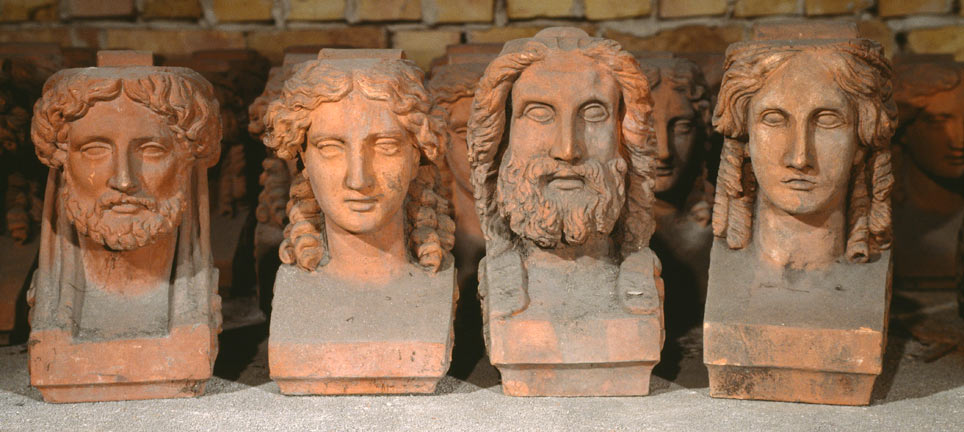
Although Schinkel’s Bauakademie was a clear, functional building, its façade was nevertheless richly adorned with terracotta sculptures. Following its demolition in 1961, these sculptures found their way, via various detours, into a wide range of storage facilities and collections – including those of the Staatliche Museen zu Berlin. Elke Blauert has traced the history of Schinkel’s terracotta sculptures.
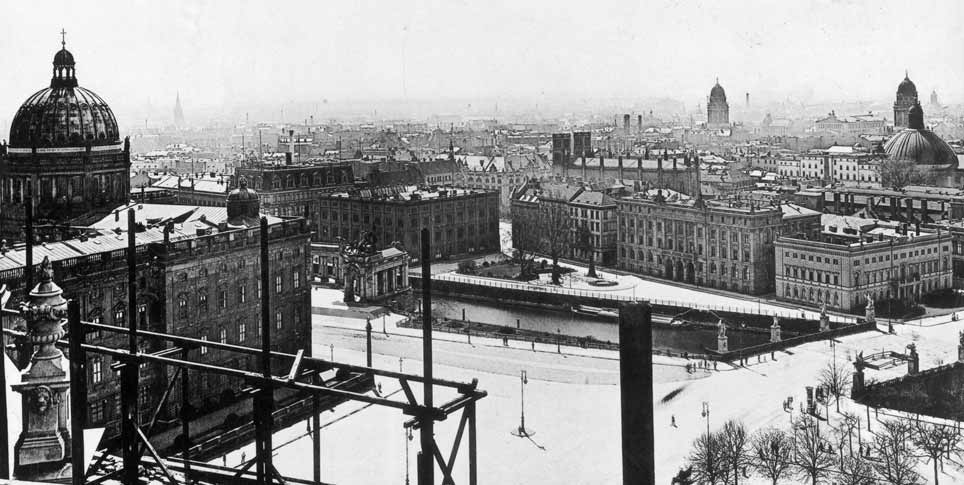
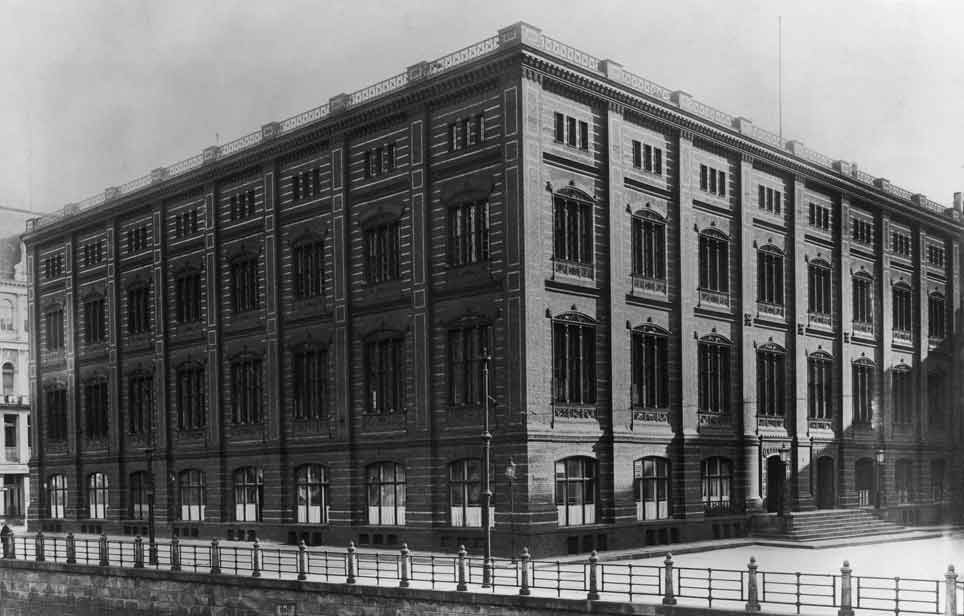
On the site of the old Packhof on the west bank of the Spree, opposite the Zeughaus and the Berlin City Palace, Karl Friedrich Schinkel erected the new building between 1832 and 1836 for the ‘Allgemeine Bau-Unterrichtsanstalt’ (General Building School), which had been founded in 1799 under the name ‘Königliche Bauakademie zu Berlin’ , which was known as the ‘General Building School’ from 1831 to 1848 and, from 1844, housed the Schinkel Museum, Europe’s first staff museum.
Schinkel’s own guiding principles for building: “emphasising the structure through its articulation, openly displaying the materials, no component without a purpose, everything concise, clear and authentic” were fulfilled to a high degree by the Bauakademie, which his opponents dubbed the “red box” – so it is no wonder that admirers praised the building’s functionality and austere beauty.
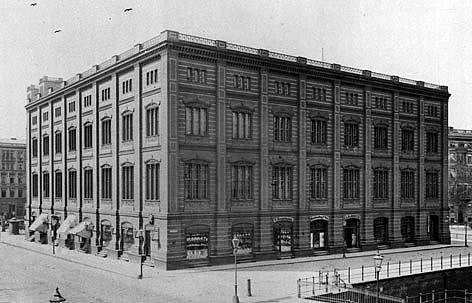
Photo: The Bauakademie © bpk / Hermann Rückwardt
The façade as the architect’s pictorial bible
The terracotta-clad façade of the Bauakademie was also unique: according to Paul Ortwin Rave, former director of the National Gallery, its extensive pictorial programme was “a classic pictorial bible of the master builder”. The pictorial programme was designed for reproducibility and – with the exception of the portals – was identical on all four sides of the building. At the heart of the pictorial cycle were 24 figurative terracotta reliefs, arranged on the first floor beneath the eight windows on one side of the façade, grouped in sets of three. The depictions from the world of building were complemented in the arched segments above these windows by animal figures, which faced one another in a symmetrical, heraldic arrangement. In the centre of each was a typical builder’s tool, such as a compass, spirit level or plumb line. The pictorial scheme of the second floor was more strongly ornamental in character. Here, the arch fields alternated between Athena, the Greek goddess of the crafts, and another female head.
These architectural sculptures were modelled by the leading Berlin sculptors of the Schinkel era, such as Johann Gottfried Schadow, Christian Friedrich Tieck, August Kiß and Julius Troschel, based on Schinkel’s drawings. The terracottas of the Berlin Bauakademie were fired in the workshop of master potter Cornelius Gormann. Even at the time of their creation, the terracottas from the Bauakademie were also used in other architectural contexts, such as on the residence of master potter Gormann in Gormannstraße—now named after him—and on a pergola in Neustrelitz. Following his visit to Berlin in 1836/37, the Russian aristocrat Vladimir Davidov also commissioned 24 terracotta pieces for the window parapets and 16 for the doors from Cornelius Gormann. Some of these were later intended to adorn his tomb in Crimea. The relief sculptures from the Bauakademie were early collectors’ items.
In Berlin’s Weinmeisterstraße, too, the entrance hall of the former Sophiengymnasium houses 14 copies of the panels from the Gormann House, some of which feature duplicate motifs. In 1935, the director of the National Gallery, Paul Ortwin Rave, had five damaged terracottas replaced with copies. Individual terracotta pieces from the confiscated collection of Marie Busch, who belonged to the Mendelssohn-Bartholy family, found their way into the Alte Nationalgalerie. This collection has been restituted. With so many copies, the question naturally arises as to how to distinguish between a copy and an original – thanks to the fragment structure, a system of offset marks and special mortar, the pieces originally installed in the Bauakademie can be easily distinguished from the rest.
How the terracotta pieces came to the museum
“The former Bauakademie is to be demolished. The valuable parts are to be salvaged with the aim of rebuilding the building at a later date on the site at the corner of Französische Straße and Kurstraße,” read the final resolution of the “Leitungskollektiv Aufbau Stadtzentrum” (Institute for the History of the Labour Movement, Archive 2 PAW, IV 2/2026/18). It is an irony of history that this decision was taken on 13 March 1961, the 180th anniversary of Schinkel’s birth. The idea of reconstruction must have been discarded quite quickly, otherwise the building would have been demolished differently. Traces of jackhammers speak for themselves.
The most valuable terracottas were nevertheless taken to the heritage conservation depot in the factory building of the ‘Ermler-Haus’. When this was cleared in 1966 to make way for the relocation of the front building to its current site, around 300 terracottas had to be taken over by the Berlin State Museums. The original plan had been to integrate the Bauakademie’s terracottas into the Alte Museum, which was then under reconstruction, but this never happened. Some terracottas were subsequently transferred to the Museum of Decorative Arts.
When work began in the 1970s on the construction of the Palace of the Republic and the Schinkelklause in the area of the Kronprinzenpalais, the historic preservation authorities and the commissioned ‘Meisterwerkstatt Richard Paulick’ requested the return of terracotta pieces from the museums. According to two documents, the Museum of Decorative Arts returned a number of terracotta pieces to Ms Waltraut Volk of the Office for the Preservation of Historical Monuments in 1968.
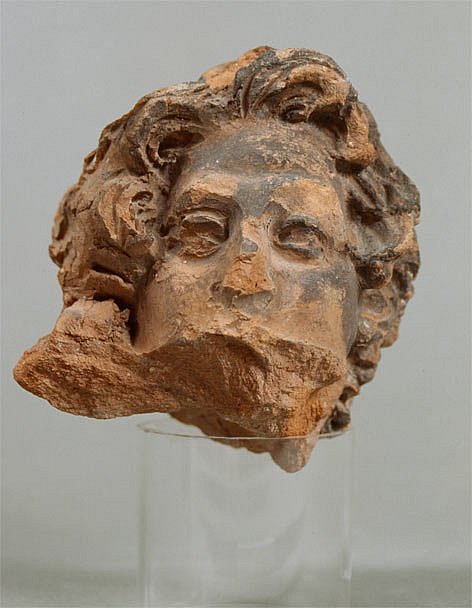
There is no evidence that these terracottas were returned to the museums after the moulds required for the buildings had been taken. Many probably remained with Berlin sculptors. For example, a fragment from the right-hand main portal, ‘Master Builder Crowned by the Genius of Art’, from the collection of Waldemar Grzimek, has been published.
Art Library
The Art Library is an interdisciplinary research institution housing one of the world’s largest museum libraries. It also holds significant collections on the history of architecture, photography, graphic design and fashion, as well as book and media art. Together, the library and the collections represent the entire spectrum of sources for research in art and cultural studies. It is represented at the Kulturforum (museum collections, art history library), the Archaeological Centre (Archaeological Library) and the Museum of Photography (exhibition venue for the Photography Collection).
Valuable original moulds in the cellar
In the 1950s, a large proportion of the original moulds for the terracotta elements were still stored in the cellar of the ruined Bauakademie. These were used until 1957 to produce new versions of the parts damaged during the Second World War, meaning that the copies produced up to 1957 are also particularly valuable and could be used for a reconstruction of the façade. As late as 1979, the Berlin Senate instructed the brickworks to permanently preserve the moulds. After reunification, however, the brickworks disappeared, and with them the original moulds.
In addition to the ‘Ermler House’, Berlin’s Monument Preservation Authority had other depots where parts of the Bauakademie were stored. The Märkisches Museum, now the Stiftung Stadtmuseum Berlin, has six terracotta pieces in its collection. These once hung in the stairwell of the Monument Preservation Authority’s office building on Neue Grünstraße.
Government officials, but also well-meaning citizens, acquired parts of Schinkel’s Bauakademie. A private removal contractor was granted permission to secure bricks from the demolition of the Bauakademie. However, he took not only ordinary bricks but also terracotta pieces. Traceable to this provenance, the City Museum and the Art Library each hold three terracotta pieces, including the only surviving arch relief depicting ‘Athena Ergane’ in the Art Library. The museums have recently acquired individual parts of the Bauakademie and the ‘Feilnerhaus’ from private collections.
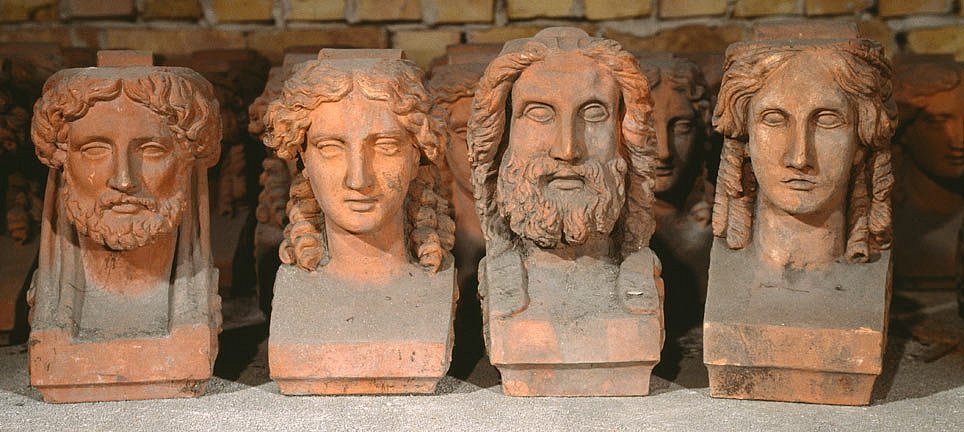
Individual original parts of the façade keep turning up, some of which were carried away from the demolition site in shopping bags. The heads of the window herms apparently also made good flowerbed edging. The number of parts in private ownership that remain unaccounted for is therefore likely to be high. There were evidently significant ‘transport losses’ during the removal of the demolition material. It is to be hoped that, should the building be reconstructed, many parts will be traced and made available. Copies were also given away to ‘deserving citizens’.
A large number of terracotta pieces are in private ownership far beyond Berlin and in various museums such as the Stiftung Stadtmuseum Berlin, the Georg Kolbe Museum, the local history museum in Neuruppin, and the Technikmuseum Berlin.
The terracotta figures from the pergola in Neustrelitz were smashed by vandals. Remnants of these were found in the cellar of the local Orangery around 1993. During façade renovations in the last decade, such as at 121 Linienstraße in Berlin, the number of terracotta figures incorporated into the building was significantly reduced.
Individual panels have appeared on the art market in recent years; for instance, in 1993 a panel depicting lamenting youths from the first window was sold at the Orangery exhibition, despite public protest.
What happened to the terracottas in the museums
Of the original 300 or so pieces received by the State Museums, 215 terracotta works – both originals and copies – were still present in the Alte Nationalgalerie in 1994.
In the early 1990s, all the Bauakademie pieces held on Museum Island were brought together. From the collections of the Alte Nationalgalerie, the Kupferstichkabinett and the Museum für Europäische Kulturen, 215 pieces were brought together in a specially created storage facility within the Pergamon Museum. As part of the clearance work for the Pergamon Museum, the pieces were moved to an external storage facility. The terracotta works in the permanent exhibition ‘Classical Sculpture’ remained in the Friedrichswerder Church until the building closed.
The Alte Nationalgalerie has since decided that the terracottas from the Bauakademie are third-party property and has returned most of them to the historic preservation authorities.
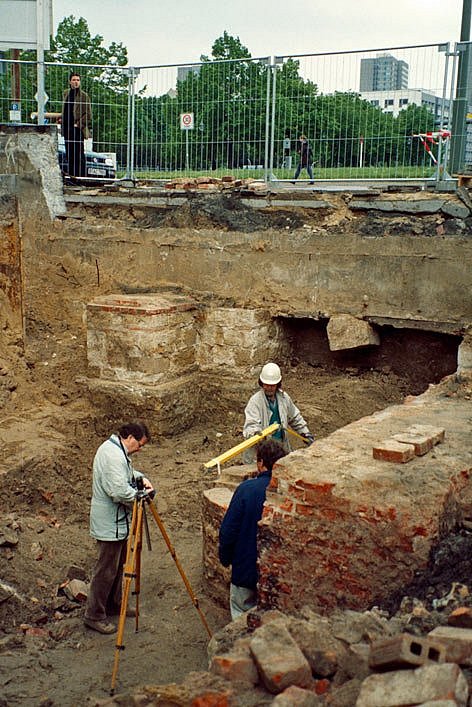
The Berlin Bauakademie was encroached upon by the footprint of what would later become the GDR’s Ministry of Foreign Affairs. When the demolition of the Ministry was imminent in 1995, excavations were carried out in the foundations of the Bauakademie, and the foundation walls were simultaneously registered as an archaeological monument. During the very rapid excavation, 575 original pieces were recovered; these were processed by the Museum of Prehistory and Early History of the State Museums in Berlin and are kept there. When construction work to lay pipes was carried out three years later, further pieces were recovered. However, some important sandstone anchors, with which Schinkel had secured the building, could not be recovered. Nor could the contents of a well located in the cellar, dating from before Schinkel’s time, be excavated. A further excavation is therefore urgently required.
In 1996, the Art Library of the Berlin State Museums organised the exhibition ‘Karl Friedrich Schinkel’s Berlin Academy of Architecture – In Art and Architecture – In Past and Present’, in which the pictorial programme of Schinkel’s Academy of Architecture was presented to a wide public for the first and only time using original parts and fragments. It is high time to bring the widely scattered parts and fragments together in one place once again and reassemble them. Karl Friedrich Schinkel’s architectural legacy deserves nothing less.