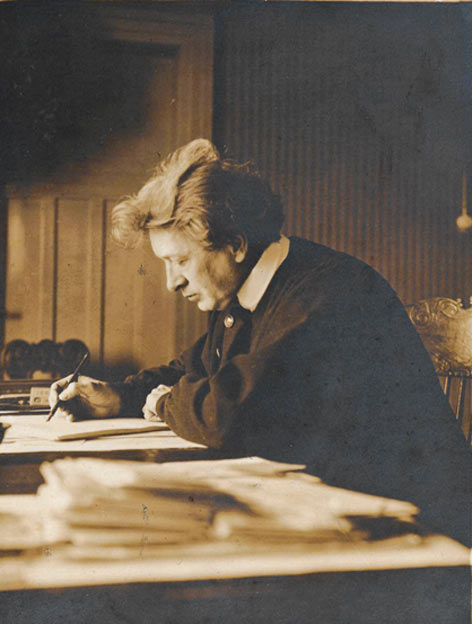
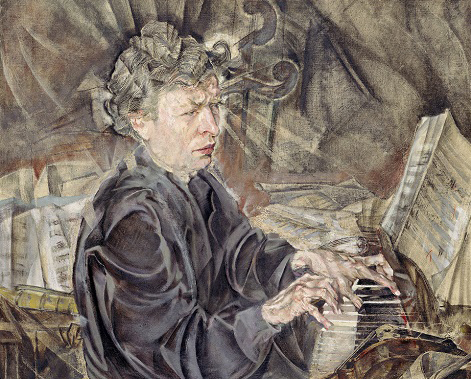
Two giants of modernism, two different approaches to life: the composer a thoughtful theorist, the painter an impetuous champion of the revolution – and the two were friends for years. Why, exactly?
“I was with the ‘Futurists’ and was deeply impressed by a number of things,” writes Ferruccio Busoni in March 1912 from London to his wife Gerda in Berlin. And he adds, “this Boccioni seems to me the strongest; he has a painting, ‘The Growing City’, which is truly huge.” In a further letter, Busoni tactfully informs his wife that he has purchased the imposing painting – measuring two by three metres – and notes that it “is in your room”.
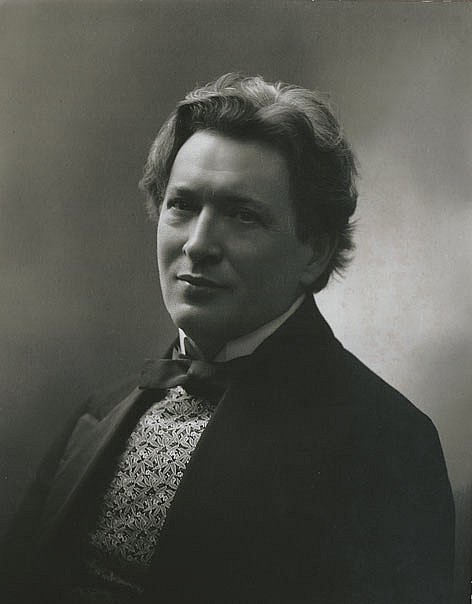
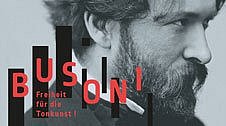
“This Boccioni” was none other than Umberto Boccioni, one of the leading figures of the young Futurist artists’ group. By chance, his path crossed with Busoni’s in London, where the latter was making a stopover on a long concert tour. For Busoni, the well-established piano virtuoso, well-connected composer and theorist, Boccioni, the up-and-coming painter, was to remain the only artist whose works he systematically collected – even though he was fond of criticising the Futurists. The exhibition “Busoni. Freedom for Music!” explores – among other things – Busoni’s unusual appreciation of art. We spoke to co-curator Michael Lailach (Art Library of the Berlin State Museums) about an unusual friendship between artists.
The Allure of Speed
What was it that now stood in Gerda Busoni’s room? Busoni had acquired nothing less than a showpiece among the works of the Futurists – those young Italian artists who toured the metropolises of Western Europe together. In 1909, the group was founded around the charismatic writer Filippo Tommaso Marinetti, who quickly found followers in other disciplines – in painting, sculpture and music.
Boccioni’s ‘The Rising City’ (Italian: ‘La città che sale’) was created in 1910, shortly after the group’s manifesto had gone to press. The painting encapsulated the Futurists’ ideals: to translate the dizzying innovations of modern life into art, far removed from convention. Boccioni shifts his vision of the dynamic metropolis to the outskirts of Milan, far from glittering boulevards, bustling streets and busy pedestrians. Against the backdrop of the skeleton of a soaring power station, his city manifests itself in the forcefully contorted limbs of faceless factory workers and rearing draught horses. Energetic, unstoppable – a shimmering whirlpool of bodies and colour. Boccioni’s painting was a feast for the eyes and unheard of for its time: he idolises the disintegrating form, breaks up the picture plane, and flouts tradition.
Marinetti was the one beating the drum for the works; his Futurists made their mark through their scandals. “Marinetti was the impresario of the Futurists and ran the group with a very tight rein,” emphasises Michael Lailach. “We know from their exhibition tour in Paris that thousands of visitors came every day. They didn’t actually sell very well, but everyone wanted to see the scandalous paintings and the artists behind them.” Aggressive, crazy, capricious – this is how Europe’s art-loving public experienced the young wild ones from Italy in their shows: “Marinetti gave fiery speeches, was politically radical; people fought, people hurled insults – scandal was part of the strategy,” says Lailach.
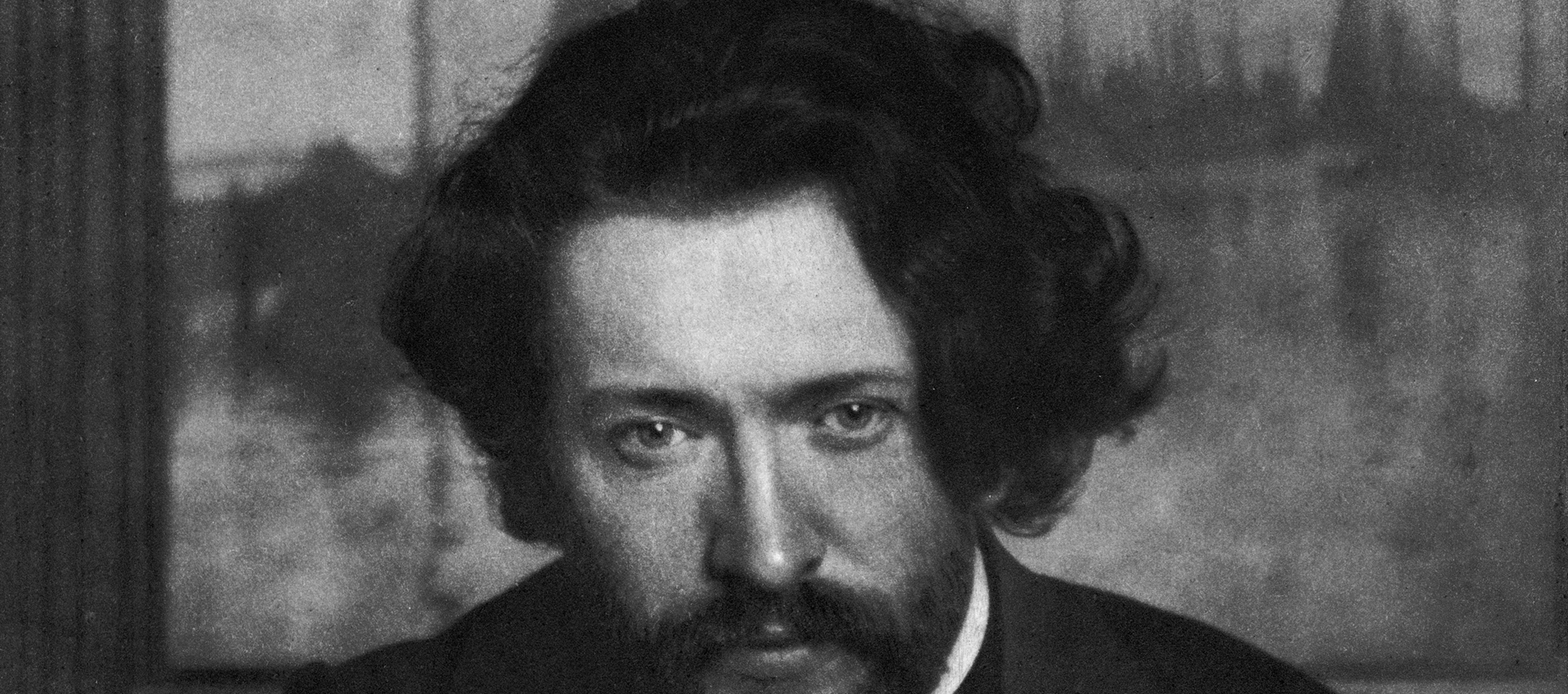
Busoni was a reserved, thoughtful man. To this day, we do not know exactly why he suddenly began collecting Boccionis’ works.
![Auszug aus Carlo Carràs Kapitel in Marinetti, Filippo T. [et. al.], „I Manifesti del futurismo" (1914), S. 154.](/fileadmin/_processed_/1/b/csm_Cara_rrroosssiii_nw2_35f3617053.jpg)

The fact that Busoni, too, took an interest in Futurist art strikes curator Lailach as all the more surprising: “Busoni was a reserved, thoughtful man. To this day, we do not know exactly why he suddenly began collecting Boccionis’ works.” The thousands of letters preserved in Busoni’s estate offer no clue as to what attracted him to Boccionis’ works.
Intersections and contrasts
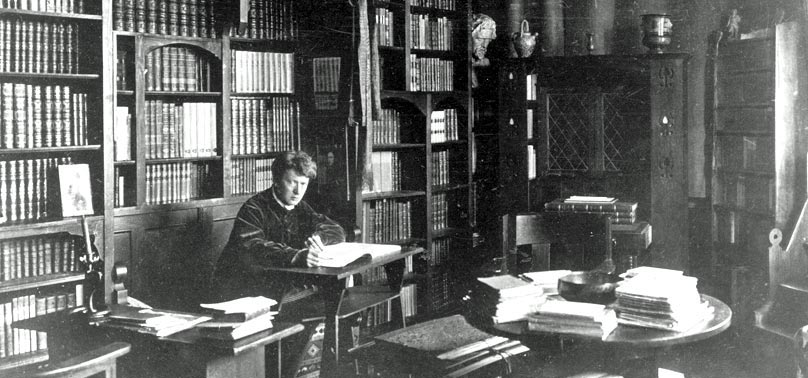
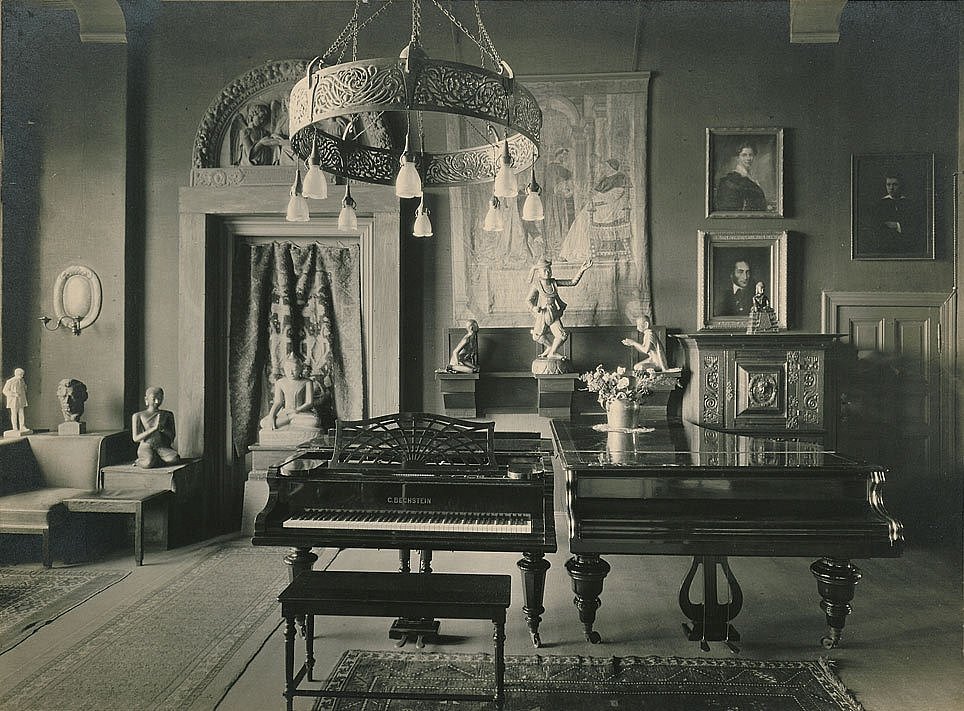
By 1912, Busoni could already look back on a career spanning two decades. As a virtuoso pianist, he filled concert halls in major cities on both sides of the Atlantic; he composed, wrote and was restless. “Get up, travel, arrive, play the piano for three hours for the audience, go to sleep, set off in the night to travel on, arrive, the next concert… Busoni kept this up for years. And during these travels he read a great deal, was an extremely popular conversationalist and had a very wide range of interests,” remarks Lailach, referring to the home of the Berlin resident at Viktoria-Luise-Platz No. 11: here Busoni transcribed Bach’s works for the 20th-century piano, debated with Arnold Schönberg and hosted Europe’s up-and-coming musicians. But in these rooms, Renaissance reproductions also meet meditating Buddhas, angels gaze down from reliefs on the lintel, lavishly illustrated books are piled before finely decorated furniture – and in between lies Boccionis’ vision of the modern city. It was not only Busoni’s musical work that oscillated between past and present, but his sense of art as well.
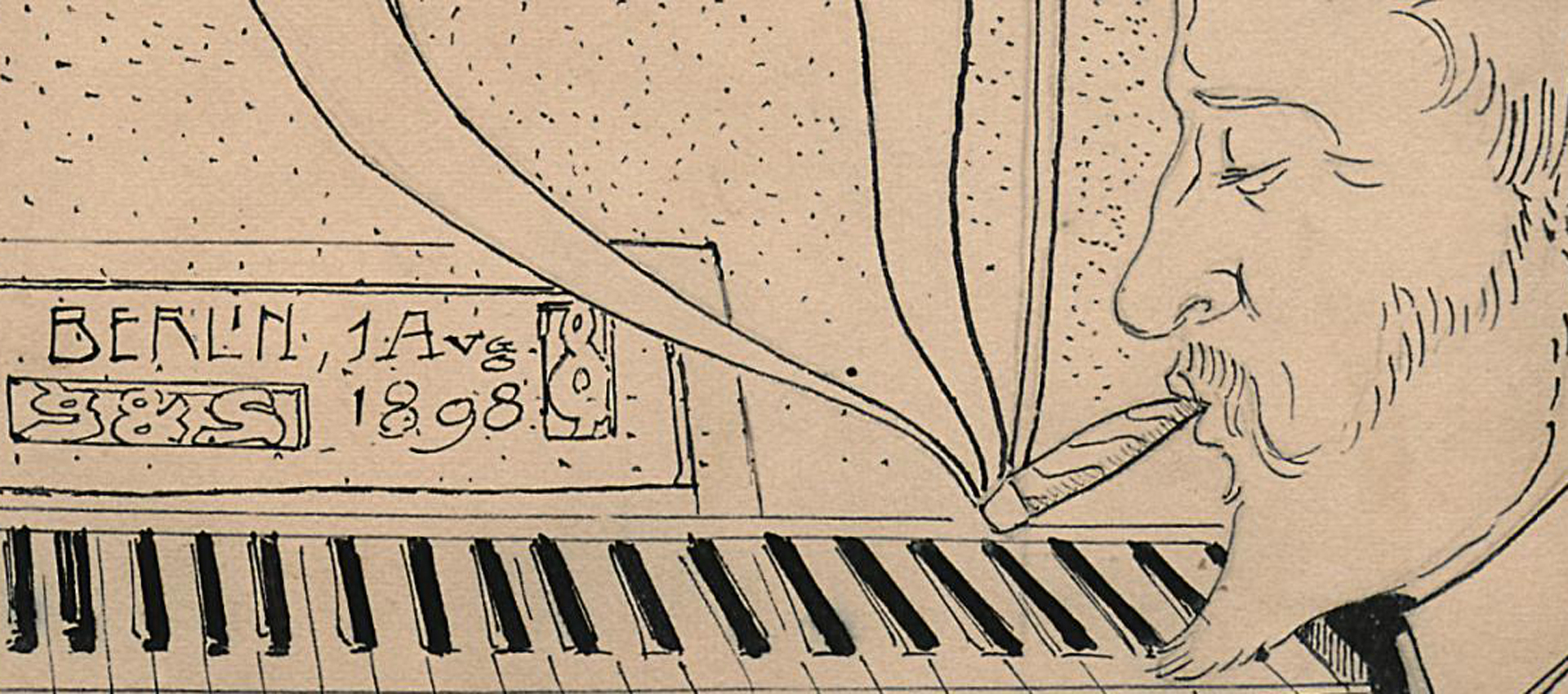
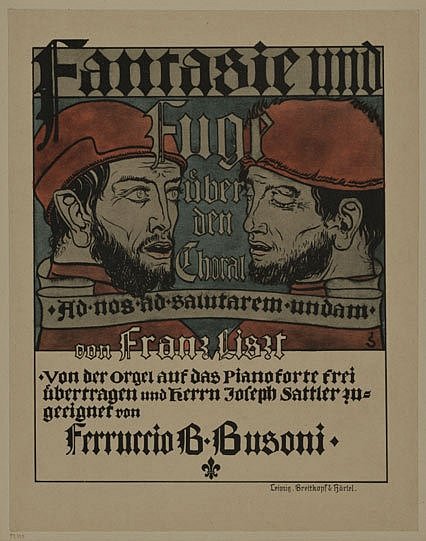
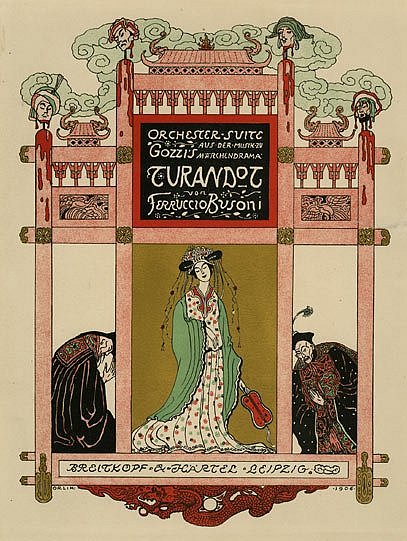
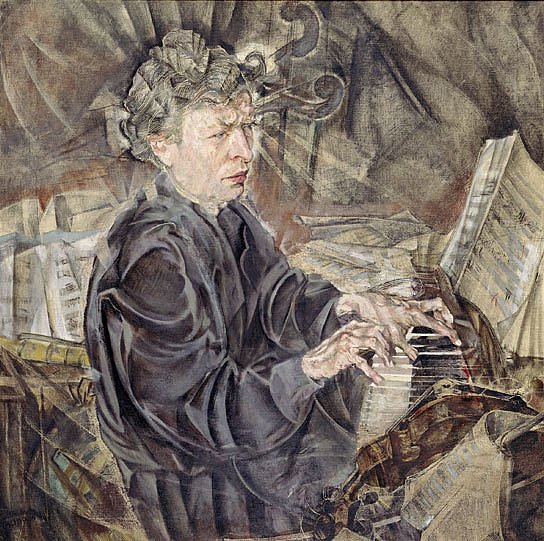
Art Nouveau artists such as Heinrich Vogeler and Joseph Sattler designed elaborate title pages for his sheet music. Max Oppenheimer portrayed him as a musical genius. Emil Orlik, the painter and graphic artist with a penchant for Japanese woodblock prints, illustrated Busoni’s version of the opera ‘Turandot’. And Busoni did not merely compose his operas, according to curator Lailach, but had clear ideas regarding the libretto and stage design: “He was convinced that opera constitutes a Gesamtkunstwerk, uniting theatre, music and the visual arts. Busoni therefore blended genres in his operas: he saw himself as his own author and not only created the music but also wrote libretti and gave thought to the design of the stage sets.”
With these ideas, he touched upon the aesthetic debates of the avant-garde at the beginning of the 20th century. For many of them, the aim was to break through established genre boundaries. The Futurists were no exception: the Futurist Pratella experimented with microtones, his colleague Russolo crafted novel noise-generators, and Carrà dreamt of sound as colour and colour as sound, and indeed of sight and hearing blended together as ‘total painting’. From 1910 onwards, Boccioni also ventured into new territory. The painter made the rhythm of dynamic movements his central theme, experimented with sculpture and created fragmented figures that merge with their surroundings.
With great fanfare, the Futurists proclaim the artistic revolution. Busoni pricks up his ears. Since the dawn of the still-young century, he himself has been searching for new forms of expression, wishing to expand the established tonal systems and think beyond the confines of the major and minor scales – and he is interested in what the young generation of artists has to say about music, theatre and art.
Nevertheless, his relationship with Futurism is not a straightforward one: with the group’s impassioned treatises in mind, Busoni writes in his 1912 article “Futurism in Music”: despite all the revolutionary intellectual experiments in music, the group must first prove itself, for convincing compositions are still a long way off. In his letters to his wife Gerda, Busoni finally sums up his stance: the Futurists were “tout passé” – already a thing of the past.
For curator Lailach, Busoni’s judgement is an expression of a deliberately detached curiosity: “A man like Busoni could not live with Marinetti saying ‘destroy the museums, burn the Mona Lisa’. As a respected arranger of earlier composers, he carried the past into the present. He did not want to brush it aside. The Futurists, however, proclaimed a clear break with the past in order to create something new. The irony is that in doing so, they developed and cemented recurring techniques and a style. The break with the old thus becomes a gesture in itself, and through the repetition of that gesture, a convention. Busoni recognised this. He saw that the Futurists were incredibly loud, but that the claim to permanently break with what had already existed was, in fact, untenable.”
The Futurist who wasn’t one
Despite all their differences, Busoni continued to collect Boccioni’s works – including numerous etchings and drawings. Boccioni reciprocated this support with reverent gratitude, as curator Lailach emphasises: “He was aware of Busoni’s prominent public role. In his letters, he addresses him as ‘Maestro’.” Gerda posed for Boccioni, and the patron himself was also depicted by the painter. The last painting for Busoni was created in 1916.
“Both were invited in August 1916 by a gentleman with the fine name of Casanova to his summer residence on Lake Maggiore in northern Italy,” explains Lailach. “They spent two weeks there. This resulted in a portrait showing Busoni looking quite relaxed in an intellectual’s robe amidst the greenery.” Yet the Italian idyll is deceptive. The First World War had long since caught up with both Busoni and Boccioni – one was a pacifist and had long been in exile in Switzerland, the other, swept up in the frenzy of war, volunteered for the front.
For the Young Wild Ones, the outbreak of war was a welcome and logical step towards the modern world. Michael Lailach comments: “With the war, Futurism entered a second phase in which the group’s early radical political tendencies came to the fore.” Yet Boccioni’s euphoria was soon tempered by disillusionment. The reality of war has caught up with him and he longs to create art, seeking new means of expression: “That Boccioni was searching for a new direction can also be seen in his portrait of Busoni,” says Lailach. “Here he reduces many of his Futurist stylistic devices and turns to his great 19th-century role model: Cézanne.”
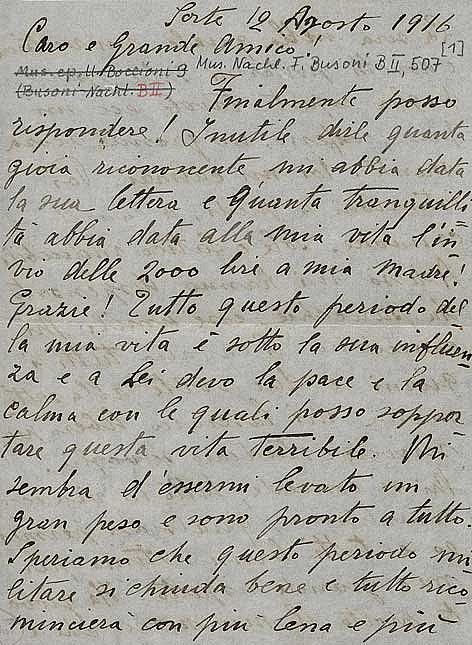
In a rollercoaster of emotions, Boccioni writes to Busoni on 12 August – shortly after his interlude at Lake Maggiore and having already been called up for military service: “Throughout this entire phase of my life, I have been under your influence, and it is to you that I owe the peace and tranquillity that enable me to survive this terrible existence.” He puts on an optimistic front, but concludes: “I cannot speak of art here. The strain is great and my brain no longer functions.”
Four days later, Boccioni fell from his horse during training and died – and thus became a war hero in the Italian press. Yet Busoni could not find his friend, the artist, in the obituaries. “It distressed him that it was not Boccioni the artist who was honoured in the Italian press, but Boccioni the soldier,” says Lailach. “That is why he spoke out and tried to set the record straight regarding Boccioni’s legacy.”
Yet Busoni’s own work had long since become part of the ideological battles of the time: in 1916, he republished his euphoric “Draft of a New Aesthetic of Musical Art” – in which he called for music to be freed from entrenched compositional norms. In response, the critic and composer Hans Pfitzner launched a sweeping attack on Europe’s avant-garde movements in 1917. He titled his polemic “The Futurist Threat”, declared Busoni to be the embodiment of music far removed from “German values”, and denounced him vehemently as the ‘futurist’ par excellence, devoid of any appreciation for the musical greats of the past.
For Busoni, this was an affront. “He, the well-travelled Berliner by choice, a child of both the 19th and the 20th centuries, was thus not only forced into the role of the eternal stranger, but also branded with an artistic label towards which he remained ambivalent throughout his life,” explains Lailach.
Busoni replied in an open letter in June 1917: “Futurism, a movement of the ‘present’, could have no bearing on my arguments.” He is referring to the musical utopias of the group around Marinetti, not the avant-garde in general. Busoni, the master of subtle nuances, accepts neither Pfitzner’s sweeping attack on modernism nor does he leave his overly rigid conception of art uncommented. The essence of art, he counters, rebels “against the rigidity of a single form for all ideas: already today, and how much more so in years to come.”
“BUSONI. Freedom for the Art of Music!”
The exhibition catalogue – a musician’s life in 14 essays
From 4 September 2016 to 8 January 2017, the exhibition at the Kunstbibliothek recounted 11 stages of Busoni’s life and work: from ‘child prodigy’ to ‘teacher’, from ‘travels’ to ‘exile’. It was organised by the Berlin State Library, the State Institute for Music Research and the Art Library of the Berlin State Museums. The catalogue expands on the exhibition and, for the first time, sheds light on Busoni’s universalist interest in the music, art and culture of his time.
Art Library
The Art Library is an interdisciplinary research institution housing one of the world’s largest museum libraries. It also holds significant collections on the history of architecture, photography, graphic design and fashion, as well as book and media art. Together, the library and the collections represent the entire spectrum of sources for research in art and cultural studies. It is represented at the Kulturforum (museum collections, art history library), the Archaeological Centre (Archaeological Library) and the Museum of Photography (exhibition venue for the Photography Collection).