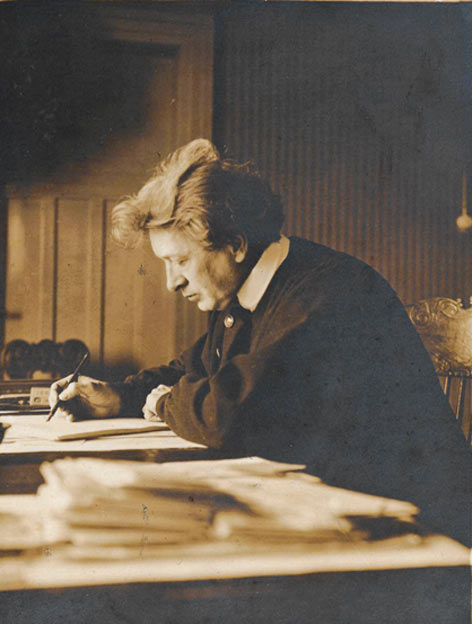
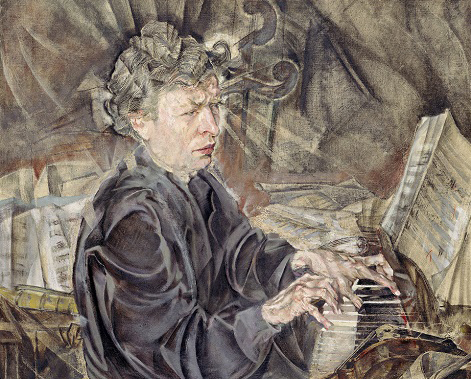
Mozart died penniless, Beethoven fretted over every penny lost – and Ferruccio Busoni? What role did money play in the life of the celebrated pianist and pioneer of modern music?
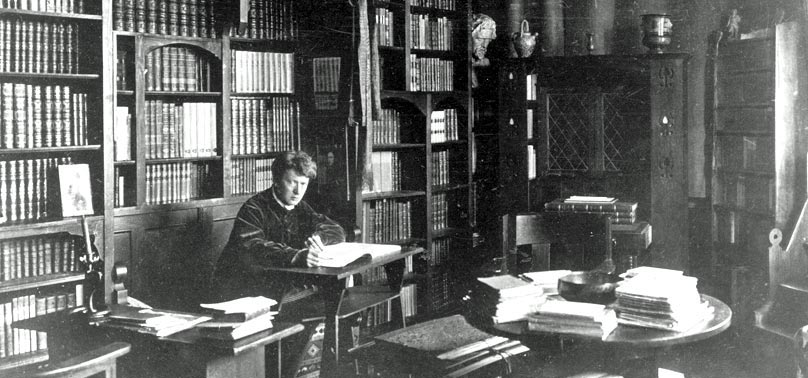
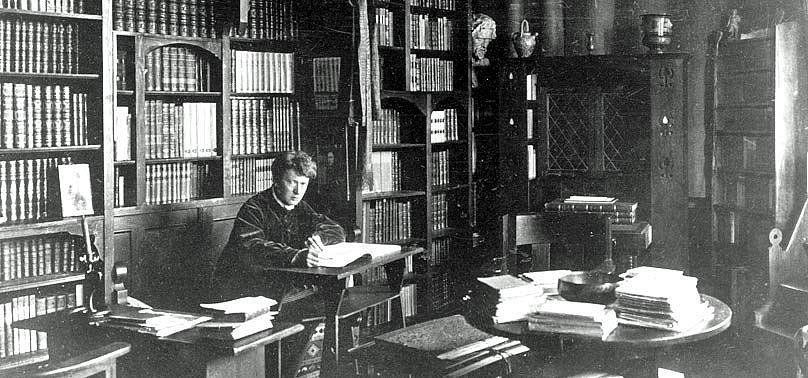
In 1924, Gerda Busoni was forced to realise with great sorrow that being the wife of a great artist does not guarantee financial security. Following Ferruccio Busoni’s death, his widow had to sell the composer’s private library to avoid starvation. 5,000 volumes, including valuable, artistically designed copies, were sold off in their entirety. So does the cliché of the starving artist apply to Busoni as well? Not at all: the internationally acclaimed concert pianist and esteemed professor of the masterclass in composition at the Prussian Academy of Arts enjoyed a substantial income. His high standard of living is evident, among other things, from his two residences. Busoni not only owned a house on the middle-class Viktoria-Louise-Platz in Berlin, but also called a retreat in Zurich his own. In addition to the extensive private library already mentioned, he possessed an exquisite art collection featuring works by contemporary artists such as Umberto Boccioni and Max Oppenheimer.
Performing, teaching, composing: for the sake of art and for the bank balance
Busoni had built the foundation of his fortune as a pianist on concert tours. In America alone, he undertook four tours. His successes on the international concert stage also made him world-renowned as a composer. Furthermore, Busoni established a reputation as a theorist through his 1907 treatise on a new aesthetic of music. This reputation led to him being offered the directorship of the prestigious Liceo Musicale in Bologna in 1913 and a prominent position at the Prussian Academy of Arts in Berlin in 1920. These posts not only came with a substantial salary, but also afforded him generous amounts of free time for composing.
Busoni’s dilemma was that he had to carve out space for compositional work amidst the gruelling life of a piano virtuoso – throughout his life, he received recognition (and income) primarily as a performer and scarcely as a composer.
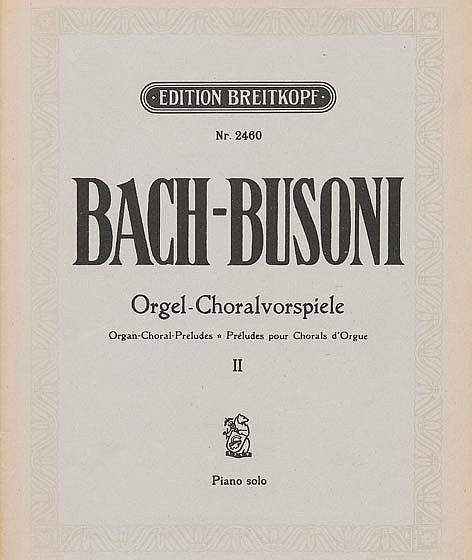
This is where the publisher Breitkopf & Härtel comes into the picture; they had already made contact with the composer, then just seventeen years old, in 1883 and published his first compositions three years later. As a mediator between ‘art and commerce’, the publisher was responsible for ensuring that Busoni’s manuscripts could be printed, distributed, promoted and ultimately sold. Busoni had met the head of Breitkopf & Härtel, Oskar von Hase, in person in Leipzig in 1885 and had maintained a lively correspondence with him ever since: in fact, the number of his letters to the publisher is surpassed only by those to his wife. The correspondence with the publisher provides (among other things) insight into the creative process behind Busoni’s complete musical works, almost all of which were published by Breitkopf & Härtel – including the popular Bach arrangements and the edition of Bach’s works edited by Busoni.
Incidentally, in letters to the publisher, Busoni expressly regrets that these arrangements were more popular with both the publisher and the public than his original compositions (a situation that remains true to this day). It is hardly possible to estimate Busoni’s income from sheet music sales given the sheer volume of works in question. Above all, however, there are too many factors to consider: how high were the royalties and retail price relative to their actual purchasing power? What share did the composer receive? What was the print run? How many copies were sold? etc.
What is certain is that, thanks to his collaboration with Breitkopf & Härtel, he could count on a regular income. This reveals a central dilemma for Busoni: not only did he have to carve out space for compositional work amidst the gruelling life of a piano virtuoso – throughout his life, he received recognition (and income) primarily as a performer and scarcely as a composer.
Another source of income for the composer was performance royalties. These are the share of revenue from performances that the composer receives for his intellectual property – a practice that is entirely commonplace today, but which was only legally regulated at the beginning of the 20th century. Incidentally, (music) publishers played a decisive role in securing composers’ rights to their works. Busoni was thus able to afford a comfortable standard of living. The fact that he nevertheless left his widow no real inheritance may – quite simply – have been due to the fact that he simply could not manage his money.
The situation was exacerbated by the massive economic impact of the First World War. Busoni’s letters reveal that Italy’s declaration of war in 1916 amounted to a ban on his performances there, given that he was a concert pianist who had committed himself to strict neutrality.
He therefore wrote to Volkmar Andreae, the principal conductor of the Tonhalle Orchestra in Zurich, expressing his concern about financial losses. The financial constraints triggered by the political and economic difficulties of the post-war period are also reflected in his correspondence with his publisher – even though the composer showed only limited understanding for his publisher’s cost-cutting measures. The resumption of an intensive concert schedule after the end of the First World War is likely to have provided Busoni with some financial relief at first. Then came inflation, which wiped out large parts of his fortune. Despite serious illness, he attempted to offset the losses through further concert tours. After a performance with the Berlin Philharmonic in May 1922, he no longer had the strength for major concerts. It was not until the end of 1923 that inflation was brought under control – too late for Busoni, who died in July 1924.
“BUSONI. Freedom for the Art of Music!”
The exhibition catalogue – a musician’s life in 14 essays
From 4 September 2016 to 8 January 2017, the exhibition at the Kunstbibliothek recounted 11 stages of Busoni’s life and work: from ‘child prodigy’ to ‘teacher’, from ‘travels’ to ‘exile’. It was organised by the Berlin State Library, the State Institute for Music Research and the Art Library of the Berlin State Museums. The catalogue expands on the exhibition and, for the first time, sheds light on Busoni’s universalist interest in the music, art and culture of his time.