The local history museum no longer has anything to do with old farm cupboards – it changes along with the local area. A conversation about small things and a big topic.
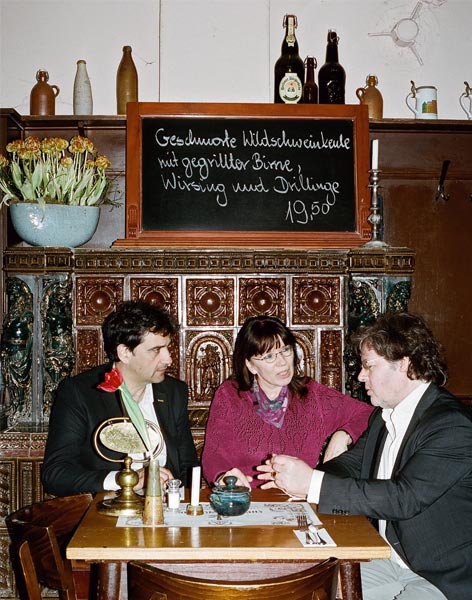
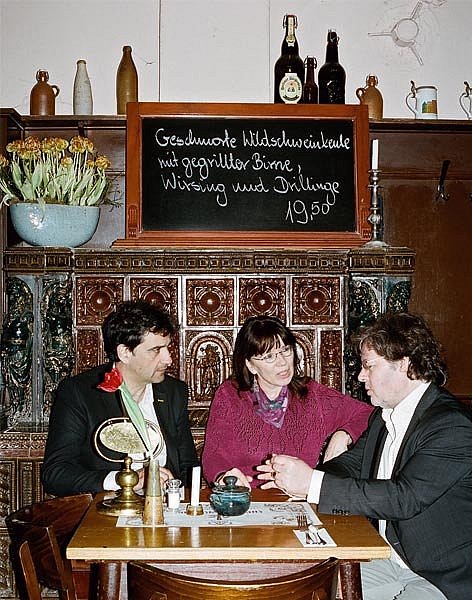
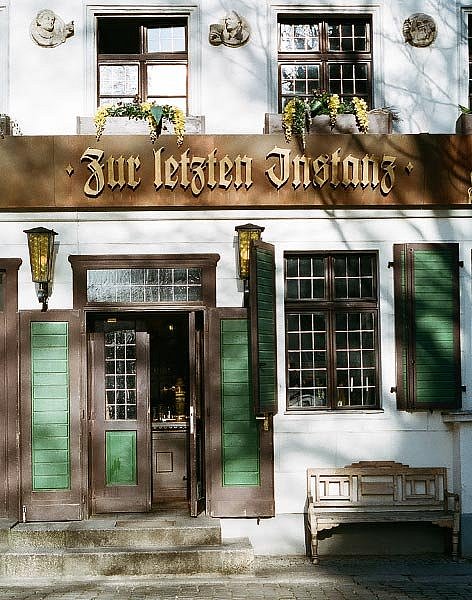
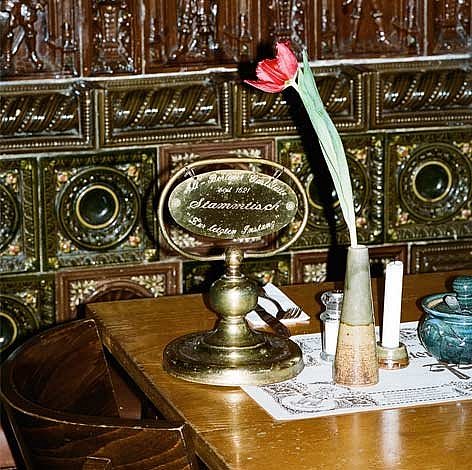
We are sitting here in the pub ‘Zur letzten Instanz’, which, with its tiled stove, bull’s-eye windows and home-cooked fare, has almost become a museum of old Berlin heritage in its own right. What is it like in your museum – is ‘home’ actually still a concept you work with?
Elisabeth Tietmeyer, Director of the Museum of European Cultures at the Berlin State Museums: The concept of ‘Heimat’ emerged at the end of the 18th century in connection with bourgeois society and became further emotionally charged through industrialisation in the 19th century. Society was in a period of profound upheaval and an identity crisis. Today, in the face of migration flows towards Europe, we are once again speaking of a crisis. Those people who fear ‘strangers’ and are hostile towards them are now once again invoking the concept of ‘Heimat’, which they associate with a defined territory. For them, ‘Heimat’ is a place of longing and familiarity that never changes.
Udo Gösswald, Director of Museum Neukölln: In 2004, we renamed the Heimatmuseum Neukölln as Museum Neukölln – because the concept of ‘home’ is so narrow, tends to exclude people, let alone be reflective. If, on the other hand, one perceives something or oneself as foreign, there is an awareness, and thus the term “foreign” becomes more reflexive than the term “home”.
These two poles relate primarily to the individual, but are also of interest to society. I don’t really share this notion of a crisis, because I consider German society to be relatively stable. It can tolerate the foreign and has been doing so, particularly in Berlin, for several centuries.
Paul Spies, Director of the Stiftung Stadtmuseum Berlin: There is no translation for ‘Heimat’ in Dutch. It is only because Edgar Reitz’s German series was so popular that the Dutch have a rough idea of what ‘Heimat’ might be: namely, a German sense of origin. The English word ‘home’ is much better. ‘Home’ is where you have settled, where you feel you belong, where you feel most at ease – in the sense of a base. And that is always changing. The Stadtmuseum Berlin can only say: Tell us, city dwellers, what does ‘Heimat’ mean to you? Then a thousand different stories emerge. ‘Heimat’ as a monoculture is a thing of the past.
Gösswald: Some Turkish immigrants also have this very specific, yet narrow, concept of “home”, namely the Anatolian village. That is where the family is. But if you look closely, a complex picture emerges with many influences, be they Kurdish, Armenian or Alevi. Family history is simply decisive. My mother, for example, fled from Mecklenburg to escape the Russians; I grew up in New York; my wife is from Hong Kong.
But how do you showcase such stories in the museum?
Tietmeyer: Participation is absolutely vital. For instance, in our museum we are hosting an exhibition by the ‘Rete Donne’ association, a network of Italian women who came to Berlin to work due to the economic crisis in their country. Through installations in the permanent exhibition, these women depict their migration experiences using specific personal objects. This allows visitors to see how they feel about their homeland, Italy, and how they now perceive Berlin. As curators, we wouldn’t dare to exhibit something like this; only the protagonists themselves can do that.
There is a shift to the right across Europe, and terms such as ‘homeland’, ‘culture’ and ‘identity’ are being misused for political ends. They are used to conjure up an illusion of an ideal world in which people are meant to feel safe and secure, without reflecting on their own views or engaging with other perspectives. Our museum work aims to achieve precisely the opposite.
Gösswald: There are often complex stories behind the objects, such as the bronze model of the sculpture of Johann Amos Comenius, which we display in our permanent exhibition ‘99 x Neukölln’. The larger-than-life sculpture was a gift from the Czech government and was erected in 1992 in Neukölln’s Comenius Garden to mark the 400th birthday of the eminent Bohemian theologian, educator and philosopher, in the presence of the then Speaker of Parliament, Alexander Dubček, the leading figure of the Prague Spring.
Comenius, the last bishop of the Moravian Church, was himself an exile in many European countries and shared the fate of the Bohemian immigrants to Rixdorf in the 18th century, who were forced to leave Bohemia because of their faith. At the unveiling of the sculpture, Dubček expressly pointed out that many German Social Democrats and Communists had fled into exile in Czechoslovakia in 1933.
Spies: And then, of course, it’s about using a clever narrative technique to get people interested in seemingly everyday things like a small bronze statue or a map. Great art has it easy. You have a beautiful museum with white walls, plus the big names like Picasso and Gauguin.
You hang the works with a short text alongside them and the cash registers ring. Our task is more complicated: we have to make an effort to achieve that kind of relevance – and yet, those who listen to us sometimes say: ‘That’s actually quite interesting, much better than a painting by Gauguin.’ We need to develop an exhibition technique that presents our objects and stories so powerfully that they are experienced as if they were a Gauguin.
Mr Spies, I understand there is also to be a new approach to handling the objects at the Humboldt Forum. What has been your experience with this?
Spies: There are objects that are no longer sacred items, which only the curator touches with white gloves. They are returning to the communities and are being loaned out for rituals. Surinamese people in Amsterdam commissioned an artist to make a mask for Keti Koti, the celebration of the abolition of slavery. We keep it in our storeroom and bring it out every year. It’s allowed to fall down or get broken, as long as it’s worn by the priestess during the Keti Koti dance. Because that’s when something like that actually gains value. It has to be used again and again, year in, year out. That was, of course, completely new to us; at first, we didn’t want to assign it an inventory number, because then it would be considered art and could no longer be touched. Now, every year, the Surinamese in the Netherlands collect this mask and use it to perform an Afro-Surinamese ritual.
How are visitors responding to this new kind of museum?
Tietmeyer: I’ve noticed that visitors, especially international ones, like to see things they recognise from home. Seeing familiar objects naturally evokes – usually positive – feelings. But of course, many also enjoy learning something new.
Gösswald: You can always offer several levels. I think it’s perfectly legitimate to display familiar things. But it’s just as important to have that in-between space where people half-know what something is, or perhaps don’t know at all. You want to spark curiosity with unfamiliar things, but you mustn’t completely unsettle people by only displaying things they have no idea about.
Spies: It’s very difficult for us to cater to so many different target groups at the same time. And yet we always try, or we focus on smaller target groups. As a city museum, we have to rediscover ourselves anew every time: what are we, actually? What exactly is our purpose? Our ambition is to do more than simply present a pleasing exhibition devoid of social significance. We want to stimulate social debate. Or to get groups involved that we wouldn’t normally reach. The museum is a democratic institution, and we should do our utmost to live up to that.
Gösswald: We aim to reach the entire audience, and we do so. Everyone finds something to their liking – from university professors to seven-year-old girls. The key is that we encourage the audience to seek out for themselves the things that interest them. We no longer have headings or a chronological order. We offer knowledge, but the visitor decides for themselves how much of it they take away and what appeals to them.
Tietmeyer: Sometimes we still encounter visitors’ expectations that we should exhibit ‘peoples’ or the cultural history of Europe. We are far removed from that. To the question: ‘How does one exhibit a people, a nation, or even the whole of Europe?’ we would have no answer at all. Instead, we take a thematic approach, often involving cultural comparisons. In this way, visitors are confronted with a theme and specific objects from their own culture and other cultures, which they then understand better through direct comparison.
Spies: For the Humboldt Forum, we want visitors to leave their own stories behind too. A museum should be more than the old ‘we speak, you listen’ approach. We want to turn that on its head and say: ‘Tell us something’. This meets the expectations of the new generation: young people always want to be involved right from the start. We will also conduct surveys to find out what Berliners expect from the Humboldt Forum.
Great art has it easy. You simply hang the works alongside a short description and the cash registers ring. Our task is more complicated: we need to develop an exhibition technique that presents our objects and stories so powerfully that they are experienced in the same way as a Gauguin.
Tietmeyer: I would strongly advise doing so, because at the time we didn’t ask the public what they expected from a new, European-oriented museum. When the Museum of German Folk Life, with its farm furniture, traditional costumes, ceramics, craft tools and so on, was closed and then given a new identity as the Museum of European Cultures in 1999, there were also critical voices asking questions such as: “How am I now supposed to explain German heritage to my children?” The thematic approach to everyday culture, featuring historical and contemporary objects not only from Germany but also from other European regions, was not understood or welcomed by everyone at the time. Today, however, the situation is quite different.
Why were the Museum of German Folklore and the European collection of the former Museum of Ethnology merged to form the Museum of European Cultures?
Tietmeyer: The Museum of German Folk Costumes and Handicrafts, which later became the Museum of German Folk Life, was founded in 1889 by Rudolf Virchow. This was also an expression of the ‘crisis of modernity’, as the aim here was to preserve the memory of the vanishing rural culture in the wake of industrialisation. The ‘good old days’ were to be preserved. Today, there are still local history museums that seek to convey this sentiment. But societies are constantly changing, and we wanted to take that into account back then.
That is why it was essential and absolutely the right thing to do to expand the Museum of German Ethnology to a European scale and update its themes. Culture does not stop at national borders, nor, for that matter, at Europe’s. Borders are always permeable; we influence one another through cultural contact.
Is there a “European homeland” that fosters a sense of identity?
Tietmeyer: Cultural Europe is not an entity, any more than a village or a town is. The House of European History is currently being set up in Brussels. Apparently this is necessary, but in essence those responsible were driven by the same impulse as the founders of the Museum of German Folk Costumes or other ethnographic museums in Europe back then: the museum as a means of identification and as a place of identity.
We, on the other hand, take a different approach: a Berlin fashion designer has created two ‘Europe costumes’ from recycled materials for our permanent exhibition. These can be used to discuss how we, or others, view ‘European culture’. Of course, Europeans share common experiences and a common history, and are shaped by the Judeo-Christian religion – but culturally, Europe has always been diverse and always will be. Europe is actually an idea, albeit a “powerful fiction”. But is there such a thing as a “homeland Europe”? When I lived in Kenya, I felt European; when I returned to Europe, I defined myself once again as German, or rather as a Westphalian.
After the attacks in Paris or Brussels, however, one really did notice what it is that is European in us, namely our free spirit.
Gösswald: I found the hashtag #jesuiseurope very interesting following the attacks in Brussels, at the heart of Europe. Despite all the difficulties, I believe that a Europe in which countries cooperate will prevail – if only for economic and rational reasons. When you look at the global economy, they have no choice but to do so.
We no longer have headings or a chronological order. We provide information, but it is up to the visitor to decide how much of it they take away or which parts resonate with them.
Spies: I believe that Brussels has made it abundantly clear that there is something worth defending. Attitudes are hardening on both sides. Those who wish to foster an open society are now even more aware of the value of this. When Eurosceptics gain ground, it is always an attack on all of us, one that serves as a wake-up call. People will increasingly appreciate the fact that we have a community in which peace is of paramount importance.
Tietmeyer: I find nationalist tendencies such as those in Poland, Hungary or Slovakia quite alarming. But in fact there is a shift to the right across the whole of Europe; these people deliberately play on the concepts of ‘homeland’, ‘culture’ and ‘identity’, misusing them for their own political ends. They use these terms to conjure up an idealised world in which people are supposed to feel secure, without reflecting on things or engaging with what is different. Our museum work aims to achieve precisely the opposite.
MEK / Museum of European Cultures
The Museum of European Cultures, part of the Berlin State Museums, collects, researches, preserves, presents and communicates everyday culture and ways of life in Europe from the 18th century to the present day – from a cultural anthropological and comparative perspective.
Founded in 1873 as the Museum of Ethnology, the MEK has existed in its current form since 1999. In that year, the European collection of the Museum of Ethnology was merged with the holdings of the former Museum of [German] Ethnology.