What do Max Liebermann and Caspar David Friedrich evoke in us? With cognitive scientist Michael Pauen at the Alte Nationalgalerie. An observation
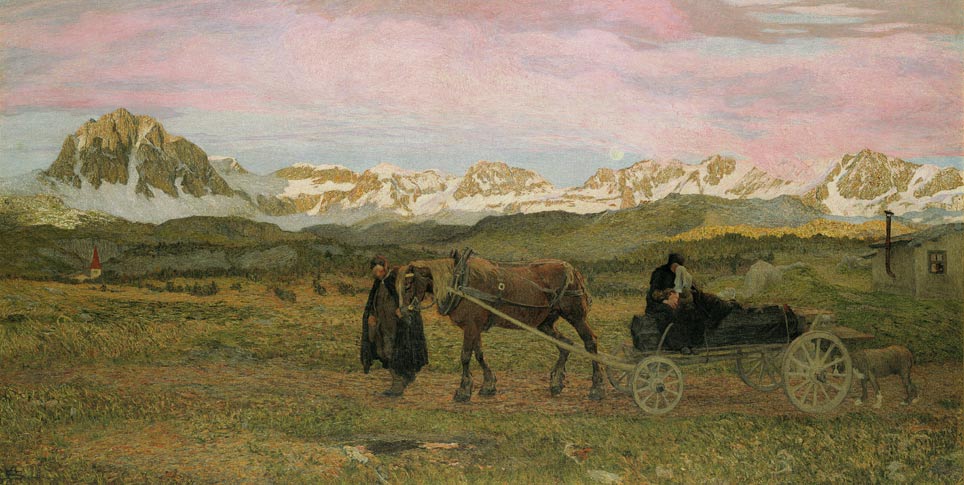
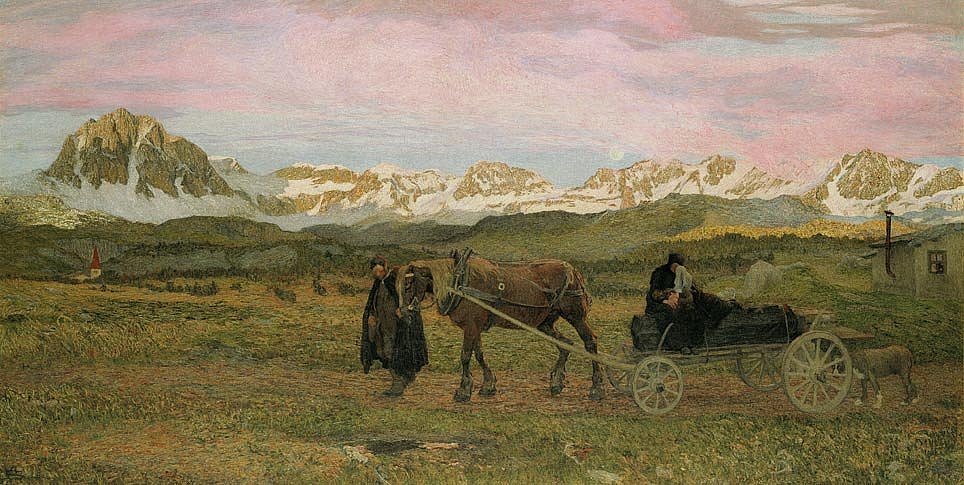
I am standing with Michael Pauen in the Alte Nationalgalerie in front of a magnificent painting by Giovanni Segantini. Pauen is a philosopher, cognitive scientist and director of the Berlin School of Mind and Brain. We have arranged to meet to discuss representations of home in art. And to explore the extent to which images trigger feelings of home when viewed, and which cognitive processes are involved. The first painting dates from 1895 and depicts a plateau, with a rugged mountain range rising in the background. In the foreground, one sees a horse-drawn cart with several people; to the left, the houses of a village can be glimpsed amidst rolling hills, from which the red spire of a church rises. At the mention of ‘home’, my untrained eye automatically wanders to the red church spire, but Michael Pauen chose the image for a different reason:
“We tend to perceive home as something positive. But home can also be something one must flee from, something oppressive. Segantini’s painting ‘Return to the Homeland’ is based on a true story. A family returns to their homeland following the death of their son. The grief is immediately apparent: it is conveyed through the figures’ body language – their stooped, hunched postures – even in the horse and the dog. There is evidence that the postures and facial expressions that control our emotions are also used to decipher the emotions of others. Our visual system draws on these movement patterns to understand stimuli from the outside world. The knowledge that we hunch over in grief helps us to intuitively understand this image.”
We tend to view home as something positive. But home can also be something you have to flee from, something that feels oppressive.
Home portrayed as something negative – yet in our minds it’s positive? As we stroll into the next room, I mention that, for me, the term still carries – albeit in homeopathic doses – connotative remnants of the Nazi era, and that, particularly these days, it is unpleasantly associated with the AfD’s inflated national pride. Couldn’t the word be replaced by another? Of course – the word ‘familiarity’ would work too. And how does familiarity come about? Isn’t it a network formed from our earliest formative experiences? Generally speaking, says Michael Pauen, it is indeed the first stimuli that trigger feelings of familiarity. The result is that innate protective mechanisms react less strongly. “Cognitive psychology has established that in a positive mood, mistakes – including one’s own – are no longer as noticeable. On the other hand, children who lack a sense of familiarity with their mother suffer more from stress.” The hormone oxytocin, which is released during pregnancy and breastfeeding, plays an important role in the development of this sense of familiarity.
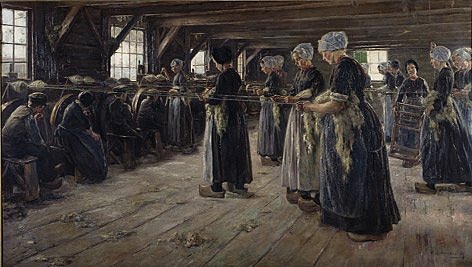
We are now standing in front of the painting “Flachsscheuer in Laren” by Max Liebermann. Michael Pauen points to the young girls who are busy with the so-called flax scutching in a low-ceilinged room: “Here, home is defined through the group. Their clothing is identical; none of them look at the viewer. The girls are almost faceless – and once again, almost all of them have the same, slightly stooped posture. You can see the constraints under which they had to work. So here, home is something confining.
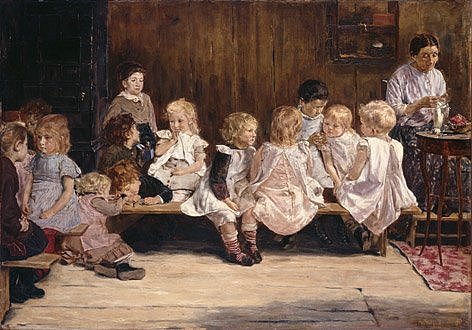
If we now turn around, we see the painting ‘Kindergarten in Amsterdam’ from 1880, also by Max Liebermann. Here, too, many children are gathered together, but they come from a middle-class background. They have different postures and are highly individualised. Each child displays their own personality – and yet is part of the group.”
Beaming faces, slipping striped socks and intimate conversations – and yet this is not idyllic ‘homeland art’. Depictions of home by great artists are therefore not exclusively problematic, that is to say, associated with sorrow, confinement or the portrayal of social injustice.
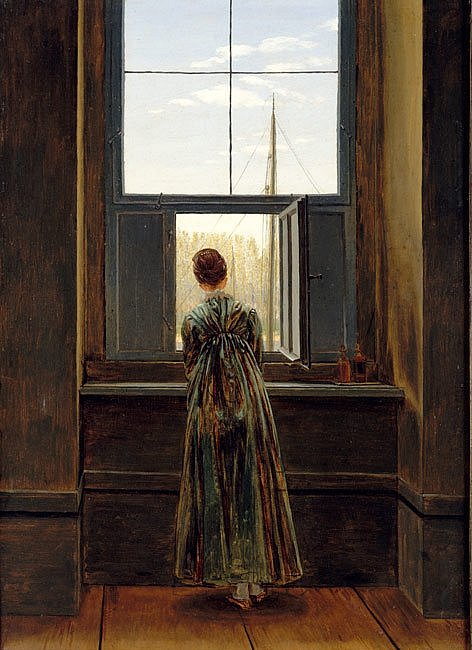

Now we come to another master of the sense of home: Caspar David Friedrich. As we lean in close to the painting “Woman at the Window” to examine the brushstrokes, a friendly attendant is immediately on hand and asks us to keep a proper distance – even though, as the cognitive scientist points out, the very point of the painting is to dissolve the distance from the figure: “We see a woman viewed from behind, standing at a window and looking out. She is looking towards the Elbe. The poplars on the opposite bank were probably actually there.”
As we understand it, private spaces form the heart of home, but for Caspar David Friedrich it is not the room, but the landscape outside.
There is a contrast between a dark, almost frightening foreground and a bright background. According to our modern understanding, private spaces form the core of home, but for Caspar David Friedrich it is not the room, but the landscape outside. If this young woman has a home, then it is where it is light. The view from behind reinforces the viewer’s identification with the figure – and with her longing. We are drawn into the distance with this woman, as if in a dream.”
Speaking of the distance: doesn’t the concept of home necessarily also include the idea that home is always where one is not at that very moment? In Christianity, the view is widespread that one’s true home lies in the afterlife anyway. According to Michael Pauen, it is above all the light-dark contrasts that create this interplay of presence and absence – and not just in Caspar David Friedrich’s work, incidentally.
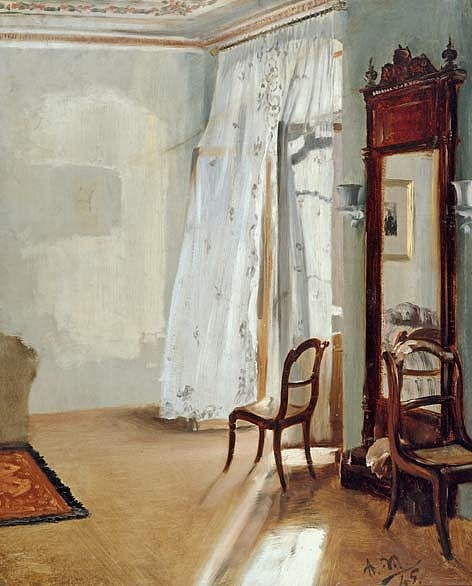
A short while later, we stand before the final painting of our tour, Adolph Menzel’s “Balcony Room”. “Here, too, there is a strong contrast between light and dark, an interior and an exterior,” explains Michael Pauen, “but the effect is quite different.
In this painting, the viewer is not drawn out of the room into the distance; here, the light streams into the room. The moving curtains, the open window, summer fills the room. Home is here, within the interior. A magnificent painting. Of course, the fact that Menzel did not complete it plays a part in its effect, and one sees things in the mirror that do not actually exist in reality.”
In Buddhism, it is said: Take refuge in yourself! During deep meditation, the gamma waves in the brain intensify, and a sense of universal connectedness sets in. Do we actually need all those external factors – familiar places or initial stimuli – to create a sense of home? Michael Pauen smiles: “I would say: when gamma waves dominate the consciousness, the question of where or what home is becomes irrelevant, because home no longer plays a role.”
Old National Gallery
The Alte Nationalgalerie, part of the Berlin State Museums, was built between 1867 and 1876 to a design by Friedrich August Stüler. Today it houses 19th-century paintings and sculptures, including masterpieces by Caspar David Friedrich, Adolph Menzel, Édouard Manet, Claude Monet and Auguste Rodin. It is also the main building of the National Gallery, whose collection is further distributed across the Neue Nationalgalerie, the Hamburger Bahnhof – Museum für Gegenwart – Berlin, the Museum Berggruen and the Scharf-Gerstenberg Collection.