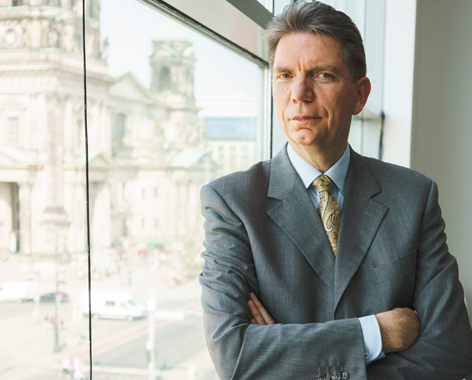
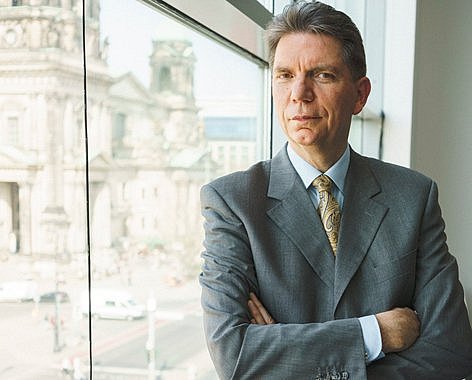
How well can one understand another culture? To what extent can one empathise with it? These are not only questions that will be of the utmost importance for the work of the Humboldt Forum; they have also always been central to Lars-Christian Koch’s professional career. It therefore seems almost providential that he was appointed the Humboldt Forum’s first Director of Collections in March. Since 2003, Koch has been Head of the Department of Media and Music Ethnology, Visual Anthropology and the Phonogram Archive at the Ethnological Museum of the Staatliche Museen zu Berlin, the overall management of which he also took over on an interim basis at the end of 2017. He is now to become Director of the Ethnological Museum and the Museum of Asian Art of the Staatliche Museen zu Berlin at the Humboldt Forum.
He intends to present their collections in such a way that they fascinate people, but also provide answers to current questions. Born in Peine in 1959, Koch completed his studies in ethnology and musicology in Bonn – and has merged the two disciplines.

It turned out that his particular passion lay with the Asian region, and India in particular. Even before he first travelled to the country of his dreams, Koch decided to immerse himself fully in its musical world. His aim was to combine theoretical knowledge with practical work: “I wanted to be right in the thick of it!” Music had already captivated him: Koch played the organ in a church and was also part of a rock band. Now it was to be the sitar. In Bonn, he actually found an Indian teacher who gave him lessons on what is arguably the best-known Indian instrument and didn’t hold it against him that he vigorously rejected her other educational offerings – for example, in Indian languages and cuisine. “I’d been studying Sanskrit at university for ages, and cooking didn’t interest me at all back then,” he says, laughing at his youthful ignorance.
On study trips, he then discovered how closely the various aspects of life are intertwined in this country. In India, he took music lessons, even went on concert tours with local musicians – and was also allowed to look over the shoulder of an instrument maker in Kolkata. The traditional teacher-pupil relationship means that one often stays in the teacher’s home, eats together and cooks together in the evenings. So, Lars-Christian Koch wanted to get to know India and improve his sitar playing – and suddenly found himself eating and drinking in the midst of an extended family? “Yes,” he beams. “That is exactly what we ethnologists do! We want to understand the whole picture.” The overall context is essential for interpreting the details, and the perspective must not merely be from the outside, but must also come from within: “You have to immerse yourself deeply in the cultures. It helps if you live with the people for a longer period and can build genuine trust with them.”
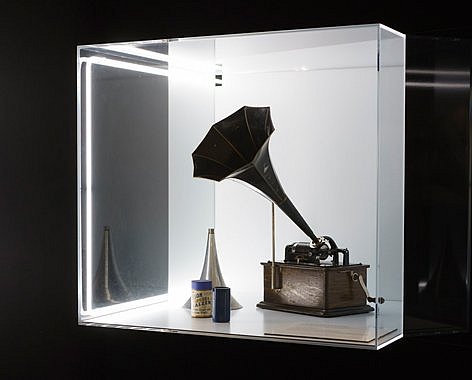
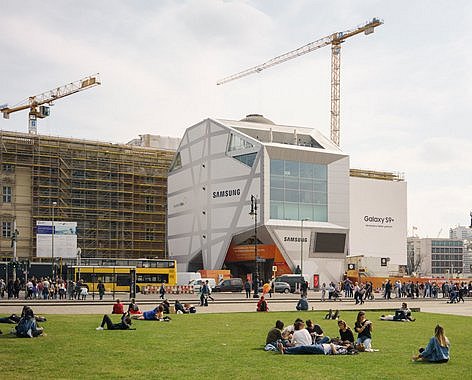
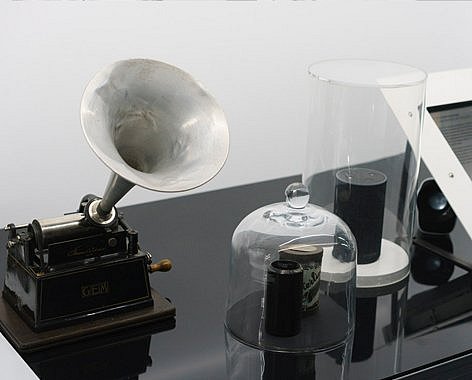
How the information obtained in this way, such as audio and video recordings, is handled in the archive is a central criterion for the exhibition concept of the Humboldt Forum. Ideally, all partners are linked through “cooperative work”, as Koch calls it, aiming to arrive at “shared knowledge” through joint consultation. The current exhibition “[laut] Die Welt hören” at the Humboldt Box illustrates exactly what he means by this. In one narrow room, for instance, there is nothing to be heard at all, even though old recordings of Navajo healing ceremonies were actually supposed to be played here. However, the representatives of this indigenous tribe who were contacted rejected this. The sounds, which are sacred to them, may only be played to those in the know. However, they did agree that these should continue to be preserved by the Ethnological Museum. “Who is permitted to record, preserve and reuse whose sounds?” – that is the crucial question for the exhibition curated by Koch. It also addresses key concepts such as provenance research, contextuality and intangible cultural heritage.
Sounds, after all, cannot be grasped, but they can be understood. This should make the Humboldt Forum the vibrant “venue for debate” that the founding directors envisioned, and Lars-Christian Koch is delighted with the broad thematic spectrum he will be able to cover thanks to the archive treasures, the size of the building and the capacity for new acquisitions. He wants to integrate the individual areas more closely, give the institution a stable identity and, when it comes to presentation, strike a note of something like a vision for the future: “I want the Humboldt Forum to be more than just a museum – its programme should go beyond that!”