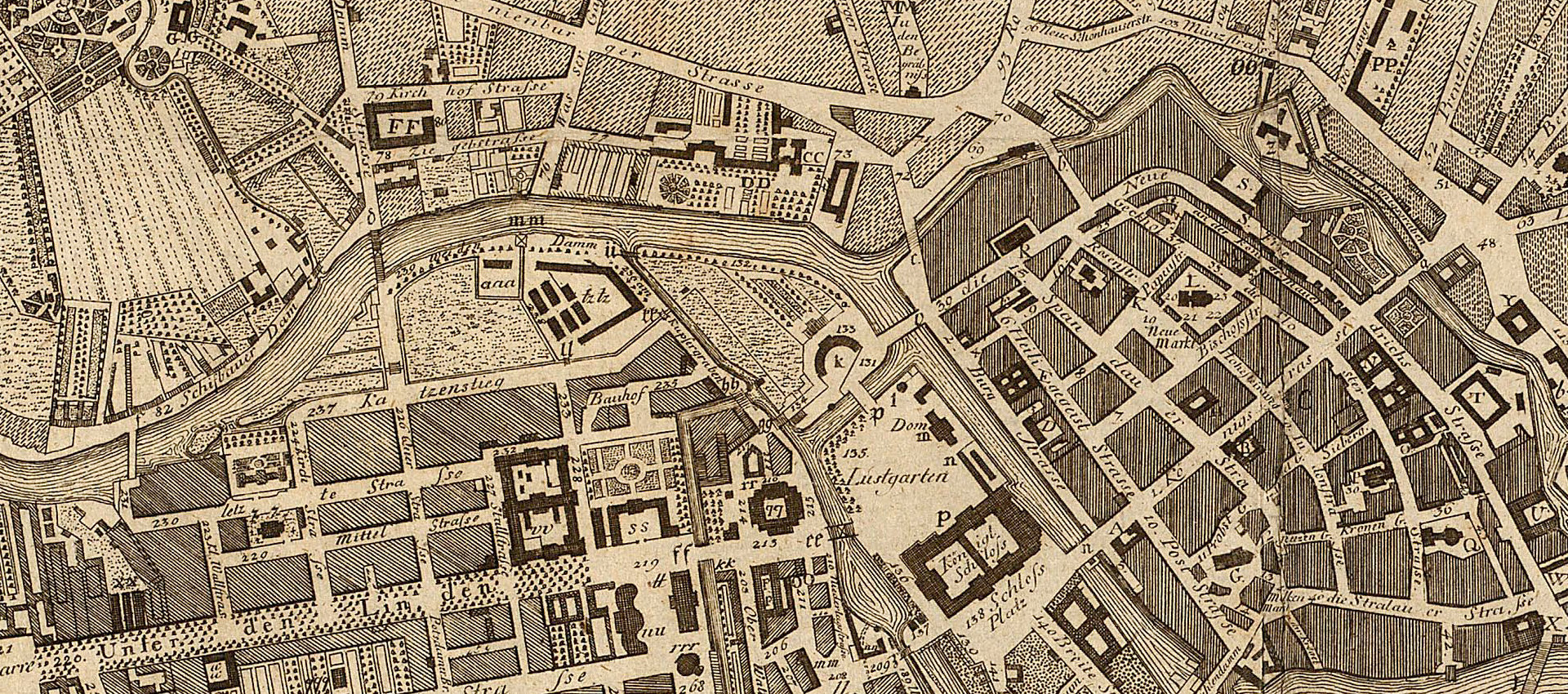
Books and much more besides: the complete refurbishment of the State Library on Unter den Linden was completed in 2020 and promises both joy and freedom.
Did he or didn’t he? Did Ludwig van Beethoven alter Friedrich Schiller’s famous ‘Ode to Joy’ and have the singers and choir sing ‘Freedom, beautiful spark of the gods’ instead of ‘Joy’? Just as Leonard Bernstein conducted it on Christmas Day 1989 in the eastern part of Berlin at the Konzerthaus am Gendarmenmarkt, broadcast on television to millions of listeners around the world?
We now know that it was not Beethoven, but that Bernstein, in the heat of the moment and euphoric over the fall of the Wall, adapted the text to suit the occasion. This can be verified quite clearly, not far from the venue of the concert. For the autograph of the Ninth Symphony lies safely and securely preserved in the State Library on Unter den Linden, and for those who find the journey too long, the digitised version can be viewed online.
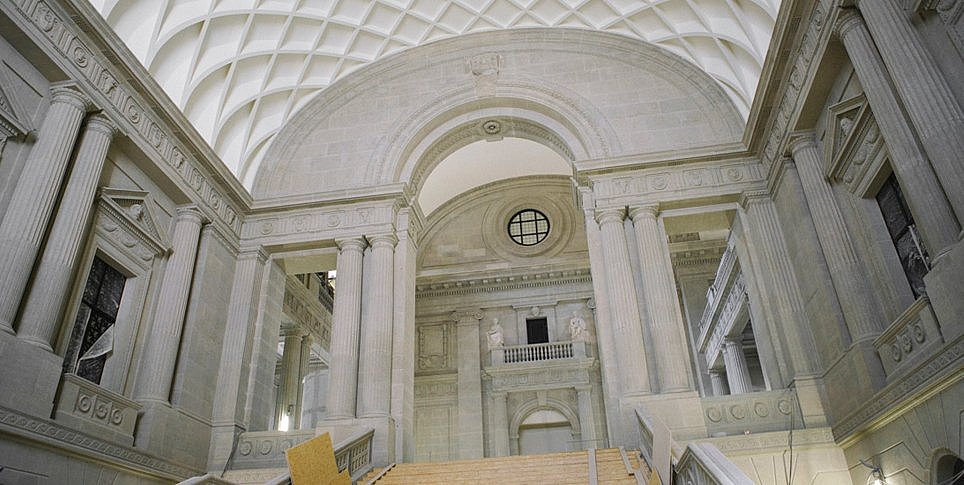
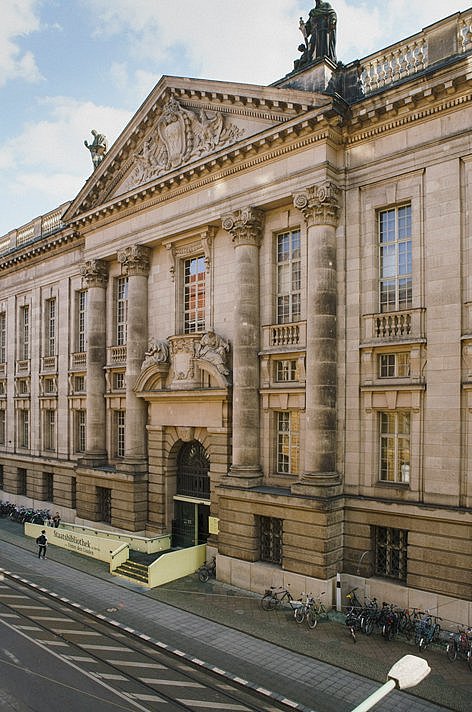
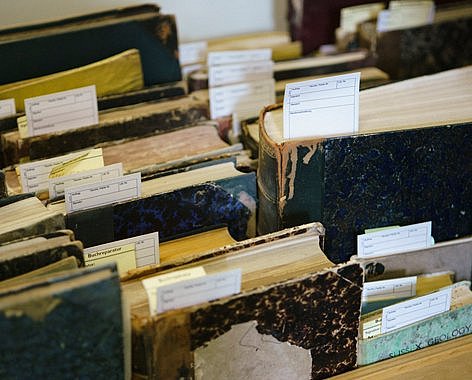
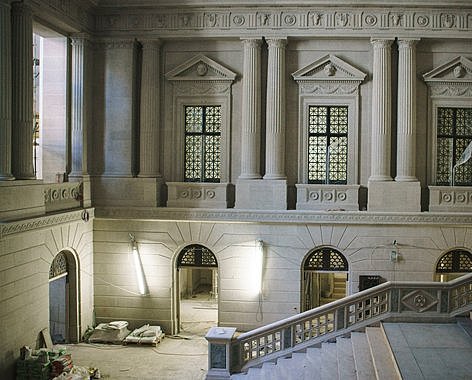
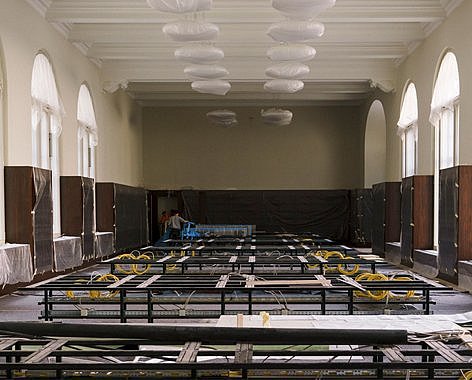
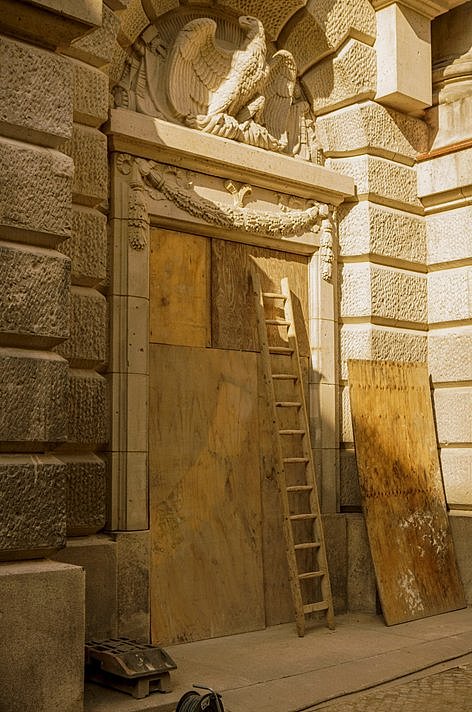
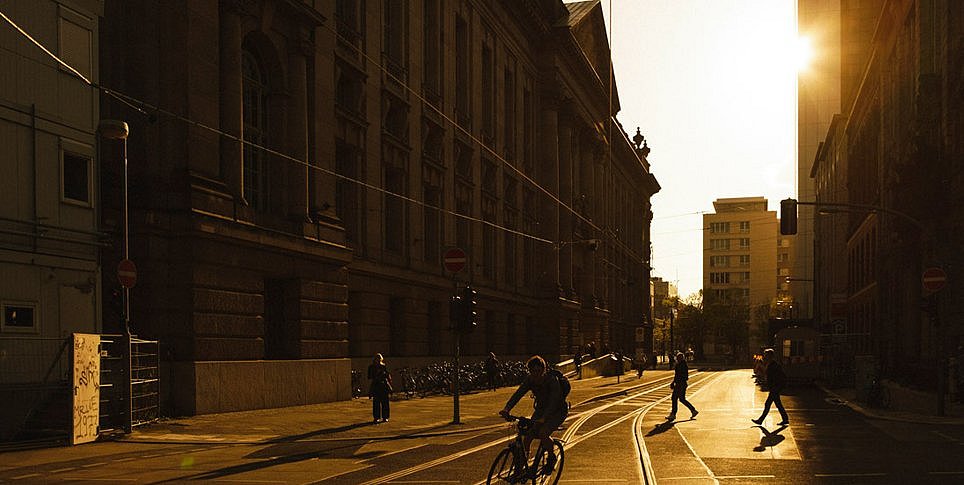
And because this treasure – and indeed the entire vast collection – must remain continuously accessible to scholars, researchers and admirers both at home and abroad, the Federal Office for Building and Regional Planning (BBR), acting as the client’s representative, oversaw a decision that was as unusual as it was magnificent: the complete refurbishment of the State Library from 2005 onwards whilst it remained open to the public. Anyone who has ever lived in a house where the attic has been converted or the heating pipes replaced knows how disruptive that is. But hardly anyone can imagine what years of construction work would mean for a building the size of the State Library, which sees such heavy public footfall. “Sometimes it would happen that, once the last visitors had left,” says Jens Andreae, who has been the project manager responsible for the State Library’s refurbishment at the BBR since 2010, “the construction workers would quickly stub out their cigarettes, put on their helmets and get to work – even at night and at weekends.”
The complex construction project, based on an architectural competition won by the Stuttgart-based firm HG Merz, was effectively split in two: first came the northern section, to rebuild the reading room destroyed in the 1943 air raids and restore the library’s functionality, followed by the southern section, which is due to be completed in 2019. The four book towers, a legacy of the GDR era that had been erected in place of the reading room – modelled on feed silos and with very low floor-to-ceiling heights – proved to be a particular challenge, which is why quite a few staff members experienced bouts of claustrophobia when they had to venture too far or too deep into the book towers. As this compact structure could not simply be blown up, because this would have caused devastating damage to everything around it, excavators were positioned at the top, which worked their way down to the ground using the ‘nibbling principle’. The rubble was collected in containers, which were then hoisted over the side walls by cranes – a height of no less than 13 storeys.
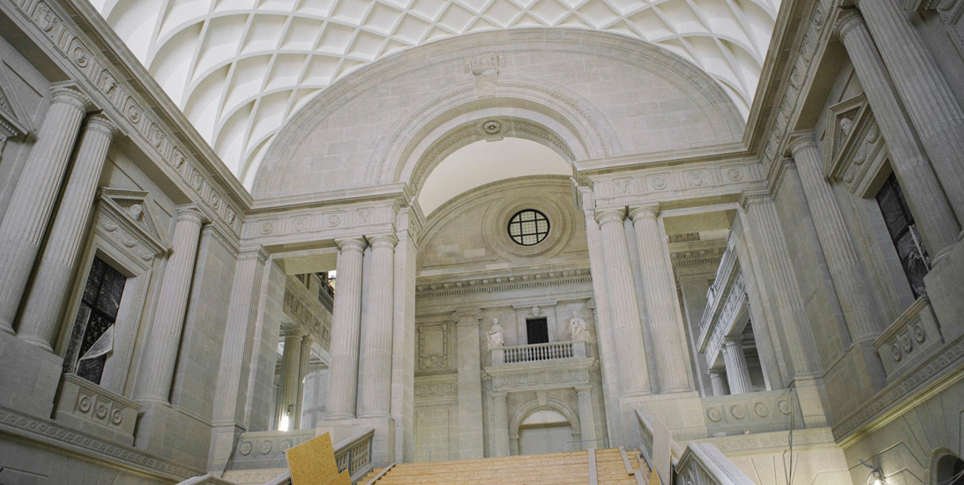
Once this tricky problem had been resolved in the truest sense of the word, the new reading room was built in place of the book silos. Unlike its predecessor, which, with its mystical lighting, massive dome and high walls, was reminiscent of a cathedral, the new reading room, designed by the architectural firm HG Merz, emerged as a 35-metre-high, light-flooded, gracefully tiered hall of knowledge with around 300 workstations. The principles upheld by the architects – transparency, rhythm and compositional identity – were consistently implemented throughout the comprehensive renovation in accordance with the strict requirements of heritage conservation.
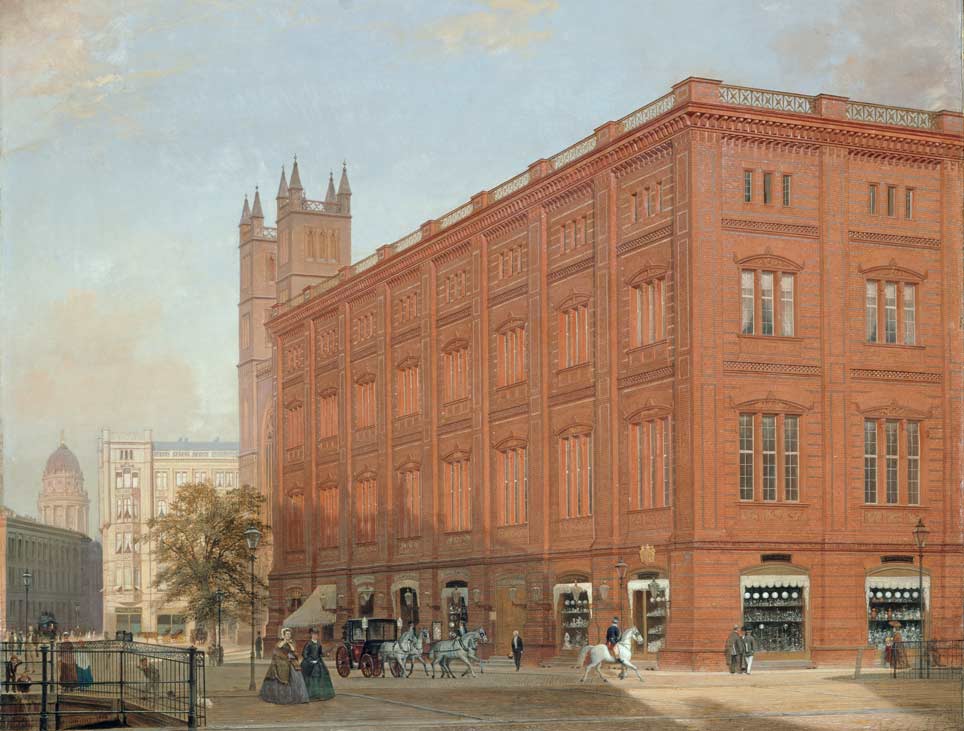
The State Library was one of Emperor Wilhelm II’s favourite projects; he wished this magnificent building to serve as a tribute to the standing of German scholarship in the world. It was therefore erected in an exquisite location between the Brandenburg Gate and the Hohenzollern Palace. Even for the Russian military command after the Second World War, it was a matter of high priority, and so orders were given to open it as quickly as possible. This took place as early as the summer of 1946, after the enormous war damage had, of course, been only provisionally repaired. Even after reunification, attention was quickly turned to the State Library, and initial stabilisation and conservation measures began in 1990. Later, unexpected damage was discovered, the most serious of which included cracks in the steel truss girders above the main stairwell and the approximately 2,700 rotting oak piles in the foundations, which had to be replaced with concrete piles.
This came at a price, which will amount to around 470 million euros upon completion of the construction work – after almost 14 years of building work on a structure larger than the Reichstag or the Humboldt Forum, for which there were well over 14,000 architectural and detailed plans and for which 405 construction contracts, 115 fee agreements and 181 contracts to specialist engineering firms. “You only do something like this once in a lifetime,” says Jens Andreae, who knows the facts and figures by heart.
Then there is the wild vine from the 1920s in the courtyard of the site, which has seen and experienced a great deal and is now classified as a garden monument. It was carefully detached from the masonry and secured to the scaffolding with leather straps, where it was to find a temporary home – and did. Now it can, as before, cling to the Silesian sandstone and continue to grow.
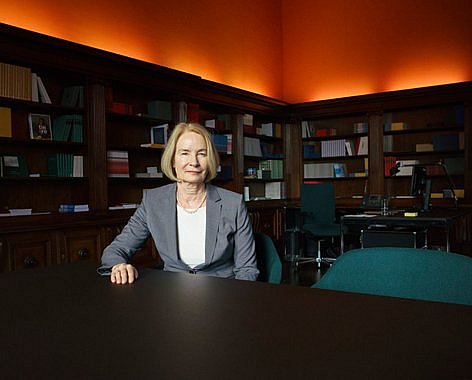
For just under two years now, this courtyard has been home to the office of Martin Hollender, a research officer in the General Directorate. From his window high above, he keeps his fingers crossed for the vine’s continued flourishing and watches with delight as the final stages of construction in the southern part of the building are completed. The surround of the fountain in the courtyard of honour is currently being finished, where a stately fountain is to splash once more; the façades and decorative elements have already been reconstructed and cleaned. And the traditional Director-General’s offices are also already in use, with Barbara Schneider-Kempf now serving as Director-General. “Come in, you’ll be delighted,” she calls out, inviting us into her office overlooking the Unter den Linden boulevard, which used to be jokingly called “The Red Salon” because of the fabric wallpaper. She has renamed it the Rahel Varnhagen Room in memory of the legendary Berlin salonnière.
The office features a restored coffered ceiling with golden, red and green accents that structure the entire space. The walls are still covered in red fabric, whilst the seating is green – though, at Schneider-Kempf’s express request, it has a modern design: “Otherwise I really would have felt like I was in a museum!” And that is precisely what the energetic Director-General does not want the State Library to be. Only on the ground floor, from 2020, will a planned library museum recount the building’s eventful history. By the time it opens, the State Library will have been operating as normal for quite some time. And then all the locals and tourists who know it only as a shadowy monument behind scaffolding and protective tarpaulins will finally be able to see it in all its splendour. Shall we bet that even Leonard Bernstein would have ‘Joy, beautiful spark of the gods’ sung there again?