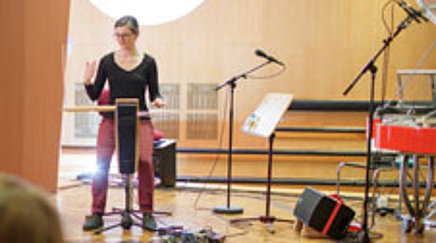
There is something magical about Carolina Eyck playing her instrument: the legendary theremin. As part of the “GOOD VIBRATIONS” exhibition, both were guests at the State Institute for Music Research for a workshop and a concert. And Germany’s most famous thereminist will also be performing with her enchanting instrument at the Institute’s grand 100th-anniversary celebrations on 24 June 2017. We put it to the test and had the theremin explained to us in all its intricacies.
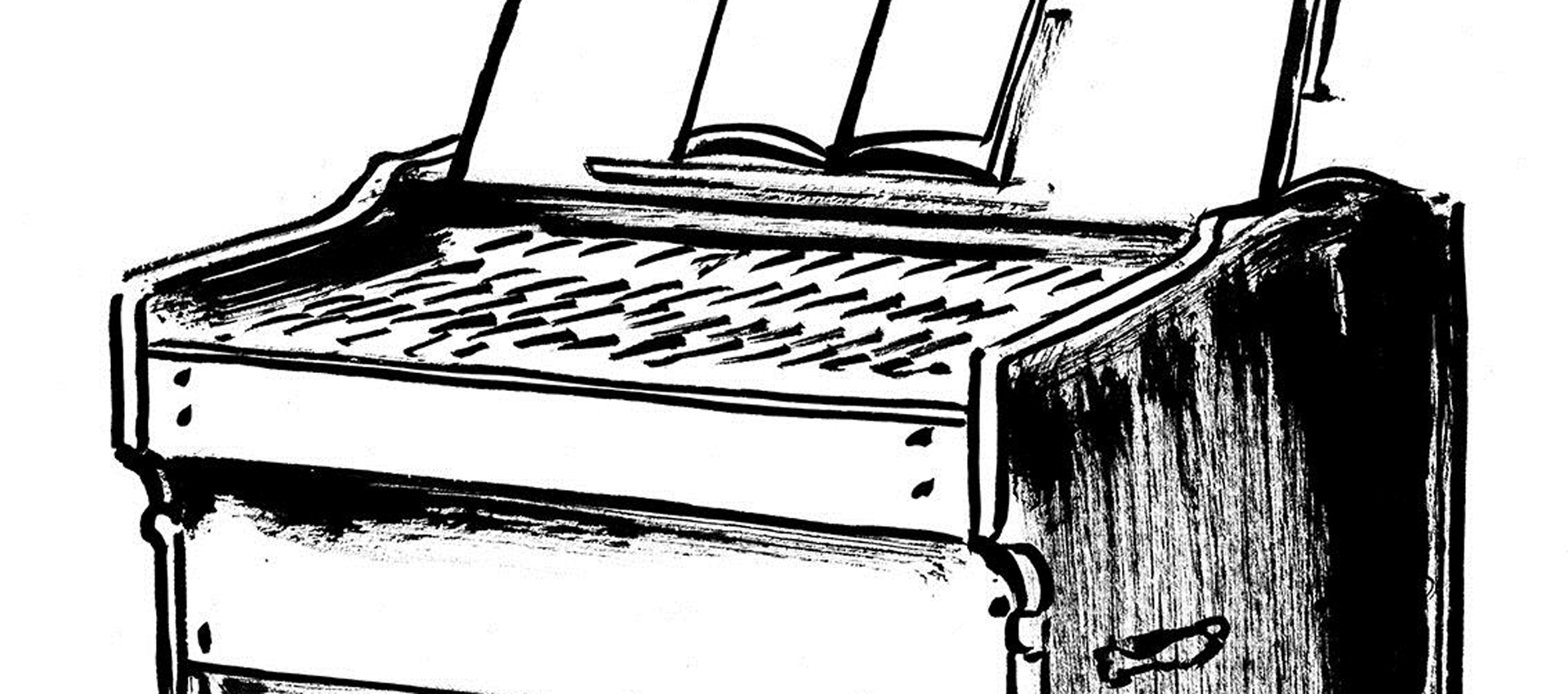
Stretched between her right shoulder and the instrument – which looks a bit like a box radio with an extended antenna – is the invisible string on which the theremin is played entirely without touch. The workshop at the State Institute for Music Research (SIM) is fully booked. The participants sit spellbound on the black leather cushions in the spaceship-like Folklore Hall, listening to thereminist Carolina Eyck, who explains the basics of playing with short demonstrations and a cheerful composure: the notes are produced on the invisible string with the right hand. The left hand hovers over the theremin and controls the volume.
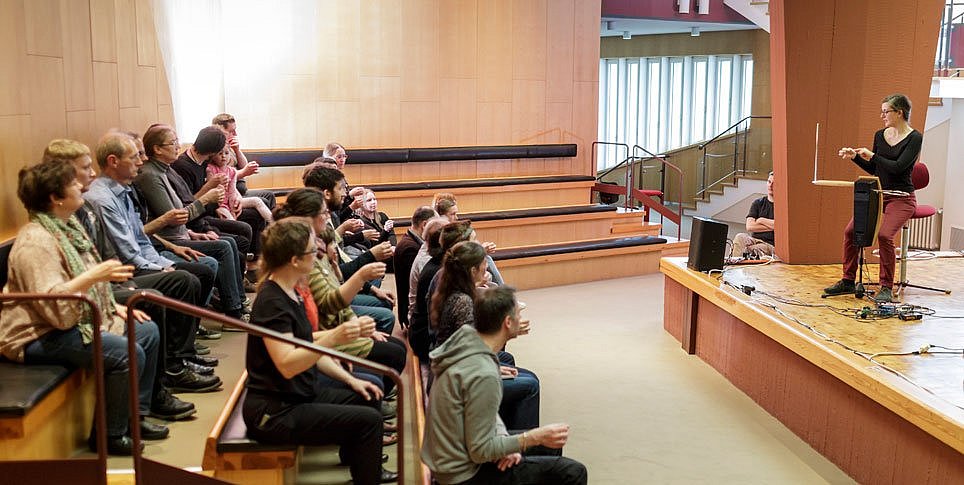
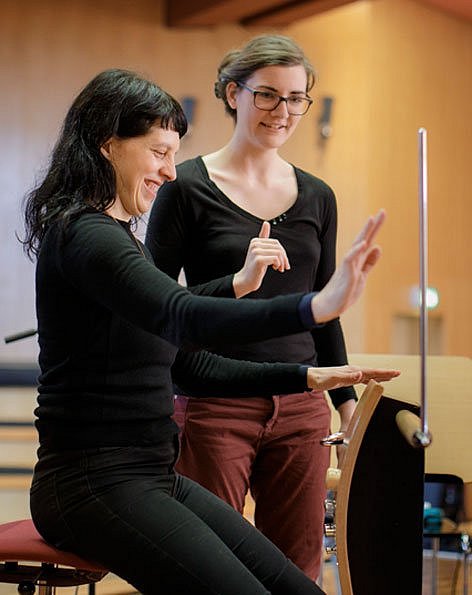
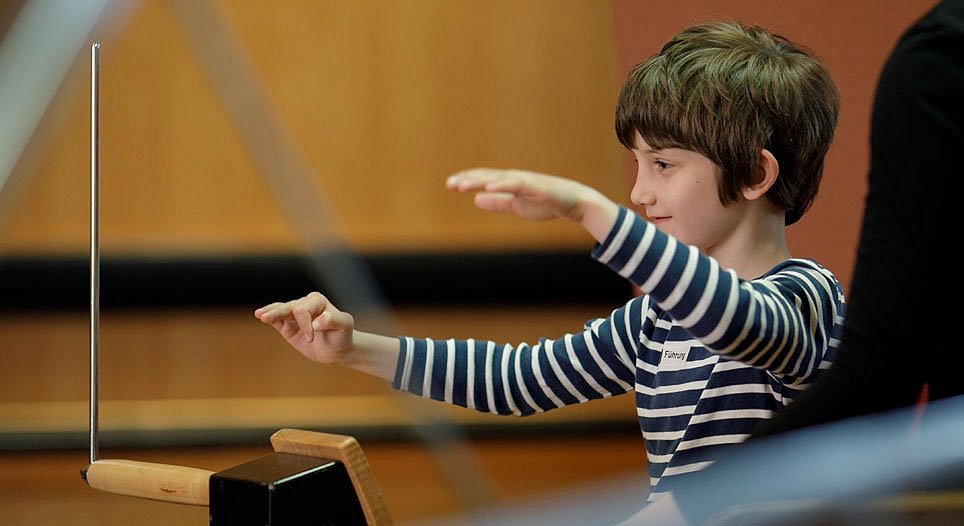

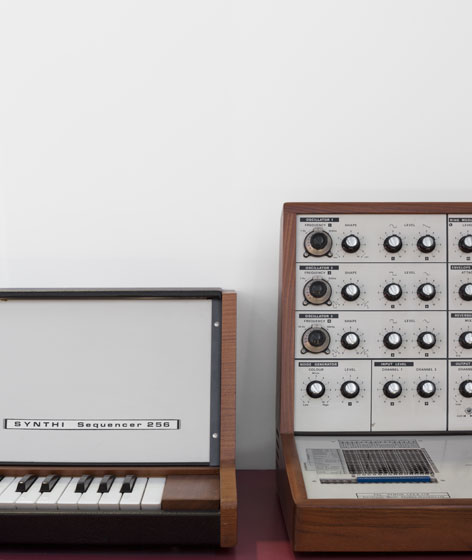
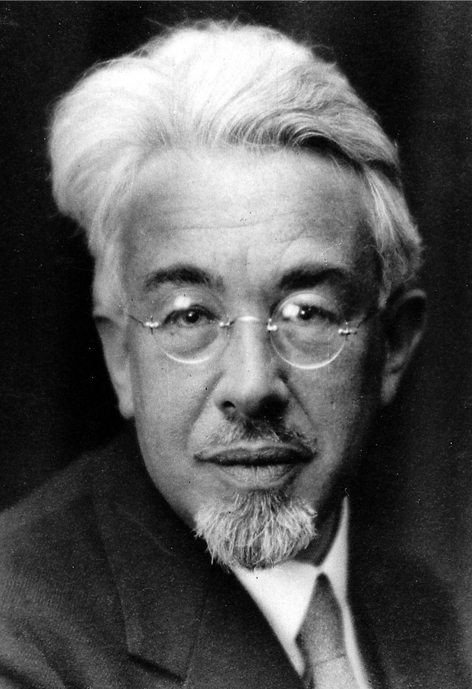
What sounds wonderful and looks as light as a feather is, in practice, not at all easy to master. It is not just the positions of the fingers and hands that need to be coordinated; the whole body influences the sounds that can be coaxed from the theremin. After all, the mechanism is based on electromagnetic fields that are influenced by movement. The theremin was developed around 1920 by Lev Termen, a Russian physicist. One of these early theremins is also on display in the ‘GOOD VIBRATIONS’ exhibition at the SIM, which runs until 27 August 2017 and explores the history of electronic musical instruments.
Carolina Eyck is one of the world’s best-known thereminists. She plays a contemporary version of the instrument, the Etherwave Pro by Moog. This theremin has been technically improved, as the intervals on the invisible string are approximately equal. As Eyck explains, this opens up far more possibilities because the instrument can be played with greater precision. Eyck developed the technique she uses to play the theremin – eight finger positions on the invisible string – herself. Many players have adopted her technique and, as she reports, Eyck teaches more and more students every year. This, too, contributes to the theremin gaining increasing public recognition.
Eyck makes a further contribution through her tireless activities, which take her all over the world – she is often on the road for several weeks at a time. In addition to workshops, Carolina Eyck gives many concerts, often together with the pianist and composer Christopher Tarnow. But she also plays with classical orchestras: “I find that the sound of the theremin fits very well with a classical orchestra. The theremin can play very high, that is, across all registers, and thus blend in very well with the orchestra. At the same time, the theremin can also float above the orchestra, because the orchestral sound carries it well.”
During the workshop at SIM, the children in particular want to keep trying out the theremin. Eyck attributes this fascination to its unique sound and the touch-free way of playing. At the same time, Eyck notes: “When people talk about the theremin, ‘fascinating’ is often the first word. That’s completely understandable. For me as an artist, however, it is particularly wonderful when I can go beyond that, when I can play music so movingly that my listeners forget how the sound is produced and let themselves be carried away by my music.”
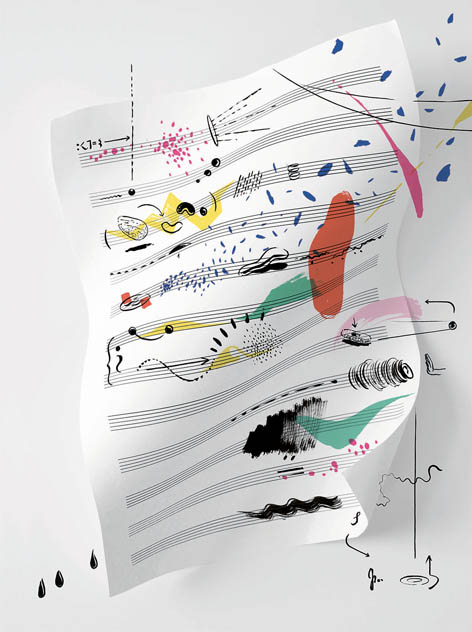
Incidentally, for Carolina Eyck, her music is not merely sound. She is a synesthete. When she composes, images and sounds are present simultaneously. “I very often see colours when making music. When something is in harmony, it also has a beautiful colour or a beautiful combination of colours. That’s how I compose too. Of course, I don’t just use C major. That would be boring, because the piece would then consist solely of red, blue and yellow. There have to be special notes that make the harmony and the colours interesting.” The fact that Eyck can also draw spontaneous inspiration from images delights the participants of the workshop at the SIM. In the blink of an eye, Eyck develops melodies from the participants’ drawings. And so, suddenly, a very lively octopus swims through the SIM, both gesturally and sonically.
Carolina Eyck has something very special planned for the SIM’s 100th anniversary: together with Lukas Rabe, she will be demonstrating her theremin to the youngest visitors at a family concert – using a hand puppet. It would come as no surprise if the next generation of theremin players were secured that very afternoon.
State Institute for Music Research
The State Institute for Music Research is the largest non-university research centre for musicology in Germany. It is dedicated to the historical and theoretical study of music and its lively presentation. To this end, its Museum of Musical Instruments presents the development of European art music from the 16th to the 21st century to a wide audience. Founded as early as 1888, the museum houses over 3,000 historical musical instruments and offers a diverse range of events – from academic symposia and concert-talks featuring historical instruments to interactive sound installations.