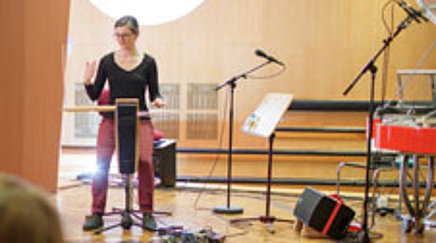
Types of current-controlled sound generation: differences in electromagnetic fields, air converted into electronic sounds, or sound synthesis. The State Institute for Music Research is showcasing the corresponding instruments in an exhibition.
As young as the genre of electronic musical instruments is, it has had a lasting impact on the world of music. Its development raises fundamental questions: How are sounds produced in the first place? Who makes music: humans or machines? Is a mobile phone already a musical instrument? The State Institute for Music Research, part of the Prussian Cultural Heritage Foundation, explores these and other questions in the exhibition “GOOD VIBRATIONS. A History of Electronic Musical Instruments”, which runs from 25 March to 27 August 2017 at the Musical Instrument Museum. We present some outstanding exhibits.
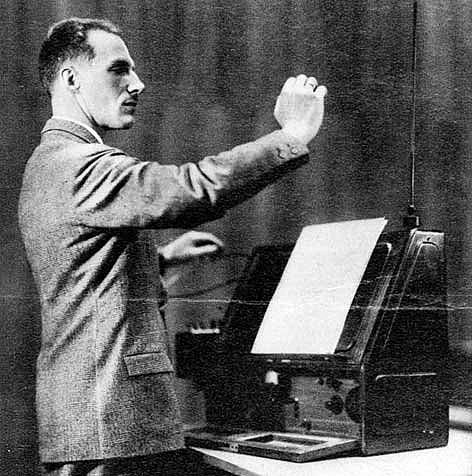
Lev Termen playing his theremin © Reproduced from: Frankfurter Illustrierte No. 30, 31 July 1930, p. 826. Photo: Knud Petersen. Image archive of the Musical Instrument Museum
Playing on the airwaves: the theremin
In 1919–20, the Russian physicist Lev Termen invented the theremin, the first instrument capable of generating sound electronically. The theremin is played without touching it; the hands influence electromagnetic fields that control pitch and volume. Termen initially called his instrument the ‘etherophone’ and, from 1927, went on a world tour with his ‘ghost instrument’. It achieved enormous popularity that extended far beyond his death in 1993. The violinist Clara Rockmore also contributed to this. Thanks to her perfect pitch, she became a virtuoso thereminist and gave concerts with the New York Symphony Orchestra. Particularly in the USA, the Theremin remained a fixture of popular and film culture. It was used to provide the soundtrack for futuristic visions and science fiction stories, such as the films ‘It Came from Outer Space’ or ‘Mars Attacks’. The Theremin was also used for sound effects in the ‘Star Trek’ series and is regarded by many as the stereotypical sound of an alien.
Bird cries from the Mixtur-Trautonium
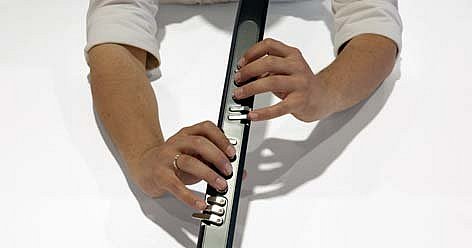
The variety of novel sounds that the Trautonium can produce was regarded in 1930 as an engineering masterpiece and a musical sensation. It ranges from string and organ tones to human-like voices and metallic sounds.
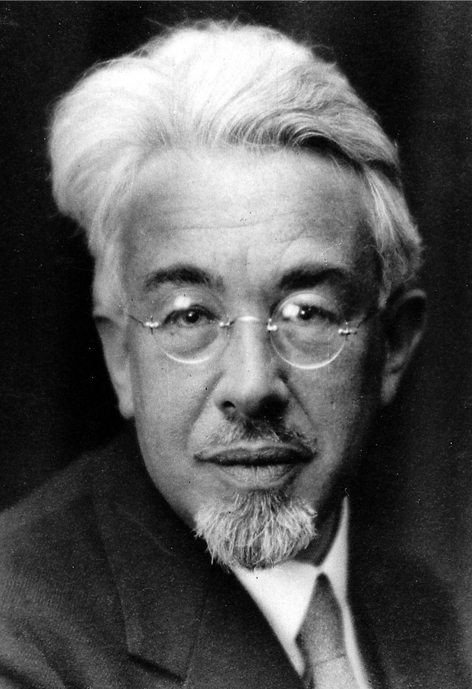
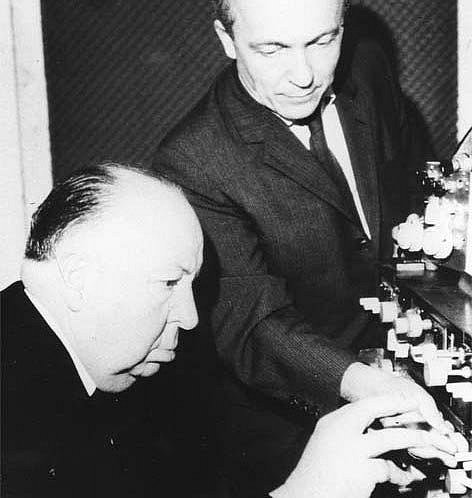
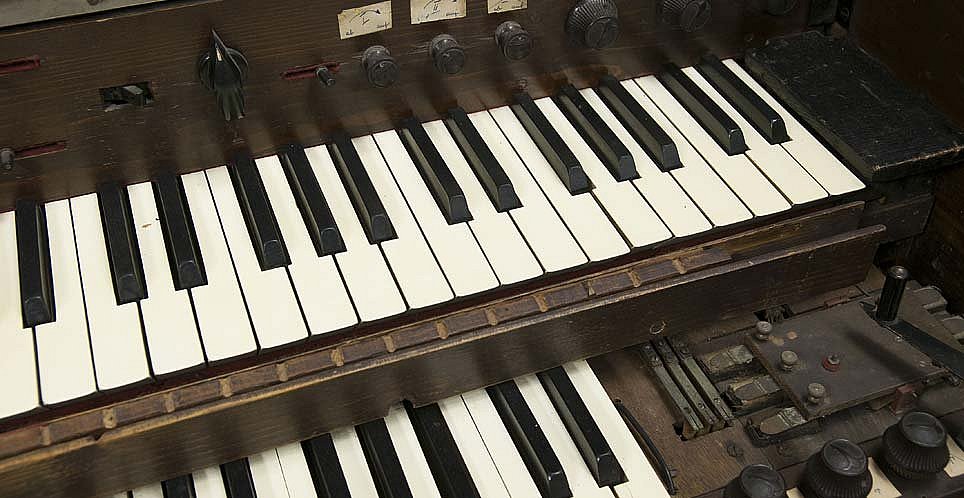
The inventor of the Trautonium was the engineer Friedrich Trautwein, born in Würzburg in 1888. He presented it to the public for the first time in 1930. From 1934 onwards, the pianist Oskar Sala further developed the Trautonium. Put simply, the sound is produced by a wire being pressed onto a metal rail, thereby closing an electrical circuit. The position of the pressure determines the electrical resistance and thus the pitch. Sliding along the wire produces a continuous change in pitch.
The Mixtur-Trautonium, which Oskar Sala had patented in Germany, France and the USA, achieved the greatest fame. It can be heard in the 1963 Hitchcock film ‘The Birds’, which is also regarded as one of the classics of the horror genre due to its shrill and unsettling soundtrack. The entire soundscape was recorded by Oskar Sala. He continued to compose for various films right up until his death in 2002. Contemporary musicians, such as Kraftwerk and Einstürzende Neubauten, regard him as a pioneer of electronic music and the avant-garde.
Music through differences: the Heliophone
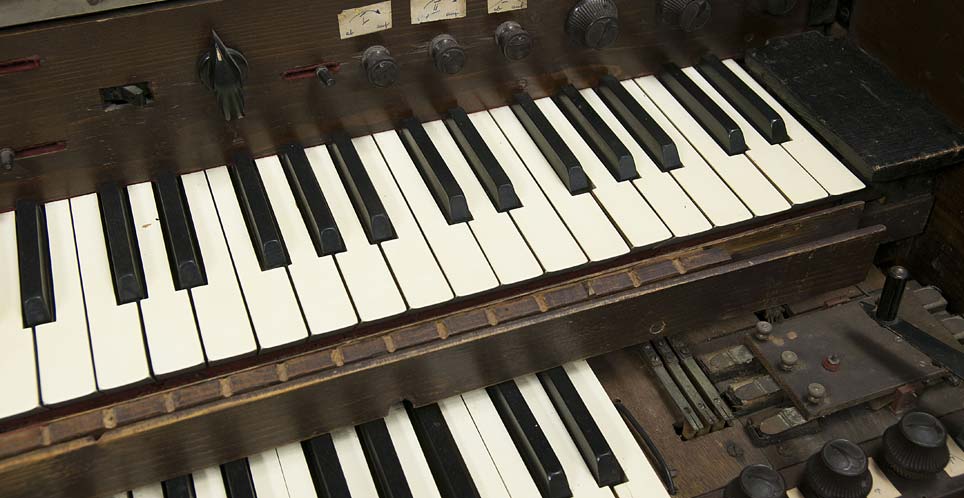
The Heliophone is a very rare instrument. It was built by the pianist Bruno Helberger and the engineer Peter Lertes. They presented it to the public for the first time in 1929 under the name ‘Hellertion’. The Heliophone from the collection of the Musical Instrument Museum is a second version, built after the Second World War. Both instruments, the Hellertion and the Heliophon, were capable of producing a variety of timbres. The pitches were generated using the principle of interference: two high-frequency oscillators overlap to produce an audible beat – just as with the legendary Theremin. Unfortunately, the Hellertion and the Heliophon never became very famous – a fate they share with many early electronic musical instruments. Nor did it help that one of the inventors of the Heliophon, Peter Lertes, published the first standard work on electronic musical instruments in 1933.
Man at the musician’s side: rhythm machines
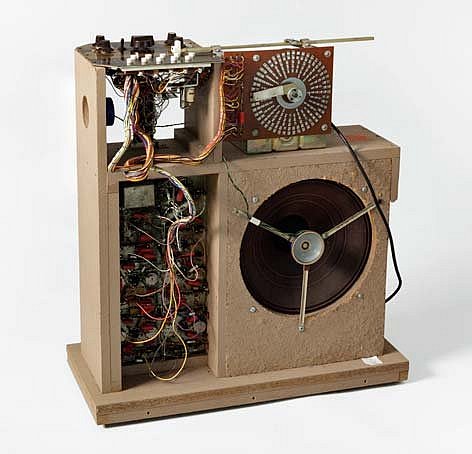
The development of rhythm machines, also known as ‘drum machines’, began as early as the 1930s. Their precursor is the Rhythmicon, designed by Lew Termen, the creator of the Theremin. One of the first rhythm machines was the Sideman. It was built in the late 1950s by the Wurlitzer company. A musician could choose from 12 pre-set rhythm patterns, such as samba, tango, waltz or march, and have the Sideman accompany them. Although a drum sound could be added at any time at the touch of a button, the Sideman was still a long way from the capabilities of later drum machines. On the Lindrum, for example, which was developed later, patterns could be programmed relatively freely.
Sounds in a suitcase: VCS-3
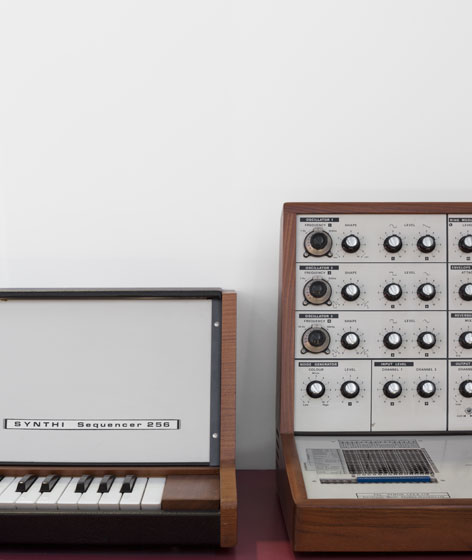
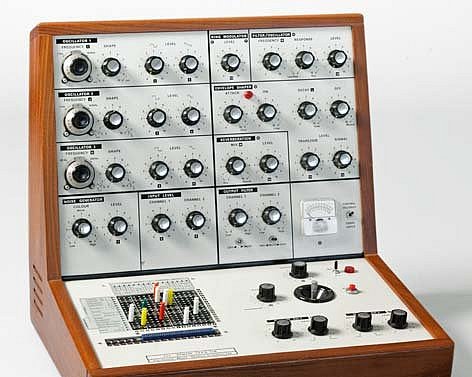
The legendary VCS-3, a monophonic analogue synthesiser designed by David Cockerell, was first unveiled in 1969 by the London-based company Electronic Music Studios (EMS). It was one of the most commercially successful and technically innovative devices of the 1970s. This was because it not only delivered an enormous range of sounds but was also exceptionally portable. At a time when synthesizers typically filled entire studio walls, weighed over a hundred kilograms and cost several hundred thousand pounds, this suitcase-sized instrument, priced at around 1,000 pounds, was a sensation.
From air to electronic sound: Lyricon
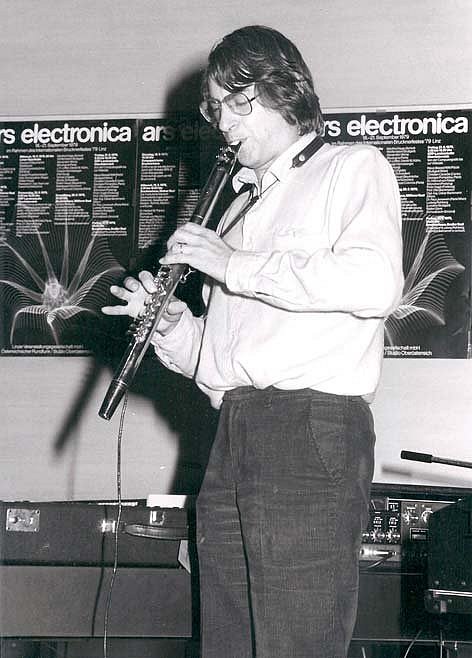
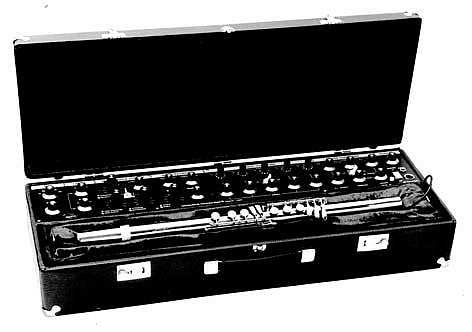
At the 1979 ‘Ars Electronica’, Bruno Spoerri won first prize in the ‘Innovative Instrument’ category with the Lyricon. The Lyricon is a wind controller. A mouthpiece detects lip and air pressure. This data is fed to a small modular synthesiser, which controls the sound generation. The instrument was manufactured by William B. Bernardi and Roger Noble as early as the mid-1970s and sold in three different versions until 1980. Alongside Bruno Spoerri, musicians such as Klaus Doldinger, Klaus Kreuzeder and Michal Urbaniak also played the Lyricon. It can also be heard in Michael Jackson’s “Billie Jean”. Eventually, the MIDI standard superseded the Lyricon’s technology. However, it lives on in numerous wind controllers still produced today, such as the AKAI EWI USB.
GOOD VIBRATIONS: A History of Electronic Musical Instruments
From 25 March to 27 August 2017, the Musical Instrument Museum of the State Institute for Music Research will be presenting over 60 pioneering electronic musical instruments. The exhibition will feature both the museum’s own extensive and previously rarely displayed collection, as well as items on loan from international partners. The extensive supporting programme offers visitors the chance to experience many instruments live or even try them out for themselves. Musicians will demonstrate their favourite instruments in action and offer insights into how to play them in workshops.
About the exhibition “GOOD VIBRATIONS. A History of Electronic Musical Instruments”