Ever since Thomas Bernhard, it has been well known that in Vienna, swearing is an art form. This is also evident in the correspondence of the Vienna School.
“If there is such a thing as the famous Viennese charm, then it consists to a large extent of uncharming remarks,” reads the foreword to a little book entitled “Ranting like a true Viennese”. And it continues: “For artful ranting is a tradition in Vienna.”
Perhaps the reverse is even true: anyone who doesn’t occasionally ‘shove their arse in your face’, in other words, anyone who isn’t capable of occasionally setting aside all conventions of politeness, cannot be a true Viennese. The writer Thomas Bernhard – at least temporarily a Viennese by choice – merely spun out a thread with his famous tirades that was already laid out in Vienna: “Vienna is a dreadful genius-destroying machine […] a horrific talent-shattering institution.”
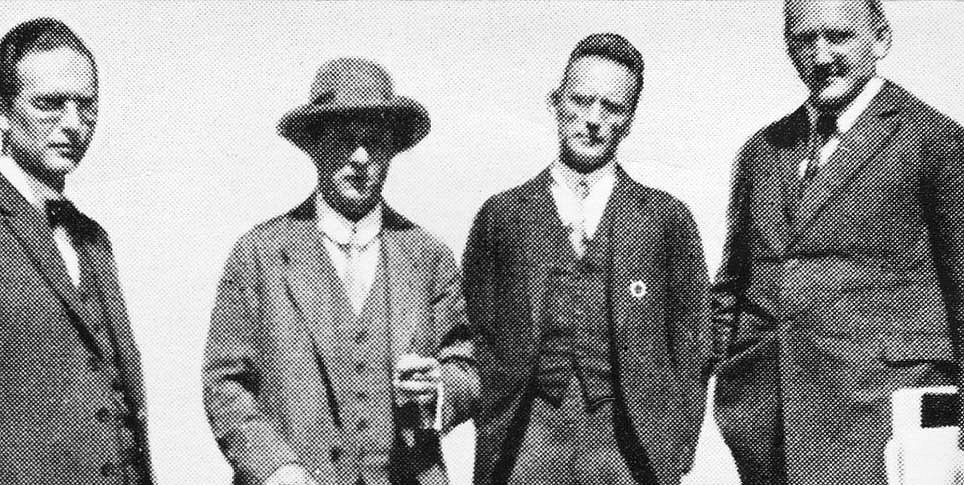
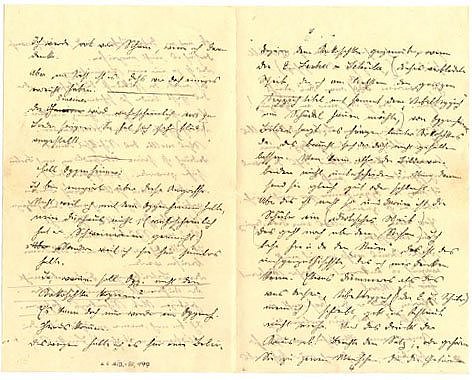


The State Institute for Music Research in Berlin is no stranger to tirades of abuse either. It is there that the correspondence of the Vienna School is published; the Vienna School, however, is not a club of foul-mouthed writers, but rather the circle of musicians that formed around the thoroughly scandal-ridden composer Arnold Schoenberg at the beginning of the 20th century. Not least his pupil Anton Webern had a tendency to prove himself a true Viennese – which he indeed was – in his letters: for instance, he often let off such steam in his correspondence with his friend and fellow composer Alban Berg that even Thomas Bernhard would have nodded in approval. At least Webern was not so tactless as to take aim at the person he was writing to: he ranted about third parties. But in that regard he was not squeamish and did not shy away from the greats either.
In August 1912, for instance, Webern was still quite enthusiastic about his study of the first movement of Gustav Mahler’s Third Symphony. And suddenly he fires a broadside at Richard Strauss:
‘It was as if scales had fallen from my eyes. There is no such thing as fast music. It only exists in Strauss, so that the filth cannot settle. Something as unsympathetic as, for example, *Feuersnot* [an opera by Strauss] […] I watched it the other day. Mahler said of Strauss that he was the Lindpaintner of our time […] I don’t know who that was. In any case, for me Strauss is something utterly and completely unsympathetic. A businessman, if not worse. I want nothing more to do with him.”
Webern really hits his stride when, in January 1912, he takes aim at the poet Else Lasker-Schüler. She had accused the painter Max Oppenheimer in the Expressionist journal ‘Der Sturm’ of copying Oskar Kokoschka. Shortly before, Karl Kraus had reprinted the poem “Ein alter Tibetteppich” (“Your soul, which loves mine / Is woven with hers in the Tibetan tapestry”) in his magazine “Die Fackel”. Reason enough for Webern to make his opinion of the poet and the poem abundantly clear:
“The Oppenheimer Case: I am outraged by these attacks. Not because I side with Oppenheimer, no, certainly not; (he has probably done some dirty deeds.) But because I consider them pointless. Yes, why shouldn’t Opp. copy Kokoschka? It can only result in another Oppenh. That is why I consider it an insult to Kokoschka when E. Lasker-Schüler, that idiotic woman, whom I would most like to smash the whole ‘Teppichtibet’ along with the ‘Tibetteppich’ over the head, says of Oppenheimer’s pictures that they are all Kokoschkas hanging there. He certainly doesn’t have to put up with that. So one cannot tell the paintings of the two apart? Well, then they are equally good or bad. But that is not the case, and that is why Schüler is an idiotic woman […] There is certainly nothing more stupid than what this ‘Tibetteppich’ (I mean E. L. Schüler) writes. And Kraus prints it! Note the sentence: ‘or are you one of those people who imitate the gestures of those they are in love with’ (that’s roughly how it goes) […] Yes, why shouldn’t one do that? That’s surely just an advantage! No, no, my dear, it’s all utter nonsense.”
In his reply, even the usually rather reserved Alban Berg was drawn out of his shell: ‘I am, of course, still of the opinion that Lasker is a wretch’. When Berlin musicologists read all these Viennese outbursts, which today would easily pass for hate mail, they must not, however, imagine themselves at a safe distance: Berlin gets its fair share of criticism too. For Webern reports the following anecdote from ‘Treks-Beaaaarlin’ in December 1911:
“A woman said she only had time until 9 o’clock; she’d just popped in to the concert on her way past. She clearly had no idea what it was all about. Instead of going to Aschinger’s beer hall, she sat down in the concert hall […] Such a lack of culture; such vulgarity. Trek, nothing but Trek. All this praise for Berlin! Outrageous! If only Kraus really knew this city of Trek. What a pity; what a pity.”
Things may not be at their best in Vienna – but elsewhere it’s simply even worse.
“Schönberg described Berlin yesterday as a city of non-art. Yes, Berlin is devoid of culture; and the civilisation that appears so great is nothing but elderberry!”
These insults do no detract from the editors’ scholarly rigour. Since not everyone in Prussia knows what is meant by ‘Holler’ (elderberry), the footnote faithfully notes: ‘Austrian: nonsense’. Secretly, however, one might think: ‘What you’re saying there, Mr Webern, is utter rubbish!’
As part of the anniversary celebrations, Jörg Gudzuhn and Christian Grashof will read from the volume of correspondence between Alban Berg and Anton Webern, edited by Simone Hohmaier and Rudolf Stephan, at the SIM Café on 24 June 2017 at 4 pm.