Before he retires at the end of May 2025, Foundation President Hermann Parzinger answers research questions
As a prehistorian, Hermann Parzinger focuses on various aspects of early human history, including the settlement of humans and the emergence of equestrian nomadism (the Scythian culture), research into which he has significantly advanced through sensational discoveries. To this day, he leads research projects and publishes regularly.
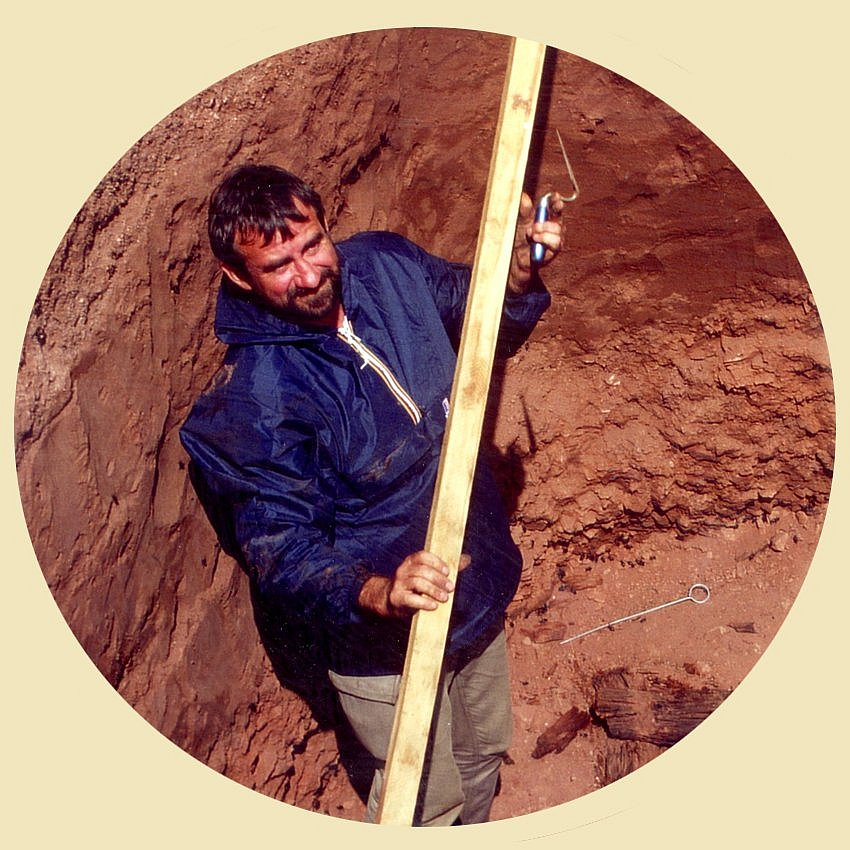
(right) Hermann Parzinger in the pit where he discovered the Scythian princely tomb in 2001.
Photo: Private
What have been the main focuses of your research career?
Parzinger: My research can be divided into three main areas. Firstly, the settlement of humans and the emergence of a productive economy between the 7th and 5th millennia BC. Secondly, the supply of raw materials, particularly early metals such as copper and tin; tin played a central role, especially in bronze production during the 2nd millennium BC. And thirdly, the equestrian nomads – specifically the emergence of equestrian nomadism and the Scythians in the 1st millennium BC.
One of the most significant discoveries in this context concerns the supply of raw materials in the 2nd millennium BC. We know that the 3rd and 2nd millennia BC are referred to as the Bronze Age – an era named after a material. Bronze, an alloy of copper and about 10% tin, does not occur naturally. But where did the tin come from that was processed from Mesopotamia via Anatolia and the Aegean to Europe, yet does not occur there?
For a long time, Central Asia, particularly Afghanistan, was discussed as a possible source, as large natural tin deposits are known to exist there. In the late 1990s, we began a research project to investigate precisely these deposits for traces of ancient mining. We were very fortunate in this endeavour: in both Uzbekistan and Tajikistan, we discovered evidence of early tin mining as well as sites where the ore was further processed and cast into ingots in crucibles – as early as the 2nd millennium BC.
These finds were a scientific sensation. Through chemical analyses, particularly isotope studies, we were able to trace where this tin from Central Asia ended up. These findings represented a significant breakthrough in understanding the supply of tin during the Bronze Age and the origin of this essential raw material.
Research Questions
How exactly does one restore paper? How can you tell if a painting is genuine? And what is the correct way to play Beethoven? With Research Questions, we give you the opportunity to ask us your questions. In each issue of the research newsletter, a researcher from the SPK answers selected questions from the community on a specific topic.
What has revolutionised archaeology?
Archaeology has always been one of the most interdisciplinary humanities – and has been so for over 100 years. As early as the late 19th century, Oscar Montelius was conducting metal-analytical investigations on archaeological objects. It became apparent early on that pure typology – that is, classifying forms based on their appearance and examining their distribution and combinations – was insufficient. To truly understand archaeological finds and comprehensively reconstruct the past, the environment must also be reconstructed: in what geographical and climatic contexts did human cultures develop? What framework conditions were dictated by nature and climate? These questions were essential from the very beginning.
In recent years, however, another branch of archaeology has provided an enormous boost: palaeogenetics. As early as the 1980s, Svante Pääbo, who later won the Nobel Prize, succeeded in extracting DNA from Egyptian mummies in our Egyptian Museum, then still in East Berlin – a groundbreaking discovery. Research continued to develop, and it was eventually proven that modern humans carry a small proportion of Neanderthal DNA in their genome. This shows that interbreeding must have taken place around 50,000 years ago, when Homo sapiens and Neanderthals encountered one another in Europe.
These genetic findings are revolutionising our understanding of human history, particularly population history and migrations. How diverse were societies? How did populations develop? Archaeological research used to be able to answer these questions only to a very limited extent. People often drew large migration arrows on maps when similar finds were made at two distant locations – a highly simplified model that often does not hold up. The analysis of ancient DNA, on the other hand, now provides robust data that actually makes migrations and population movements traceable.
However, the insights gained depend heavily on the data set. Individual samples are not sufficient to draw far-reaching conclusions. A statistically sufficient sample size is necessary to make reliable statements about population movements. Yet once this foundation is in place, palaeogenetics enables breakthroughs – not only regarding migrations, but also for reconstructing kinship relationships in burial grounds and thus for our understanding of ancient social structures. Much more is to be expected in this field in the future.
What were your greatest discoveries?
The discovery of the Scythian royal tomb in Aržan was undoubtedly one of the most significant archaeological finds. One must bear in mind that research has been carried out in Siberia for 300 years – since the time of Peter the Great. The kurgans, or Scythian burial mounds, are visible from afar and have therefore been plundered over the centuries – as early as the Middle Ages, but also during the Russian settlement from the 18th and 19th centuries onwards. As a result, there are hardly any intact kurgans left.
The burial mound we investigated had also been plundered and disturbed. But what neither we nor the grave robbers of the time knew was that the actual grave was not in the centre, but in a spot that had remained undiscovered. Because we systematically examined the entire site, we eventually made a sensational discovery: an untouched grave containing almost 6,000 gold objects and a total of 9,000 finds.
Until then, there had been only a few comparably rich Scythian graves, for example in what is now southern Ukraine on the Dnieper. However, these had already been excavated in the late 19th and early 20th centuries – without modern methods. The fact that a comparable ‘royal tomb’ could now be uncovered in Siberia for the first time using state-of-the-art excavation and restoration techniques was a scientific sensation. The discovery, however, was a huge coincidence, because we hadn’t expected it and were looking for something else there.
Another outstanding event was the discovery of the Scythian ice mummy in the Mongolian Altai in 2006. Here, it was not chance but luck that played a part. We knew that a special phenomenon existed in this region: water penetrates burial chambers, freezes immediately due to the permafrost climate and preserves the deceased in a sort of ice block. Yet it was only after examining three kurgans that we actually found a well-preserved mummy in a fourth.
This excavation, too, was carried out using state-of-the-art interdisciplinary methods. The exceptional preservation of the finds offers entirely new insights – not only into archaeology, which here had almost become an ethnography of this ancient nomadic culture, for organic finds dating back 2,500 years are found in such lifelike condition only in the permafrost zone of the High Altai.
What’s next for you?
I’m not sure whether I’ll be carrying out any more research projects in the future. In any case, I no longer intend to set off with a spade – in the way people often imagine archaeological work. An excavation is a massive undertaking: it requires infrastructure, staff and extensive planning. Of course, one could still do that as a pensioner, but I no longer see that as a priority for me.
What fascinates me about archaeology is something else. There are more than enough excavations; every year, thousands of new findings come to light – and that will continue to be the case, particularly through the work of the younger generation of researchers. Yet what is often still lacking in our field are syntheses: the consolidation and contextualisation of all these findings into comprehensive historical narratives. That is precisely what I enjoyed during my time at the Foundation – summarising our knowledge of entire eras and asking: what do we actually know now from all these excavations?
In the field of history, there are numerous books that provide an overview of major historical developments. In archaeology, however, there could be even more such comprehensive accounts that are not aimed solely at the specialist community.
By the end of the year, I will complete a manuscript for a book on the Stone Age. In it, I aim to summarise the latest developments – in particular the groundbreaking findings of palaeogenetics, new discoveries, and the migratory movements of early Homo sapiens. My goal is to reconstruct history from archaeological data and narrate it in an accessible way – because that is precisely what has always inspired me the most.
For this work, I don’t need a large team or an excavation campaign. I simply need good libraries – and there are more than enough of those in Berlin – as well as time and leisure. And that is precisely what will shape my research in the future.