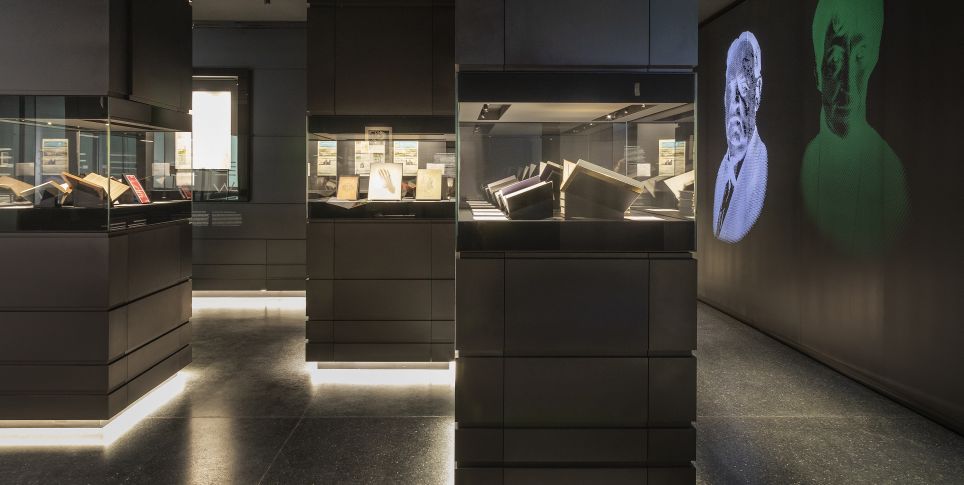
Senior Librarian Petra Figeac oversaw the exhibition “Materialised Holiness: Jewish Book Art in a Ritual Context”, curated by Annett Martini (Free University of Berlin) (19 October 2025 – 25 January 2026 at Stabi Kulturwerk). Here she answers your questions.
Could you tell us more about the State Library of Berlin’s Hebraica collection and what makes it special?
The Hebraica collection at the Berlin State Library is one of the most important in Europe, not so much because of the number of manuscripts as because of their extraordinary diversity and the great significance of the manuscripts. The exact number of manuscripts cannot be clearly determined, as there are composite manuscripts in which several individual works have been bound together, in some cases arbitrarily. Counting the individual texts brings the total to just over 1,000 items; if one counts only the individual codices, there are approximately 590 manuscripts in Hebrew script, including 22 Torah scrolls and 25 Esther scrolls, along with the fragments.
Some of the showpieces, such as the so-called Rösel Bible, were already part of the founding collection. It takes its name from a Yiddish inscription stating that a woman named Rösel presented the four-volume Bible to the Elector for his library. The first volume bears the call number Ms. or. fol. 1, making it the first in the folio series of Oriental manuscripts.
In the 19th century, the collection was significantly expanded. During this period, the leading Hebraica scholar Moritz Steinschneider (1816–1907) worked for the library as a consultant.
Two provenance groups are of particular significance for our exhibition: Erfurt and the Hamilton Collection. The ‘Erfurt Manuscript Collection’ was acquired in 1880; of the 15 manuscripts, four of the most important are on display.
The Hamilton provenance refers to the origin of nine Hebrew manuscripts from the 792-volume collection of Alexander Douglas, Duke of Hamilton (1767–1852), which the Prussian state acquired almost in its entirety in 1882. The exhibition displays three of these.
In summary, it can be said that the State Library’s Hebraica collection is a well-curated collection that makes it possible to organise an exhibition such as “Materialised Holiness” entirely without the need for loans.
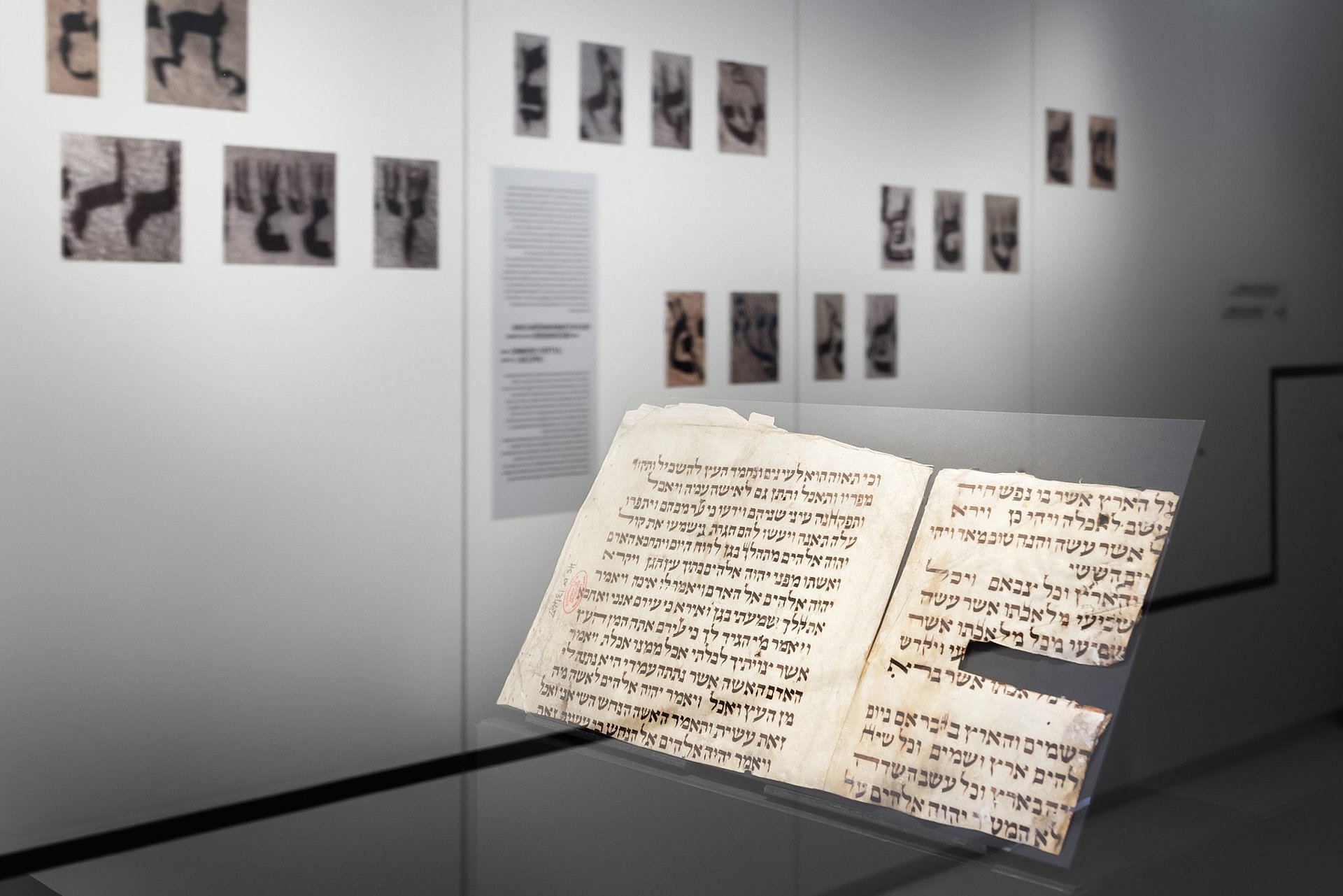
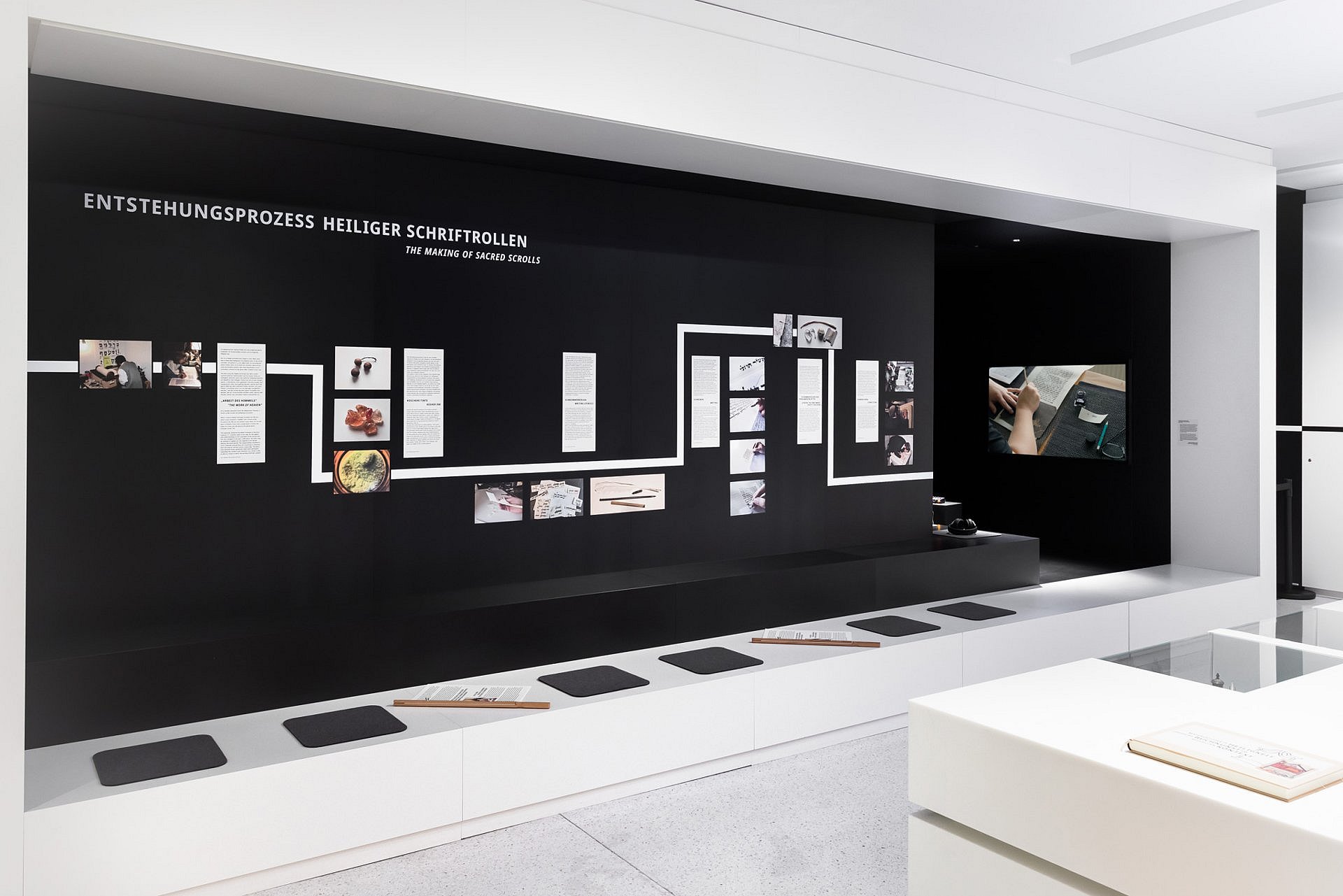
Materialised holiness – what does that actually mean? And how does holiness actually become materialised?
The title ‘Materialised Holiness’ originates from a research project successfully carried out by our curator, Annett Martini, at the Free University. The project focused on ‘Torah scrolls as a codicological, theological and sociological phenomenon of Jewish scriptural culture in the Diaspora’. The scrolls were examined not only for their content but also for their materiality – specifically, the actual writing materials and inks used. The focus also included literature on the act of writing itself and the involvement of contemporary scribes. This resulted in a film well worth watching about the world’s first female Torah scroll scribes, which is shown in the exhibition.
The sacred is reflected in the materials used; writing is a ‘work of heaven’, as per the title of a book by Martini, borrowed from the Talmud. The sacred also lies in the process of the work of writing, the production of inks and parchments for the scrolls; however, it is not only Torah and Esther scrolls that are produced in this way, but also tefillin (prayer straps) and mezuzot (scripture capsules on doorposts).
One of the outcomes of the research project was a richly illustrated book published by Deutscher Kunstverlag, which also bears the title ‘Materialised Holiness’. It explores the diverse aspects of the theme, such as the ‘magic of writing’ or the ‘materiality of writing’.
We are therefore dealing here with a triad of research project, book and exhibition. All three forms deal with the production of sacred works, whereby holiness is materialised in the objects through the precisely regulated process of production.
Research QUESTIONS
How do you actually restore paper? How do you recognise whether a painting is genuine? And how do you play Beethoven properly? With the Research QUESTIONS, we give you the opportunity to ask us your questions. In each issue of the research newsletter, a researcher from the SPK answers selected questions from the community on a specific topic.
What challenges are involved in the restoration and conservation of such ancient manuscripts? Is it actually permissible or even possible to display them?
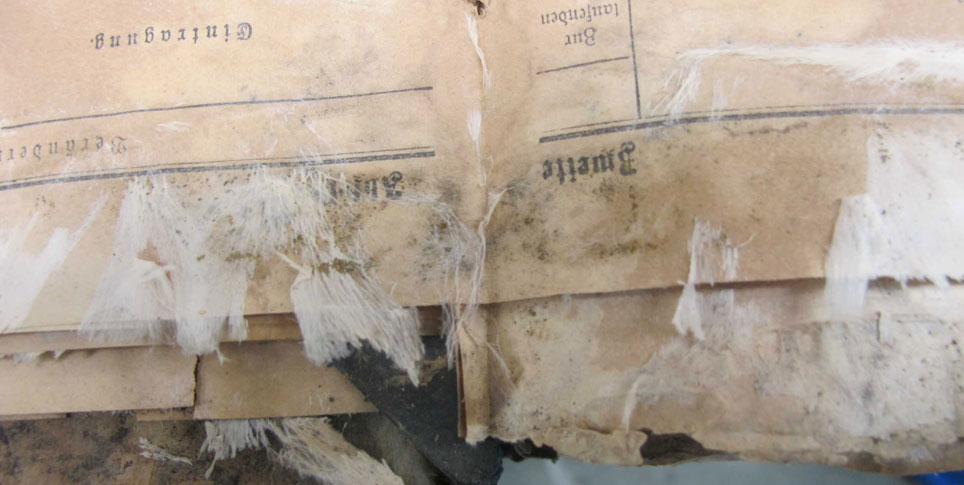
The exhibition features a restored Giant Bible from the ‘Erfurt Manuscript Collection’. The two-volume Bible is the largest known Hebrew parchment manuscript in the world. According to the colophon, the Bible was completed in 1343. Shortly after its completion, a pogrom took place in Erfurt in 1349; around 15 manuscripts survived and were handed over to the City Council. From there, they were transferred to the Ministerial Library, which sold them to the then Royal Library in 1880. During the Second World War, the Bible, each volume of which weighed 50 kg, was not evacuated. It was taken to the Reich Ministry of Economics, where it was severely damaged by a bomb hit and firefighting water:

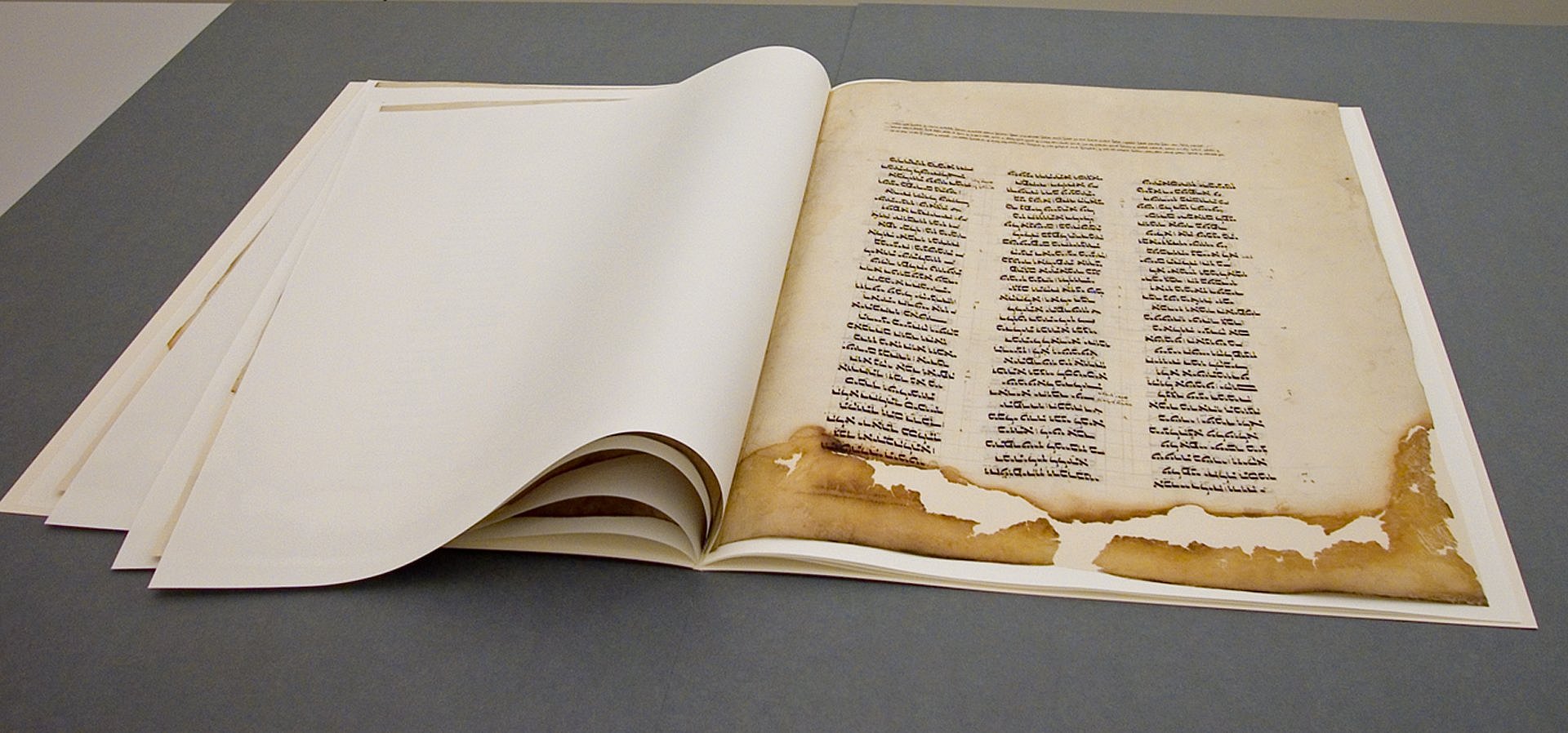
The first volume is not too badly damaged, so the decision was made to smooth it ‘in situ’, i.e. whilst it remains in the book block. This process is still ongoing.
Due to its size and weight, the restoration is an enormous challenge. Specially made tools must be used, which have to be designed and produced by the restoration department and specialist firms.
The restored manuscripts cannot simply be exhibited; indeed, they must be, as they demonstrate to the public the great achievements that can often be made behind the scenes. Naturally, for exhibitions of this kind, the conditions regarding indoor climate and presentation must meet the highest standards. We would not exhibit fragile, as yet unrestored objects; it is therefore precisely the act of restoration that makes the pieces accessible once more.
What role do exhibitions such as this play in preserving Jewish culture today?
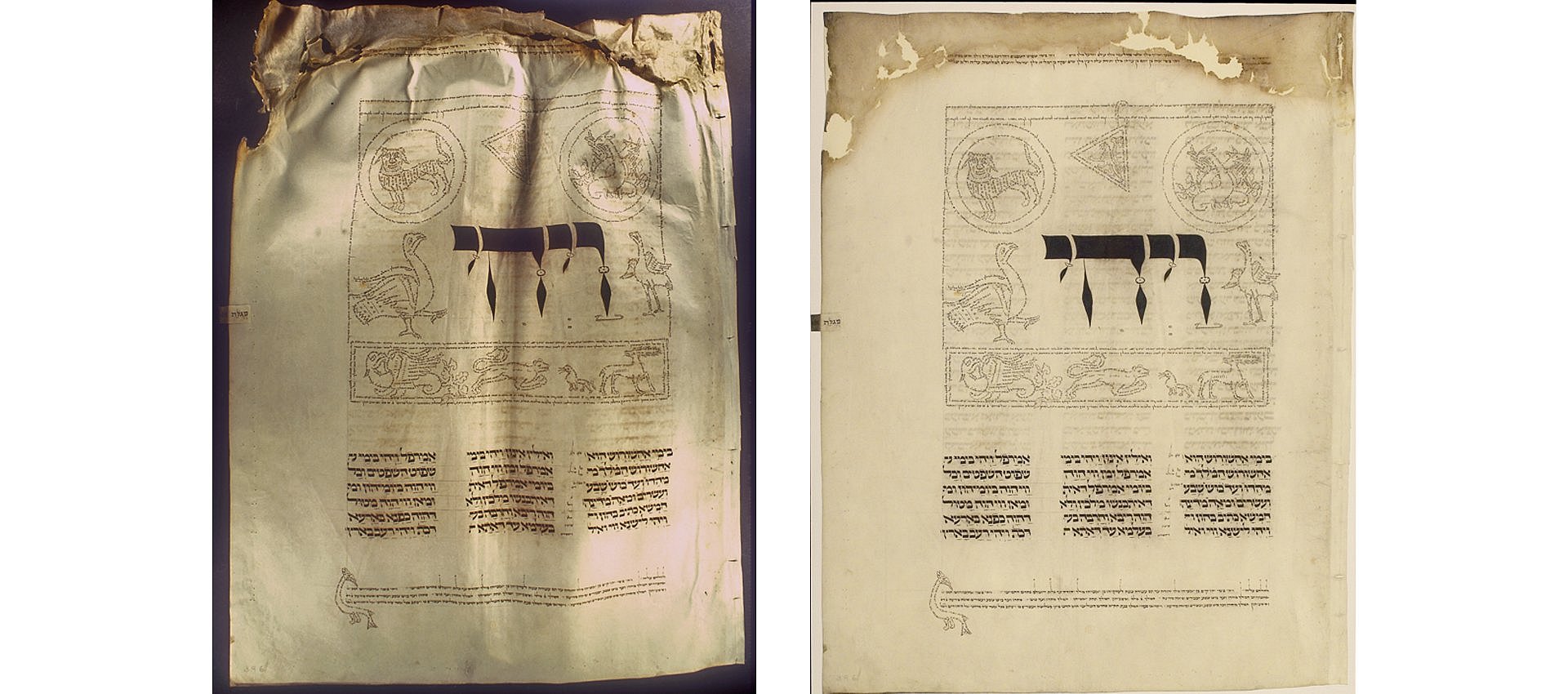
The exhibition showcases Jewish manuscripts from many well-known manuscript traditions, ranging from Yemen and the Mediterranean region, through Sephardic (Spain and southern France), to Ashkenazi (northern France, Germany and Eastern Europe). A distinctive feature of Jewish culture is that it has preserved its own tradition in all these ‘environments’, whilst also absorbing influences. The exhibition demonstrates that Judaism is an integral part of all these diverse cultural spheres, yet has set its own distinctive marks. Medieval Jewish book art, the focus of this exhibition, reveals the rich heritage of a minority that has always been part of Europe. The influence is mutual: the iconography of Western manuscripts influenced micrography (Jewish book art); conversely, Christian scholars were fascinated by the Hebrew Bible and language; Christian elements can be found in the decorations of an Italian manuscript on display; the exhibition also highlights these aspects. Jewish culture is part of Europe; the preservation and exhibition of its manuscripts reveal its roots and rich tradition.