The aim of the SPK reform is to give all the Foundation’s institutions greater freedom to shape their own direction and make decisions. Action is now being taken: since the Foundation Board adopted specific key points in December 2022, the SPK reform has been gathering momentum. Whilst 2023 was primarily focused on devising measures, 2024 is all about implementation. An overview of the key milestones:
On 5 December 2022, the Foundation Board passed a landmark resolution setting out four key pillars for the transformation of the SPK. Firstly, the Foundation is to be led in future by an Executive Board acting as a collegial body. To support the President in this reform project, the Minister of State for Culture has appointed an interim Executive Board comprising seven members. Secondly, the aim was to develop an overarching strategy as a vision for the SPK. Added to this was the aim of making the institutions, and in particular the museums and institutes of the Staatliche Museen zu Berlin, more autonomous and effective. And last but not least, the highly complex organisational structure was to be optimised.
Immediately following the Foundation Board’s decision, specific measures for change were drawn up in 2023:
- June 2023: Pilot project for recruitment at the Berlin State Library begins
To oversee the recruitment process from job advertisement to candidate selection, two staff members from the central administration are now based directly at the Berlin State Library.
- July 2023: Staff from the collections-based Education & Outreach department based directly at the
museums The Education, Outreach and Visitor Services department of the General Directorate of the Staatliche Museen zu Berlin has, to date, been responsible for both the presentation of the collections and exhibitions, as well as cross-cutting, collection-independent outreach projects. The Visitor Services department has also organised guided tours and managed ticketing. Since 1 July 2023, the staff members who were responsible for the communication of the collections and exhibitions now report directly to the museum directors and work as part of the team at the respective museum.
- July 2023: Launch of the three sub-projects
Finance, Human Resources, Reorganisation of the Staatliche Museen: these three sub-projects are the focus of the reform. A project structure was established and, with the support of external consultants, work on the sub-projects gained momentum.
- September 2023: Separate budgets approved for the museums and
institutes The budgetary funds for all museums and institutes of the Staatliche Museen zu Berlin are allocated in a chapter of the SPK budget. In future, they are to operate with their own budgets, thereby gaining greater scope for action. To this end, a total of 21 items with corresponding allocations were identified within the budget chapter, and a distribution formula was developed to allocate the budgets for the museums and institutes. On this basis, the museums and institutes have each planned their expenditure for 2024 and have been operating with independent budgets since 1 January 2024.
- October 2023: State workshop: Redesigning cooperation with thefederal
and state governments In October 2023, representatives of all the federal states and the federal government, as SPK funding bodies, met for the first time for a workshop. During this workshop, the federal states and the federal government, together with the SPK, clarified their expectations of the SPK as funding bodies and considered how the funding bodies could benefit more from the SPK and how communication could be improved.
- Autumn 2023: Organisational model for the SMB drafted
Between July and December, the broad outlines of the future organisational model for the SMB were drafted. The key innovation is the establishment of five museum teams, which will support the museums and institutes as interdisciplinary units providing on-site services. This brings a large proportion of specialist services closer to the museums and institutes, giving them direct control.
- December 2023: Core elements of the strategy defined
The SPK 2030 vision is set: “We connect people, times and spaces. We bring diversity to life, contribute our expertise to social debates and shape the future in partnership” – this formulates the aspiration by which the Foundation intends to guide itself and its work in the coming years.
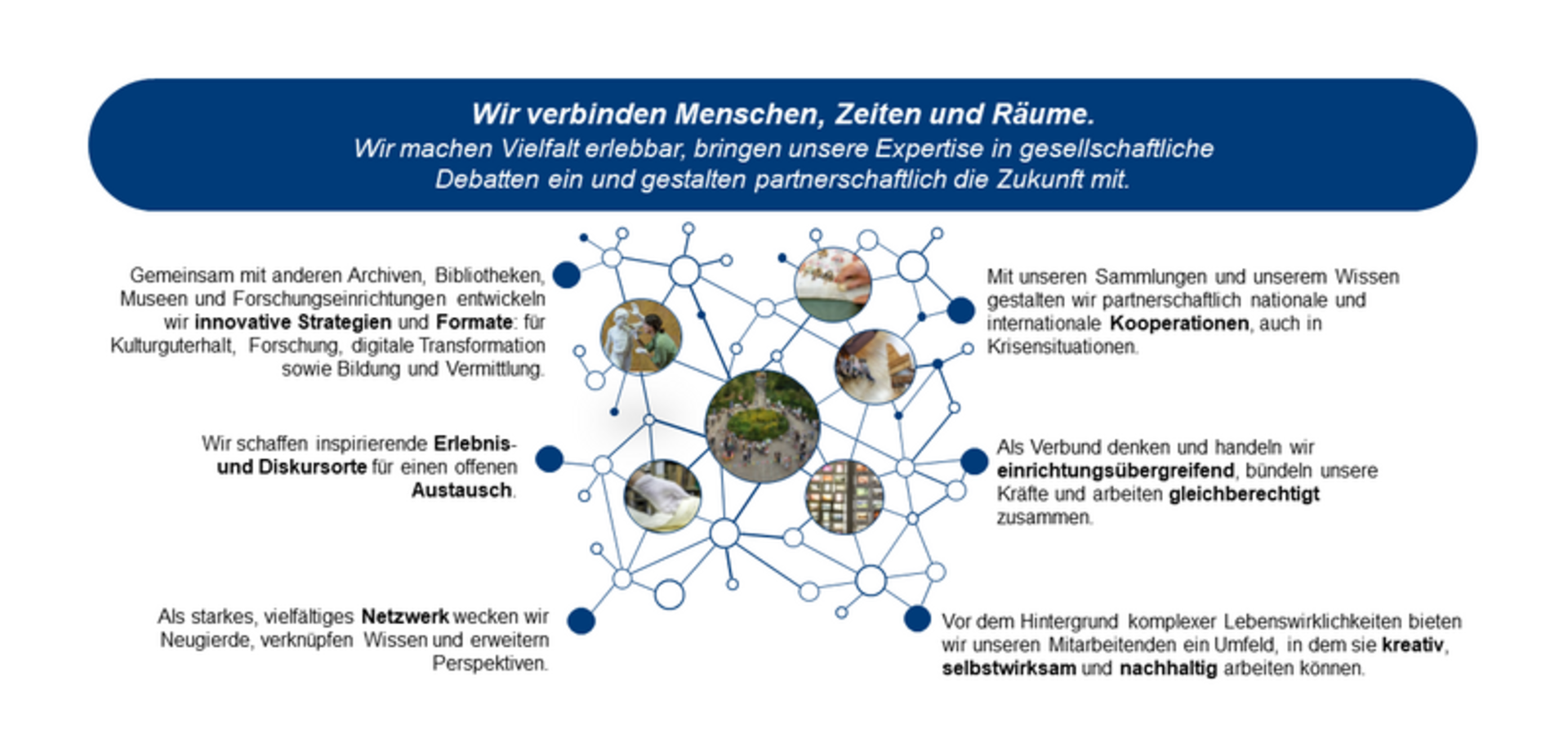
The “SPK 2030” vision sets out how the SPK network aims to develop over the coming years: an organisation that connects people, times and places. The aim is to bring the network’s diverse collections and holdings to life for the public, to contribute its expertise to social debates in ways that can be seen and heard, and to help shape the future through partnerships within networks and collaborations. SPK graphic
In 2024, the main focus will be on implementing the new concepts within the respective sub-projects:
Finance sub-project: Supporting the introduction and management of budgets
within the State Museums Following the establishment of technical budgets at the end of 2023, the coordination of budget planning at management level and the introduction of budget management tools, the focus at the start of 2024 was on reviewing the processes and identifying areas requiring adjustment. It was also necessary to define the target processes for budget management.
The establishment of separate budgets for the museums and institutes marked an important milestone in the Finance sub-project. Another key area of focus is optimising financial management. This involves optimising the reporting system for income and expenditure, establishing key performance indicators, and creating the technical framework for financial management.
In the summer of 2024, the focus returned to the museums’ own budgets: what went well during the budget implementation, and where is further action still needed? What lessons can be learned from this for budget planning and for 2025? Finally, in autumn 2024, the 2025 budget had to be drawn up and the budgets technically mapped out.
Furthermore, the reporting system must be consolidated and embedded within the organisation.Sub-project: Reorganisation of the State Museums: Gradual implementation of the new organisational model
The new organisational model of the State Museums of Berlin provides for certain tasks, which were previously carried out by the General Directorate, to be organised in future by museum teams at the respective sites. The first step was to plan the museum teams in more concrete terms. In a series of workshops held in spring 2024, representatives from the museums and institutes at each site worked out which functions were particularly important and necessary within their museum teams.
The establishment of the museum teams particularly affects the staff who will be working in new teams in future. Through an expression of interest process, staff were able to indicate which role profile within one of the museum teams matched their skills and interests. Based on these results, a staffing plan was drawn up for the respective museum teams. Staff were informed about the process and presented with prospects through numerous information sessions and personal discussions.HR sub-project: Defining roles and process
tools In the HR department, the aim is to strengthen the institutions’ decision-making autonomy whilst making HR operations more efficient. To this end, the HR department’s remit was reviewed in 2024. Individual measures, such as end-to-end process responsibility and comprehensive management consultancy from a single source, were agreed upon. Preparations for the implementation of these measures are currently underway.
Furthermore, in 2024, work began on further optimising and expanding the tools used in HR work, particularly through new opportunities offered by digital tools.