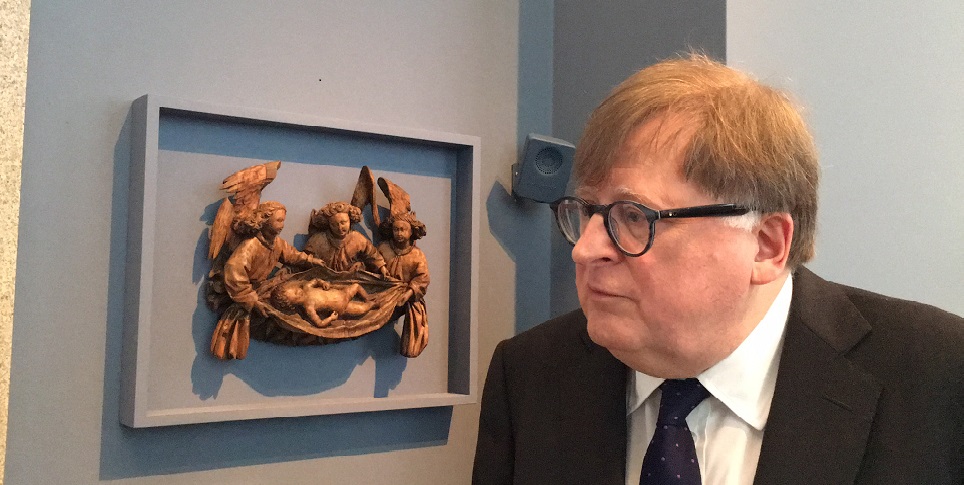
Julien Chapuis, Head of the Sculpture Collection, presents: “Three Angels with the Christ Child”
The 15th-century group of angels, carved from lime wood and now housed in the Bode Museum of the Staatliche Museen zu Berlin, originates from the art collection of Ernst and Agathe Saulmann, which was confiscated by the Nazis in 1936. In 2017, it was returned to the Saulmanns’ heirs and subsequently reacquired. The small relief was probably created between 1430 and 1440 in the circle of the Ulm artist Hans Multscher. In particular, the French style of the work, with its distinctive depictions of faces and drapery, points to such an origin. Multscher, a painter and sculptor born in Reichenhofen around 1400, who probably trained at the French court around 1420, is regarded as a key figure in the transfer of the then-fashionable Parisian style into German art. And so this relief also clearly contains elements of the Parisian style: the elaborate curls, for example, or the childlike features of the angels were unusual for local sacred sculptures in the first half of the 15th century. It is likely that the relief served as an aid to meditation and the worship of God.
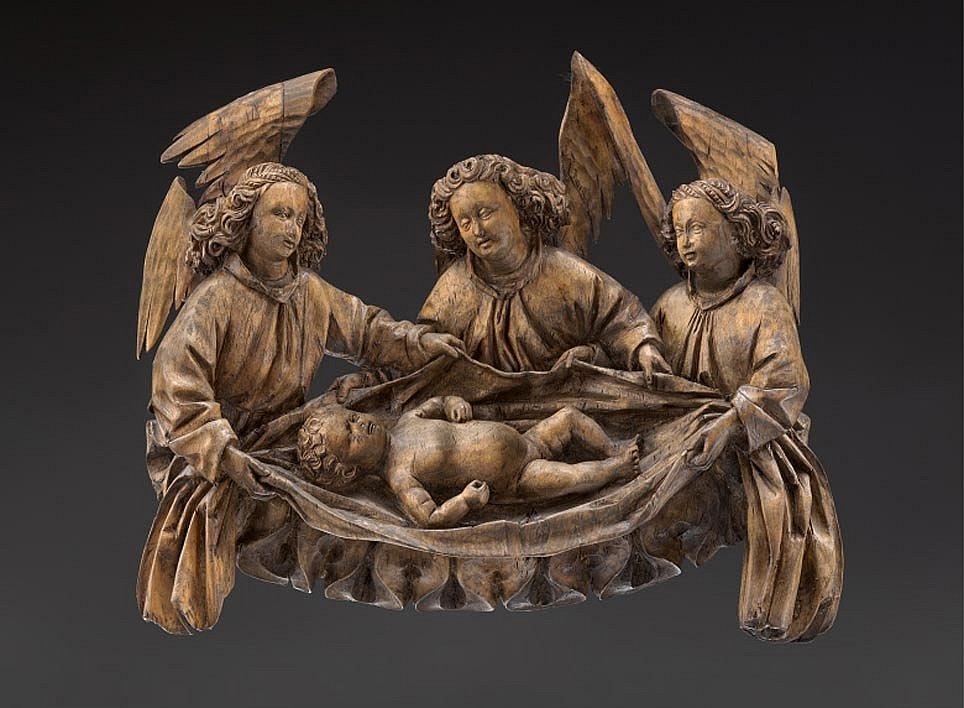
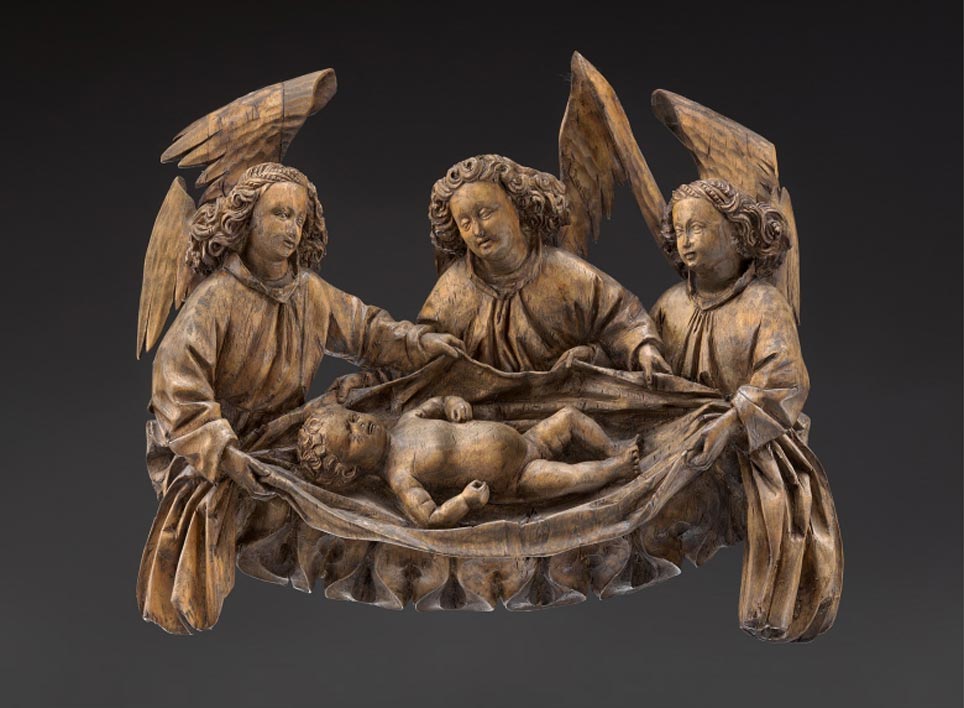
Three Angels with the Christ Child © SMB, Sculpture Collection and Museum of Byzantine Art/A. Voigt
The relief was originally painted. The angels’ wings were probably rendered in bright colours, whilst the suggested clouds beneath the Christ Child’s cloth were painted in blue and white. In its former colour scheme, the relief must have made a profound impression on the viewer.
The arrangement of the wings in a suggested arch at the upper edge of the relief roughly follows the same curve as the cloth and the depictions of clouds beneath it. The latter situate the scene, with its legless angels, in a heavenly sphere. This is a recurring motif in medieval sculpture.
The very youthful-looking angels, who seem to be literally floating in the air, gently lift the cloth bearing the naked Christ Child. In this way, the viewer is given a clear view of the Child. Four of the six hands reach for the back of the cloth, whilst only two hands grasp the folded fabric at the front. This artistic device draws the observer into the scene.
In brief: The medieval group of angels with the Christ Child from the Bode Museum
Julien Chapuis, Head of the Sculpture Collection, presents “Three Angels with the Christ Child”. The sculpture comes from the art collection of Ernst and Agathe Saulmann, which was confiscated by the Nazis in 1936. In 2017, it was returned to the Saulmanns’ heirs and subsequently reacquired.