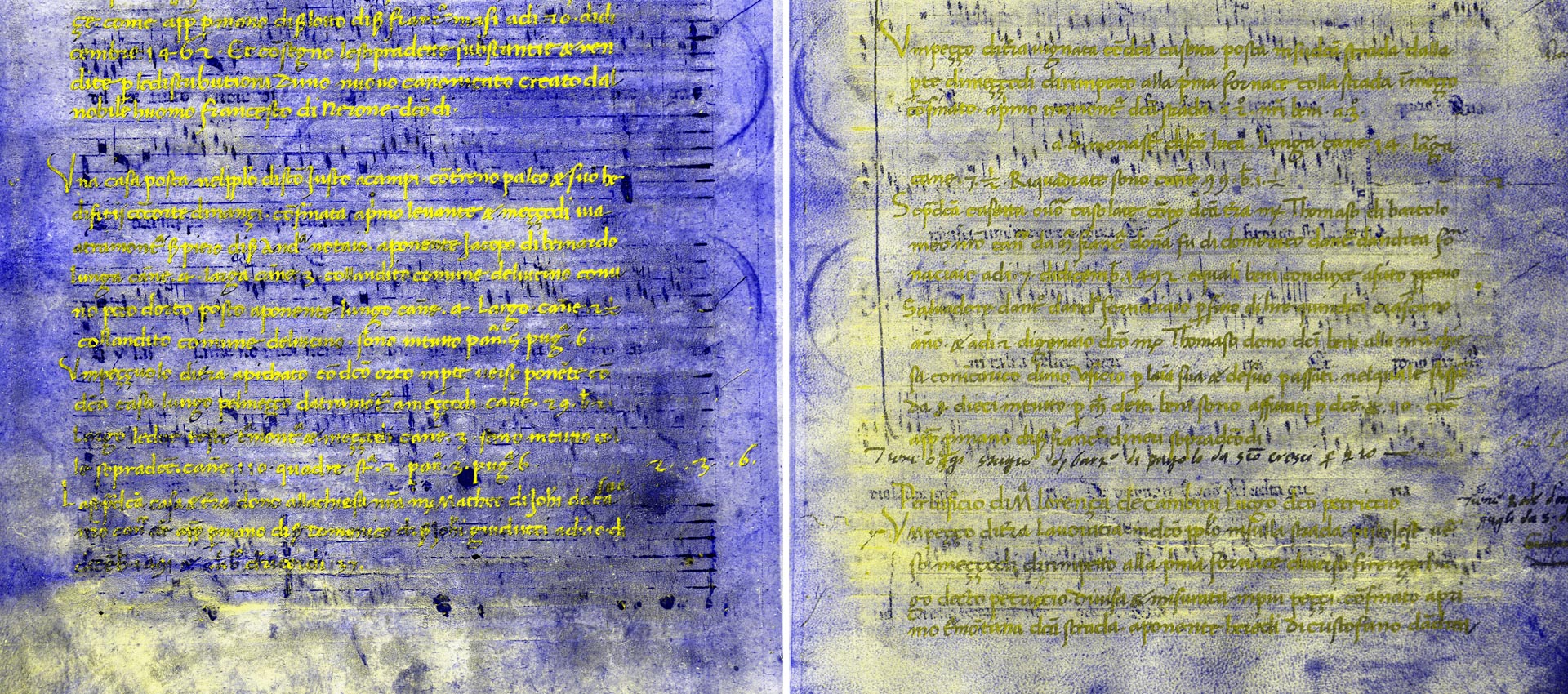
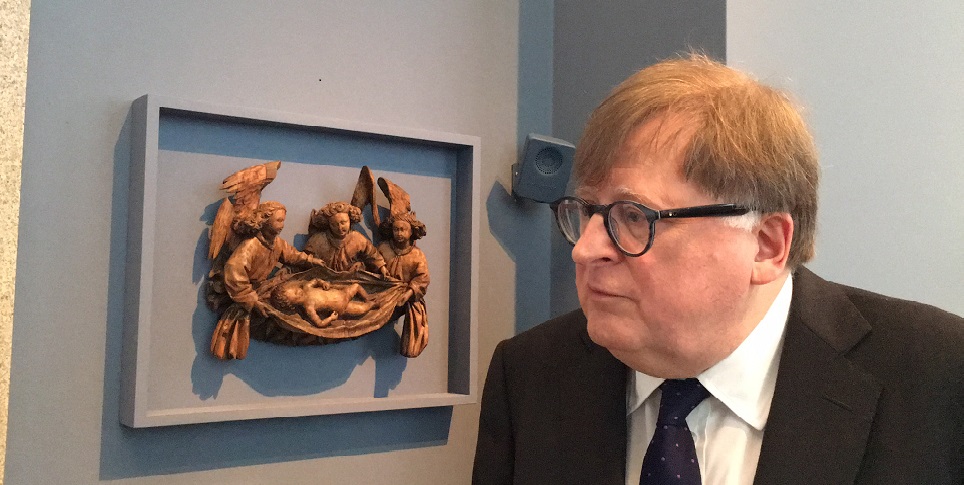
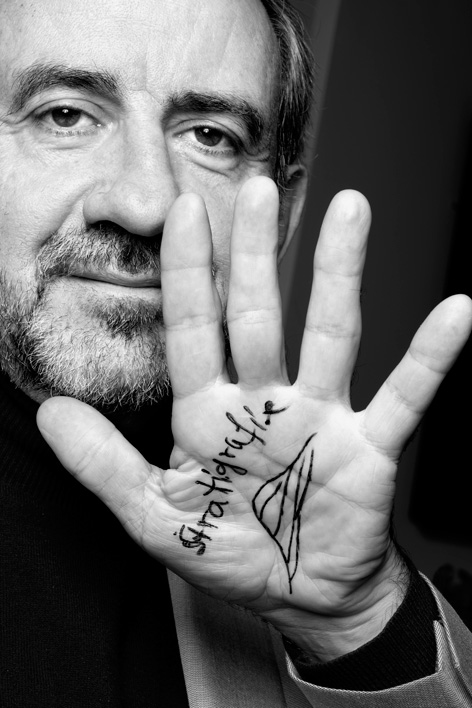
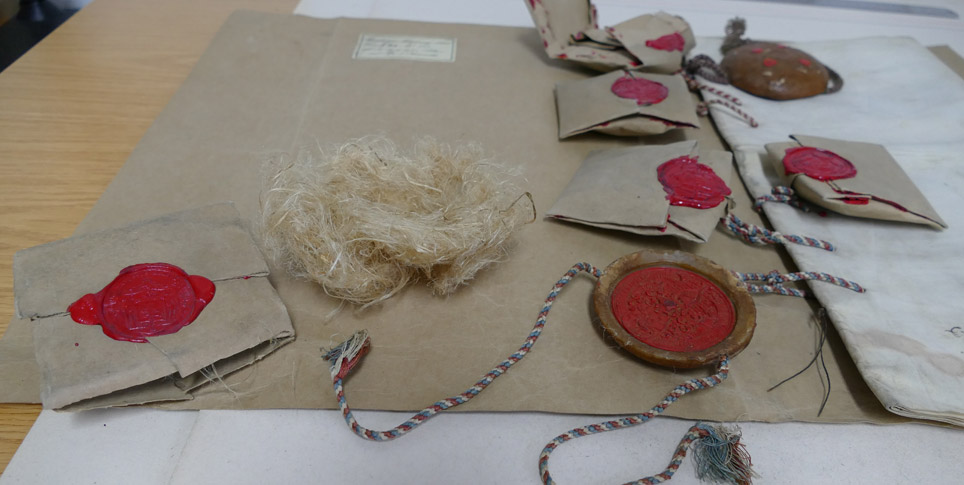
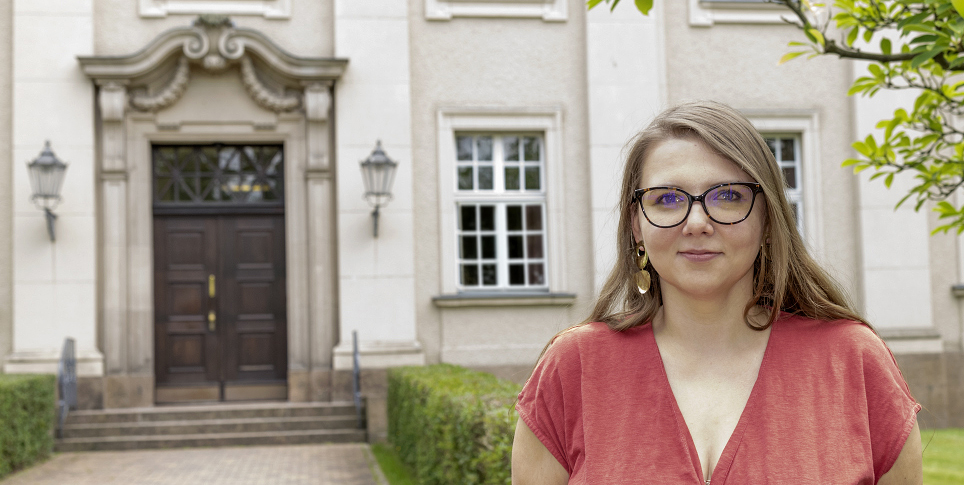
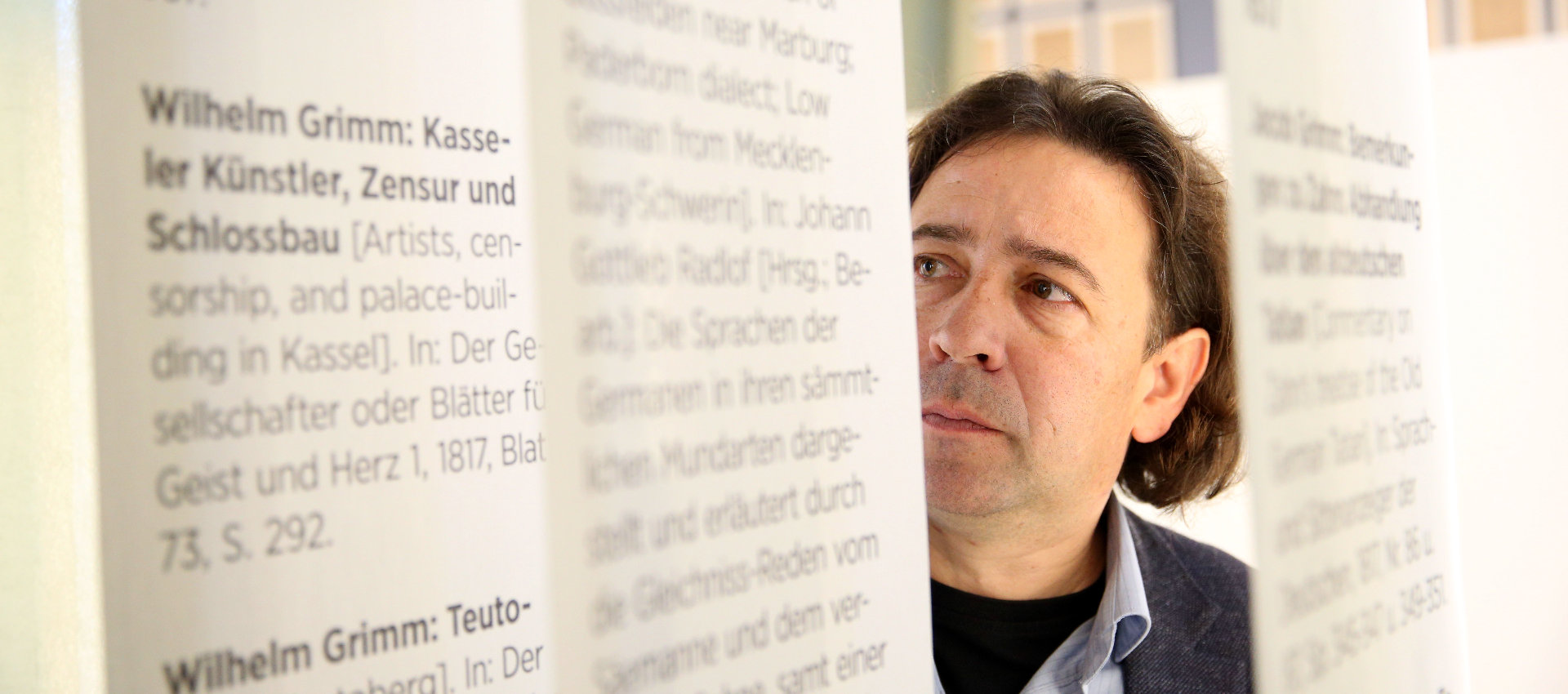
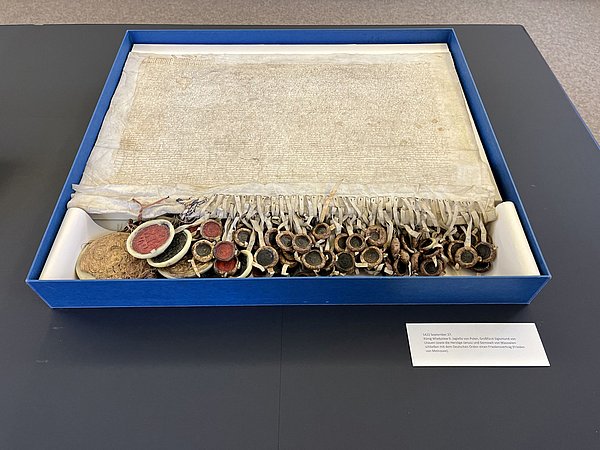
The SPK is returning 73 medieval documents relating to the Teutonic Order to Poland. Johannes Götz from the GStA is an expert on the Teutonic Order and explains in an interview why the documents are still relevant today – and why they belong in Poland.
The SPK is returning 73 medieval documents relating to the Teutonic Order from the GStA’s collection to Poland. What exactly was the Teutonic Order, and what significance did it hold?
Johannes Götz: The Teutonic Order still exists today, which is why we must refer to it in the present tense. However, compared to its historical significance, it is no longer politically relevant today. The Teutonic Order is a spiritual order of knights from the High and Late Middle Ages – a Christian community that lives according to the three classical vows and is simultaneously committed to the defence of Christianity. Essentially, it is comparable to the Knights Templar, who are somewhat better known to the general public. The Order of the Knights Templar is something like the ‘big brother’ of the Teutonic Order. Both were founded in the Holy Land during the Crusades. The Teutonic Order was very active in Central and Eastern Europe along the Baltic coast and is a very important player in German-Polish relations.
Does the return of 73 documents like this leave a gap in the GStA’s holdings? Or is there so much material there that this gap can be made up for?
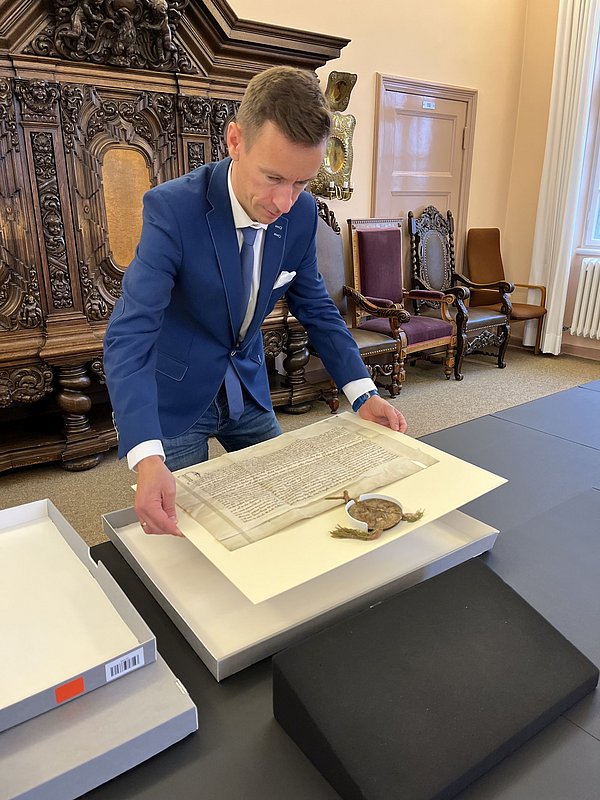
Johannes Götz: From a purely quantitative perspective, this is of course not a gap in our holdings, as in relation to the total holdings of the Secret State Archives, we are talking about a fraction of a per mille. The situation is different when one considers the quality and content of the documents – they are very significant items. But nobody likes to adorn themselves with stolen goods, however valuable they may be. The documents have significant historical value, but they do not belong in our archive and should be returned to where they belong.
You mentioned that these are significant documents. What exactly do they contain?
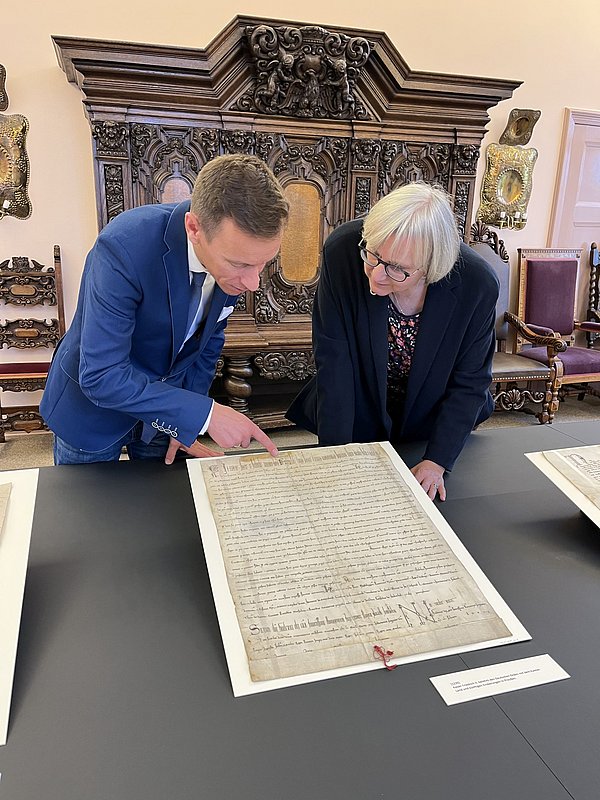
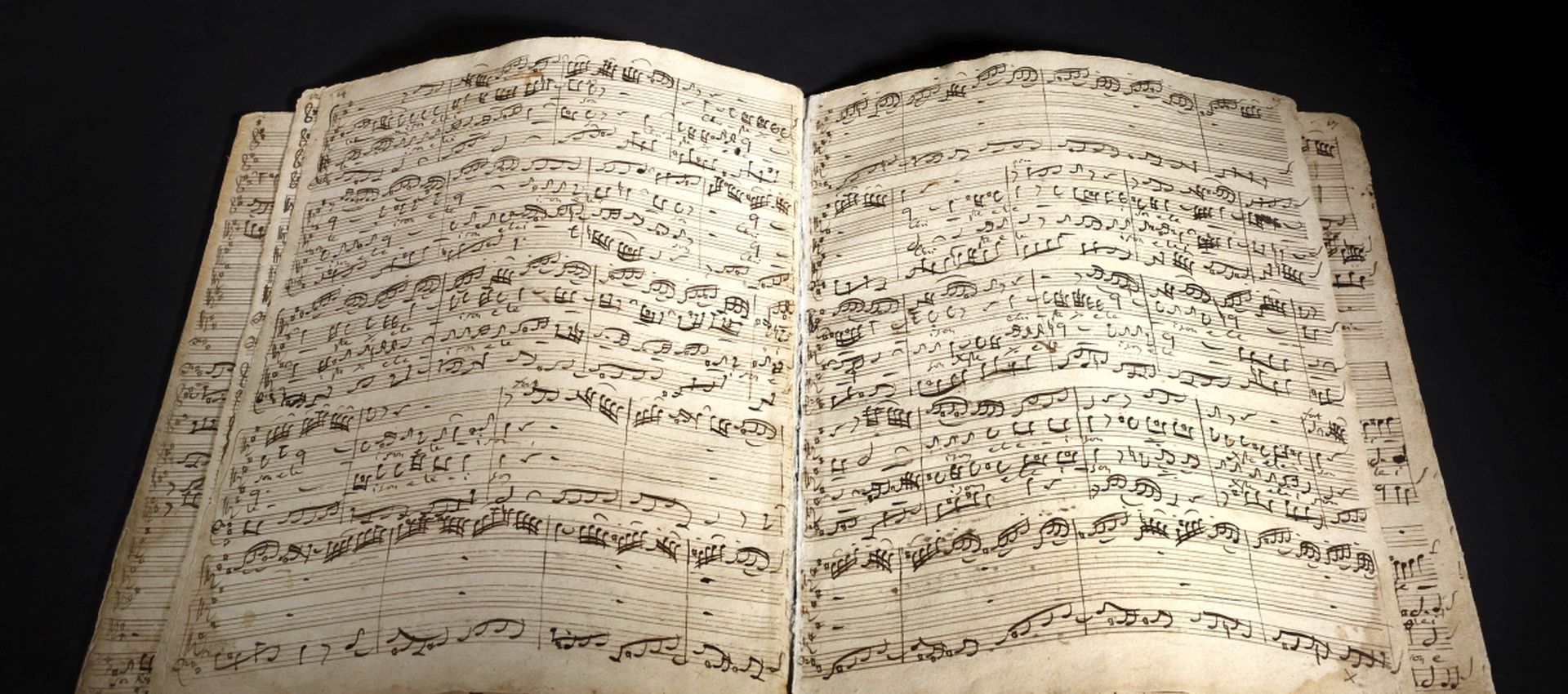
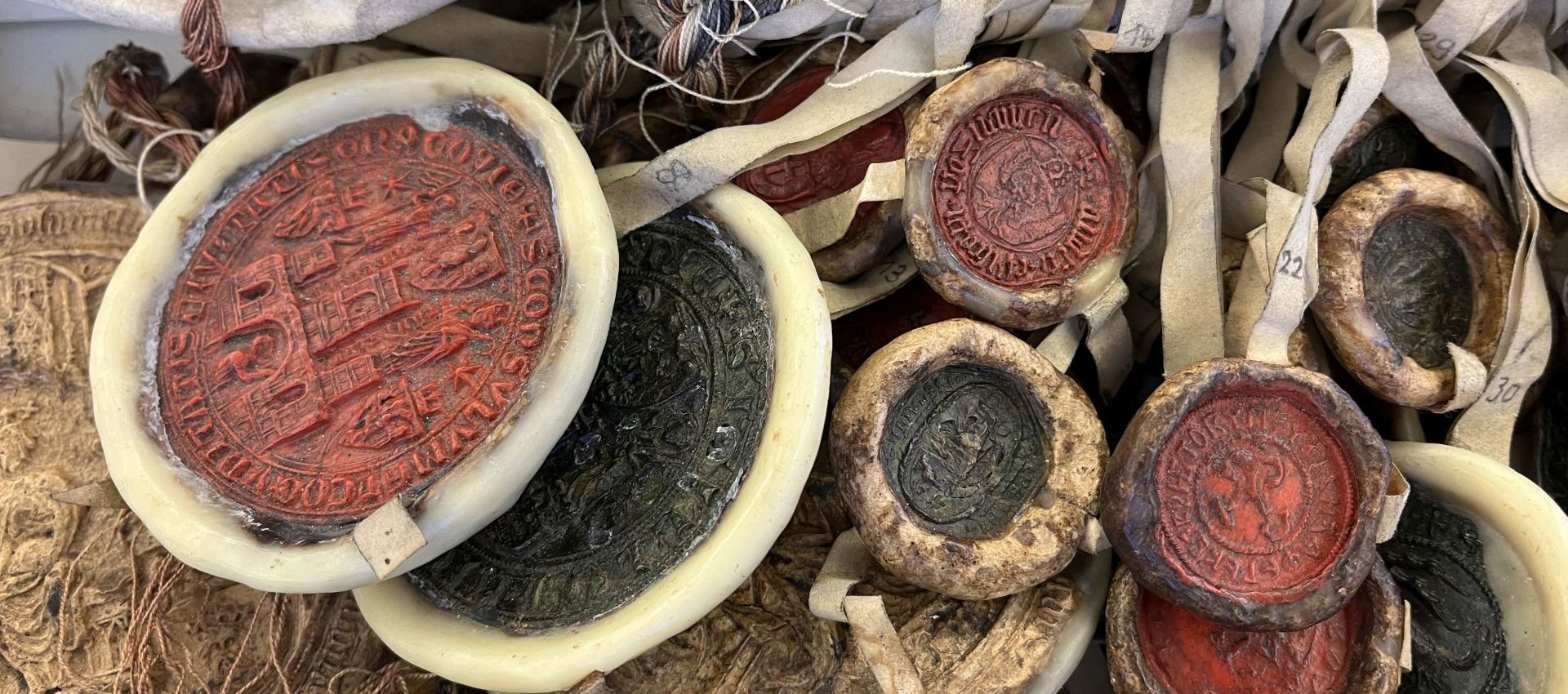
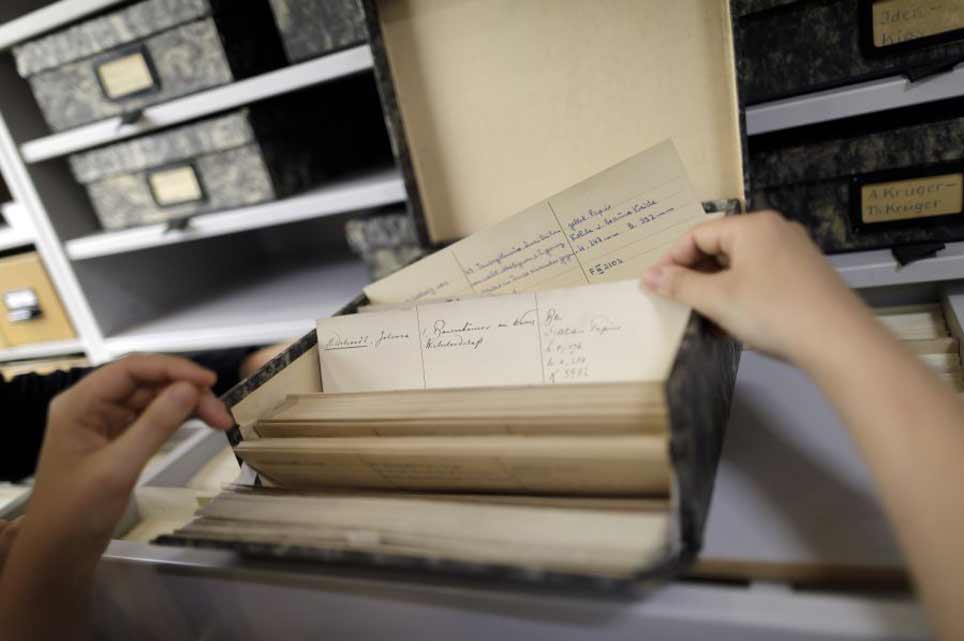
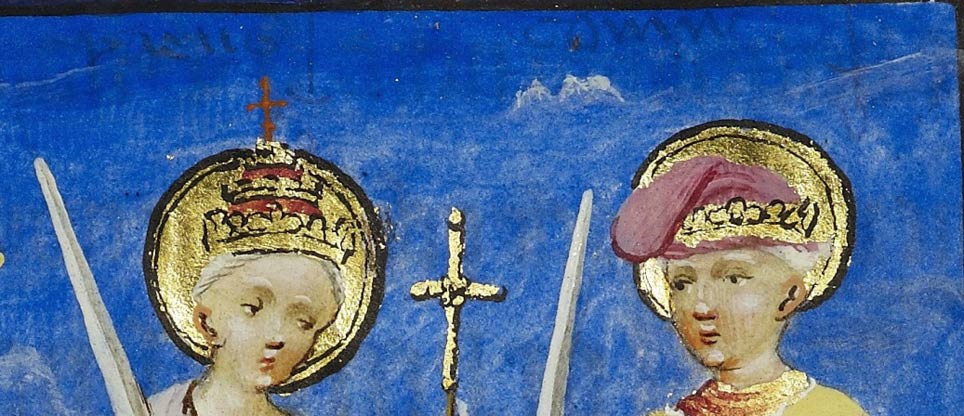
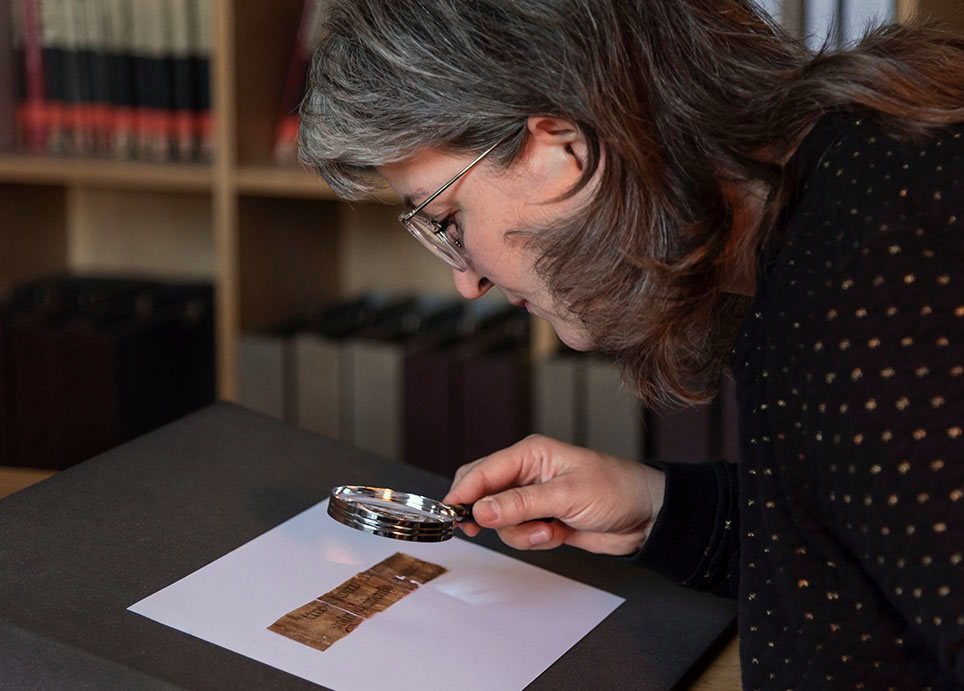
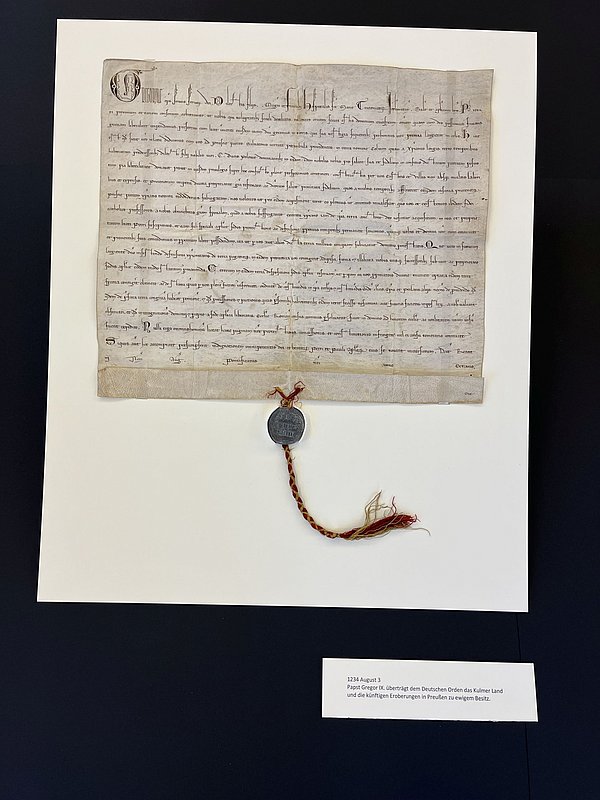
Johannes Götz: They are mainly legal documents relating to the rule of the Teutonic Order in Prussia. The Middle Ages operated within a legal framework that seems alien to us today, but one always needed legitimation for acts of governance, and this was obtained from the supreme authorities: the Pope and the Emperor. Such privileges granted by popes and emperors are found in these documents. They enabled the Teutonic Order to establish its rule in Prussia. In addition, there are numerous documents concerning the Order’s relations with the Kingdom of Poland: ceasefires, peace treaties, and diplomatic disputes.
"They are very valuable items. But nobody likes to adorn themselves with stolen goods, no matter how valuable they are"
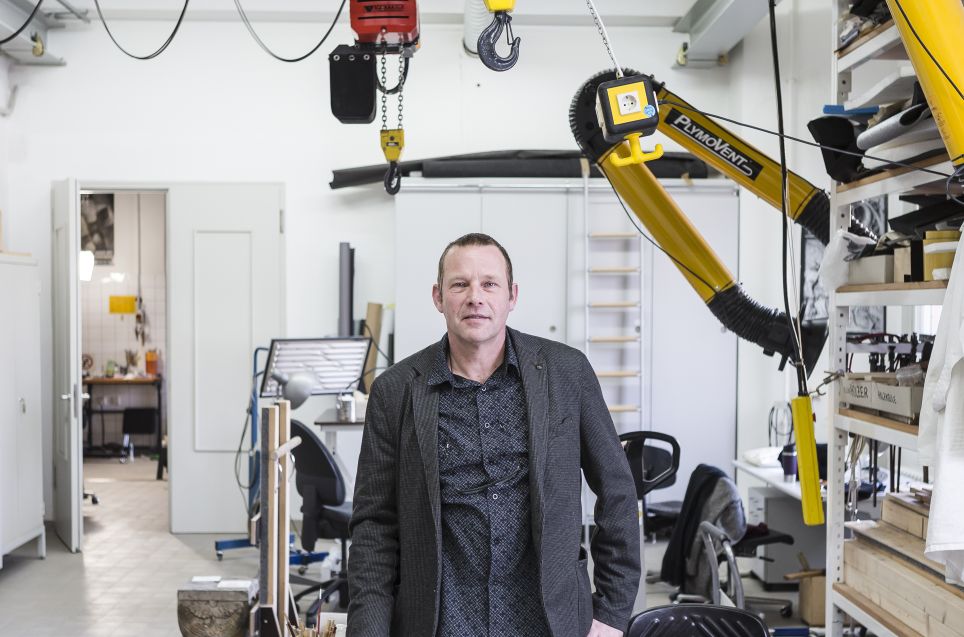
Johannes Götz
How did these documents find their way from Poland to Berlin, and how was their provenance established?
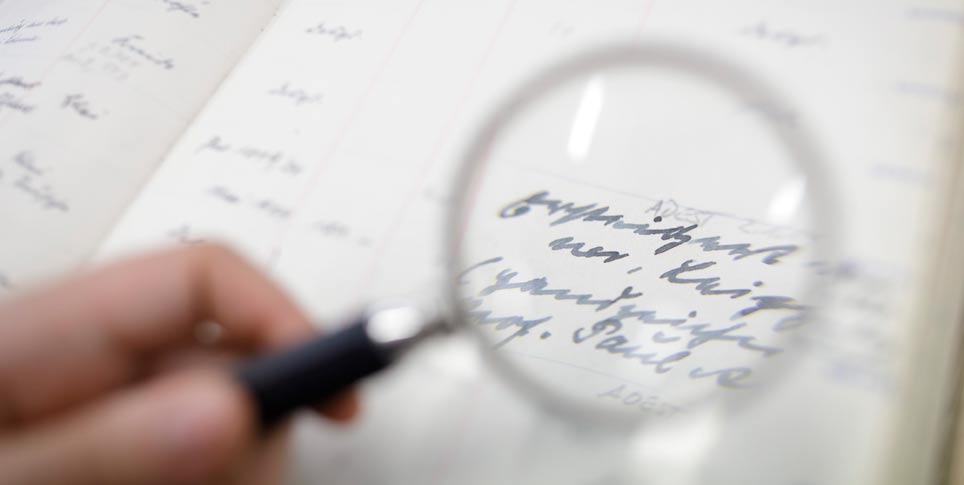
Johannes Götz: The provenance was always clear: the documents were handed over to the Polish Crown in the course of the secularisation of Prussia in 1525. The first Prussian Duke, Albrecht of Brandenburg, handed them over to his new feudal lord, the Polish King – a perfectly normal legal act for the time. The documents were then stored in Poland until 1941, most recently in Warsaw. During the German occupation, German archivists removed the documents and took them to Königsberg. Via various evacuation routes, they later reached the territory of what is now the Federal Republic of Germany and eventually Berlin.
Why are they only being returned now, when it was known that they had been moved due to the war?
Johannes Götz: It was always known that the documents had been taken, but during the Cold War and the era of the ‘Iron Curtain’, returning them was not on the agenda. Following the collapse of the Soviet Union, talks took place for the first time in the 1990s between Germany and Poland concerning the repatriation of such war-related displaced property in both Germany and Poland. However, for various reasons, politicians were never able to reach an agreement regarding the documents – until now. And we at the GStA are, of course, bound by instructions and can only return anything once a corresponding political decision has been made.
I have read that the GStA has done a great deal of work with these documents. What happens next? Are there prospects for cooperation between Germany and Poland in research on the Teutonic Order?
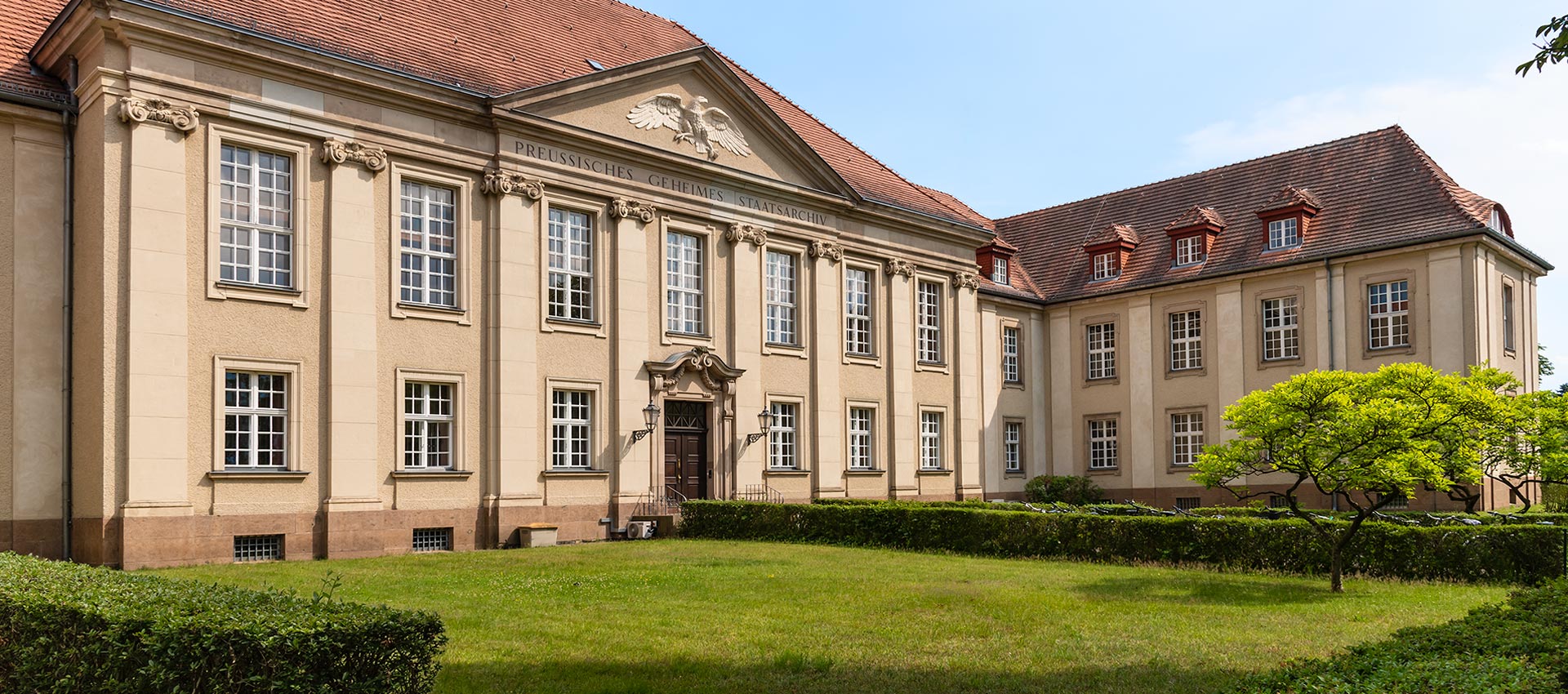
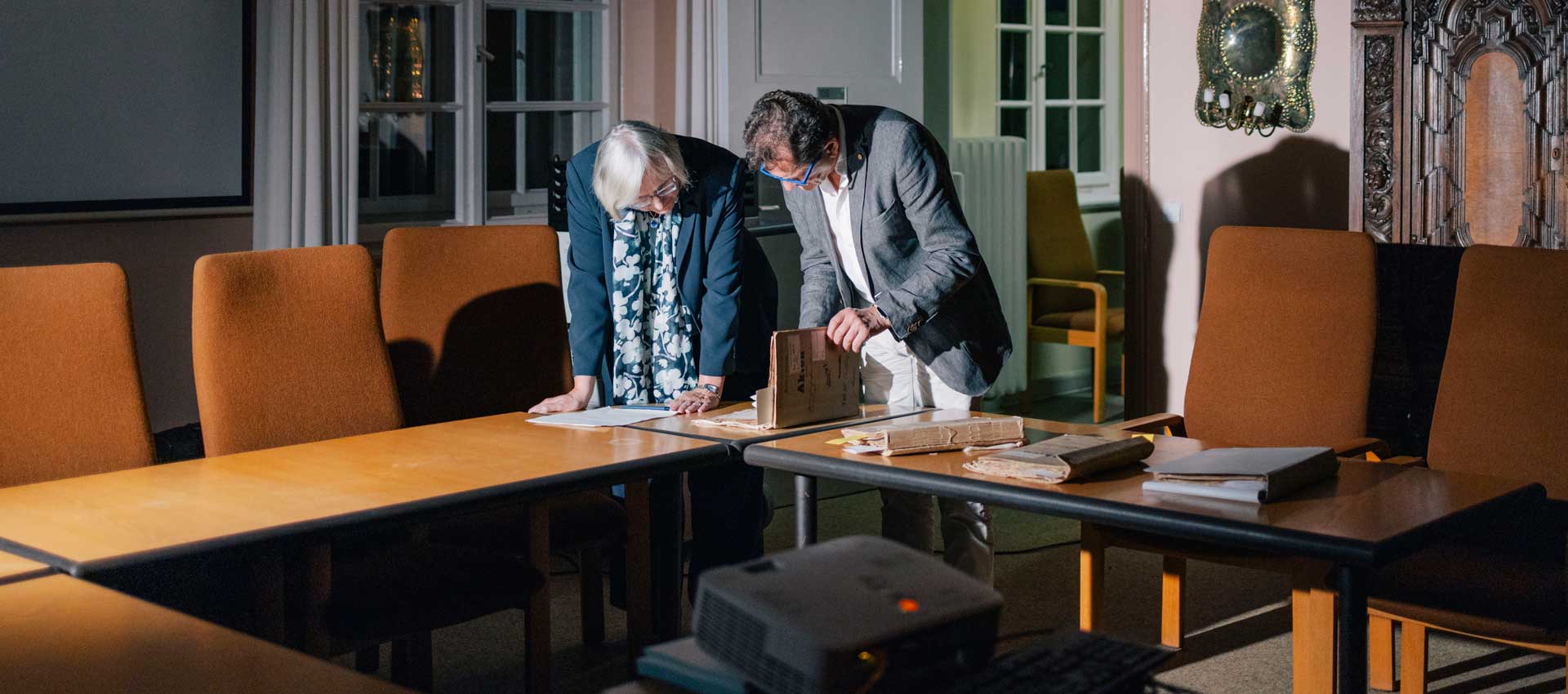
Johannes Götz: The documents are now being transferred to the Main Archive of Old Records in Warsaw. We have been engaged in professional exchange with our Polish colleagues for years, and I look forward to meeting them in person at the handover of the documents on Monday at the GStA. I am very optimistic that our cooperation will continue to deepen. The documents are frequently requested because they are so important, and in future we will simply refer enquiries to Warsaw. But that shouldn’t be a problem, as Polish historians have always been a very large user group of our archive. Not least because we hold the records of the Teutonic Order from the Königsberg State Archive here – a key collection for research.
"The Teutonic Order is an excellent subject for study because it was active not only in Prussia but throughout Europe"
Johannes Götz
The Teutonic Order was active at a time when today’s nation states had not yet even been defined. Is that one reason why the subject remains so interesting today – because it is supranational and European?
Johannes Götz: Absolutely. When you hear the name ‘Teutonic Order’, you initially think of something national, but that is not the case at all. Every year, there are major conferences in various formats where the Teutonic Order is a key focus, and scholars come from all over Europe. Poles and Germans are often in the majority, but there are researchers from many countries. In the public perception, however, the Order has receded somewhat into the background in Germany – unlike in Poland, where it forms part of the cultural memory, precisely because of its significance for German-Polish relations. In any case, the Teutonic Order is an excellent subject for study because it was active not only in Prussia but throughout Europe.
You’re conducting your own research into the Teutonic Order – are you a bit sad that the documents are leaving now?
Johannes Götz: I must admit, until a week ago I wasn’t feeling wistful at all. But when I counted and checked all the documents once more, I did feel a little sentimental. Nevertheless: the documents belong in Warsaw, and we are really glad that we can finally hand them over, because they are not our property. In terms of content, most of the documents have already been well researched and published in book form. Of course, the originals can still provide answers to specific questions. I will definitely make a trip to Warsaw at some point to have another look at them there.