How do we deal with Germany’s colonial past? Hermann Parzinger and Ruprecht Polenz seek solutions for culture and politics
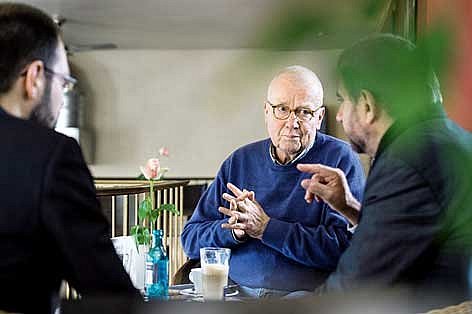
Hermann Parzinger, President of the Prussian Cultural Heritage Foundation, and Ruprecht Polenz, the German government’s representative in the reconciliation process between Germany and Namibia, explore in a joint interview whether and how the Humboldt Forum can contribute to the process of reconciliation with the successor states of the former German colonial territories.
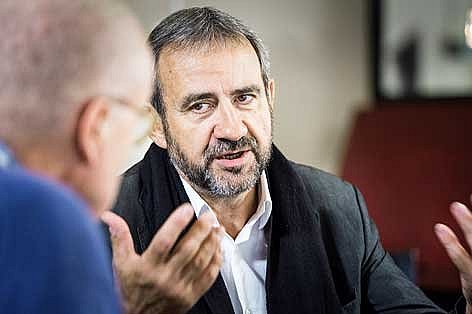
Mr Polenz, you are coordinating the reconciliation process between Germany and Namibia on the German side. When will the negotiations be concluded?
Ruprecht Polenz: Our initial aim was to conclude the negotiations before the end of this parliamentary term. I cannot say at present whether we will succeed. It has become clear that the Namibian side needs more time. There are expectations there regarding material compensation that are far too high.
Will Germany officially recognise the genocide against the Herero at the end of this process?
Polenz: We are discussing several points in our talks. These include a resolution text to be adopted by both parliaments. This will describe the events of 1904, 1906 and 1908 in clear terms. And the term ‘genocide’ will certainly be included.
Mr Parzinger, for the non-European collections in your institution, the reappraisal of Germany’s colonial past has far-reaching consequences. Are there any items in the collections of the Staatliche Museen zu Berlin that originate from German colonial wars?
Hermann Parzinger: The Berlin Ethnological Museum, which is one of the largest in the world, holds only a relatively small number of objects from colonial wars. There are, for instance, comparatively few objects from Namibia; significantly more, however, come from other German colonies, namely Cameroon or the Pacific region. By contrast, a large part of the collections, such as those from the Americas or North Asia, are not linked to German colonial history. Be that as it may, provenance research is very important to us. We have one of the richest collections, even by international standards, and do not want any objects that have been stolen or taken by force. That is why we have launched a major research project into the origins of our holdings from Tanzania. In doing so, we will also be collaborating with historians and other experts from Tanzania to jointly come to terms with the difficult colonial history. At the Humboldt Forum, both perspectives must be given the space they deserve.
What about human remains and skeletal remains?
Parzinger: A few years ago, we took over a large collection of skulls from the Charité. The more than 5,000 skulls were not in a good state of preservation. We therefore carried out conservation work on them in collaboration with the Charité and have now begun researching their provenance. Once their origin has been clarified and rightful recipients have been found, we must discuss repatriation.
Polenz: The repatriation of human remains also plays an important role in discussions with Namibia. We are trying to help the Namibian side find out where such collections still exist in Germany today. This will probably not be conclusively clarified. In Namibia, the question of what will ultimately happen to the remains there is also still open. The remains are to remain visible to the public. But suitable ways of achieving this are still being sought.
Parzinger: The human remains from Namibia are clearly linked to a colonial crime. The situation is different in the Pacific region. There, village cemeteries were apparently also plundered, as it was known that the skulls would find buyers throughout Europe. This too must be investigated.
Why is Germany actually only now taking responsibility for its colonial past?
Polenz: In Namibia, there are certainly political reasons for this. A genuine opportunity to address the issue only arose after the country gained independence in 1990. Perhaps the delay is also linked to the fact that Germany committed so many crimes in the first half of the 20th century that, after 1945, the focus was initially on the most recent past.
Namibia is one thing, but why are there no comparable steps towards reconciliation with regard to Tanzania and the Maji Maji War?
Polenz: I think that in the political consciousness of Germans, the Herero uprising has played a greater role than the Maji-Maji War.
Parzinger: Yes, the crimes against the Herero and Nama have already become part of our historical consciousness; however, this is not yet the case with regard to the atrocities of the Maji Maji War. Museums, however, can do a great deal to educate the public about this. This applies particularly to the Humboldt Forum, which, whilst not intended to be a colonial museum, will nevertheless make the colonial past an important theme. If we want a dialogue between cultures, we must also have the courage to address difficult topics.
Polenz: In the negotiations with Namibia, we are proposing a Namibian Foundation for the Future. Among other things, its task will be to foster a shared culture of remembrance. This is not just about joint research projects. It is also about how events are portrayed in school textbooks and how the past can be commemorated in public spaces.
An interesting point. When will the Herero memorial be erected in Berlin?
Polenz: That could be the result of such a foundation’s work. So far, it hasn’t been a demand in the talks. But we could always come up with the idea ourselves. I think there’s definitely room for improvement there.
Without an awareness of history, we are lost in our globalised world
Parzinger: There will also be plenty of scope within the context of the Humboldt Forum to explore a new culture of remembrance.
Colonialism, as you mentioned earlier, Mr Parzinger, plays a central role in the emergence of numerous museums in Europe. Ethnological collections in particular were once born out of the idea of collecting, exhibiting and classifying the world according to value. Will this general colonial context of museums be addressed at the Humboldt Forum?
Parzinger: Of course, we must show how the collections came about and place them within the history of the museums’ origins. There will be an area in the Humboldt Forum where we will explore the history of museums. Berlin, in particular, has been a significant centre of collecting in the past. The 19th century was characterised by systematic, encyclopaedic collecting, not just of objects. Every expedition that left Berlin at that time was sent off with a phonograph recording device. Languages, songs and music of peoples—some of whom no longer exist today—were recorded on wax cylinders. We have now largely digitised these recordings, and at the Humboldt Forum, visitors will not only be able to see the world, but also hear it.
Does this present an opportunity to break new ground worldwide in the presentation of objects?
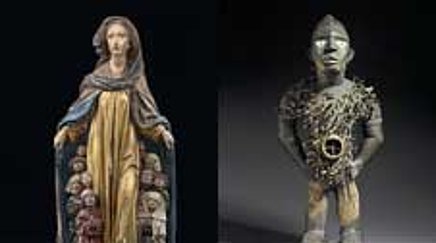
Parzinger: The Humboldt Forum will be a dynamic museum; the exhibitions must be able to change. In doing so, we will also work closely with the countries of origin. Furthermore, the non-European collections at the Humboldt Forum are to be brought together with those of other museums. We no longer wish to view the objects in isolation. We will already be putting this into practice on Museum Island. At the Bode Museum, for example, we will be staging an exhibition next year in which African and Christian sculptures are brought into dialogue with one another. For us, therefore, the Humboldt Forum begins as early as 2017.
Hermann Parzinger
Born in 1959. Studied archaeology in Munich, Saarbrücken and Ljubljana. President of the German Archaeological Institute since 2003. President of the Prussian Cultural Heritage Foundation since 2008.
Providing information is one of the Humboldt Forum’s key tasks, aimed at promoting tolerance and respect as well as dispelling reservations and fears.
Polenz: The major challenge we all face today is globalisation. If I understand the Humboldt Forum correctly, it will enable us to take a shared look back at our world. Today, this world is growing ever closer and faster. The Humboldt Forum can help to foster a shared awareness of this. That is an enormous opportunity. I believe that without a sense of history, we will be even more disoriented in the globalised world.
Parzinger: Providing guidance is one of the Humboldt Forum’s key tasks, both to promote tolerance and respect and to dispel reservations and fears, and to do so in the very best Humboldtian spirit: by delighting and educating.
What would be an appropriate goal for such ‘enlightenment’?
Polenz: We live today in a world of 7.3 billion people. Each of them is endowed with individual human dignity. My hope is that in future we will be able to deal with all the differences between cultures better than we have in the past.
Parzinger: The Humboldt Forum aims to make a decisive contribution to this.
Polenz: I believe this is more important today than ever. In the era of Trump, the AfD and the Front National, there are strong tendencies towards renationalisation. Differences are overemphasised externally, whilst they are levelled out internally. That is a very dangerous mix.
Parzinger: To conclude with Alexander von Humboldt. Referring to the indigenous peoples of the Orinoco, he said, in essence: ‘It is important to understand cultural developments even in the most remote regions of the world in order to comprehend this one world in its entirety.’ One could not put it better.
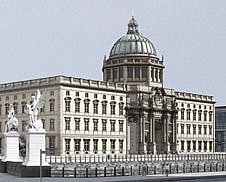
Humboldt Forum
How can the universal themes and global developments of humanity be presented in a museum? The Humboldt Forum, currently under construction in Berlin’s historic city centre, aims to do nothing less. The backbone of this mammoth project: the non-European collections of the Berlin State Museums.