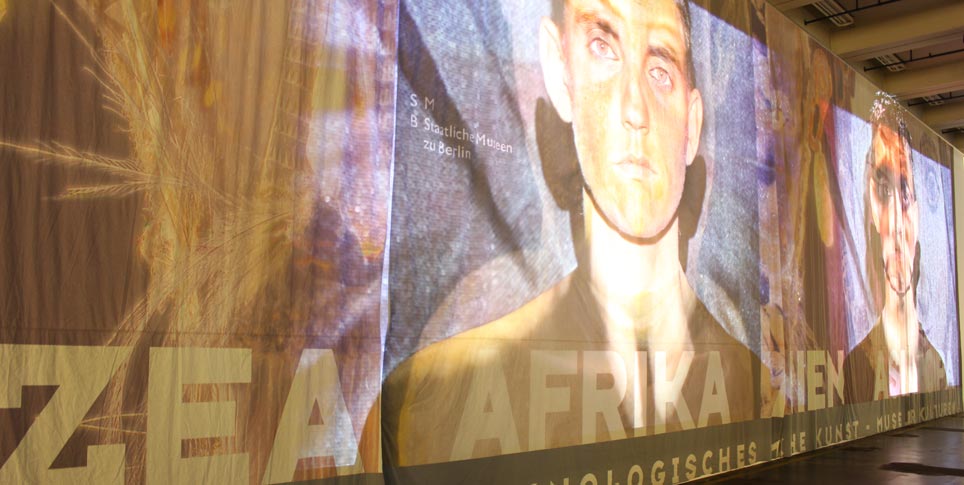
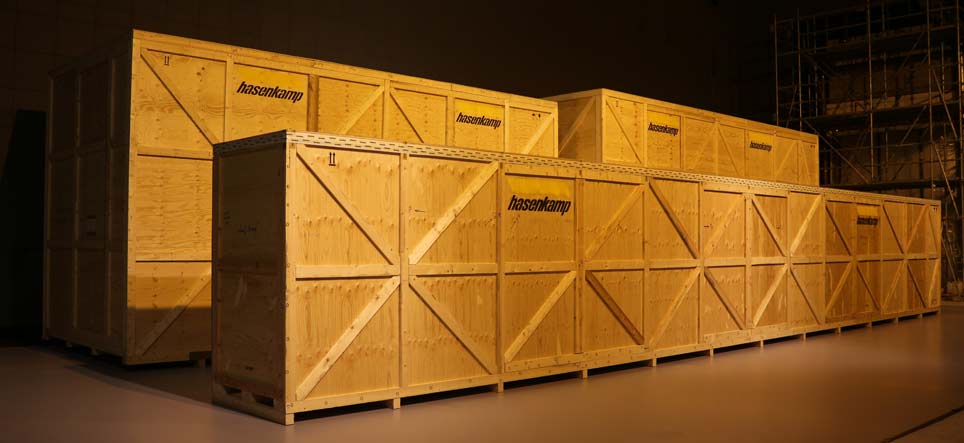
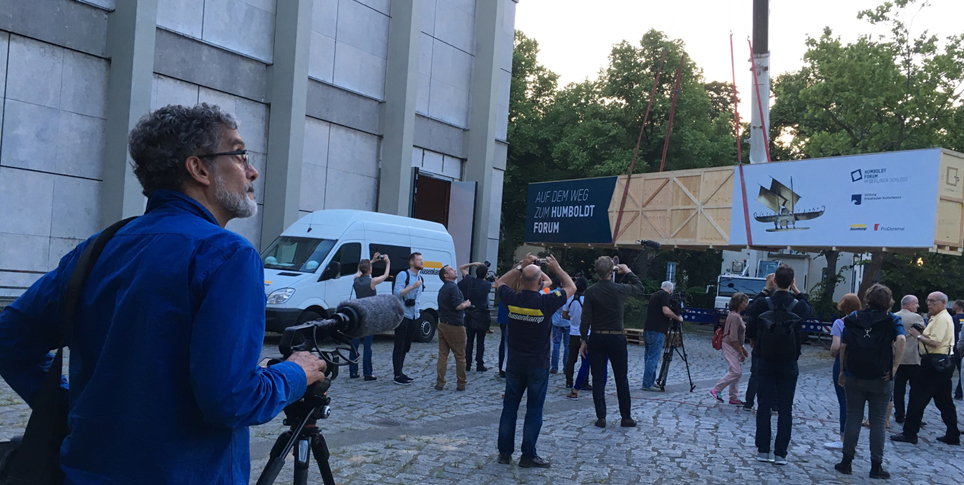
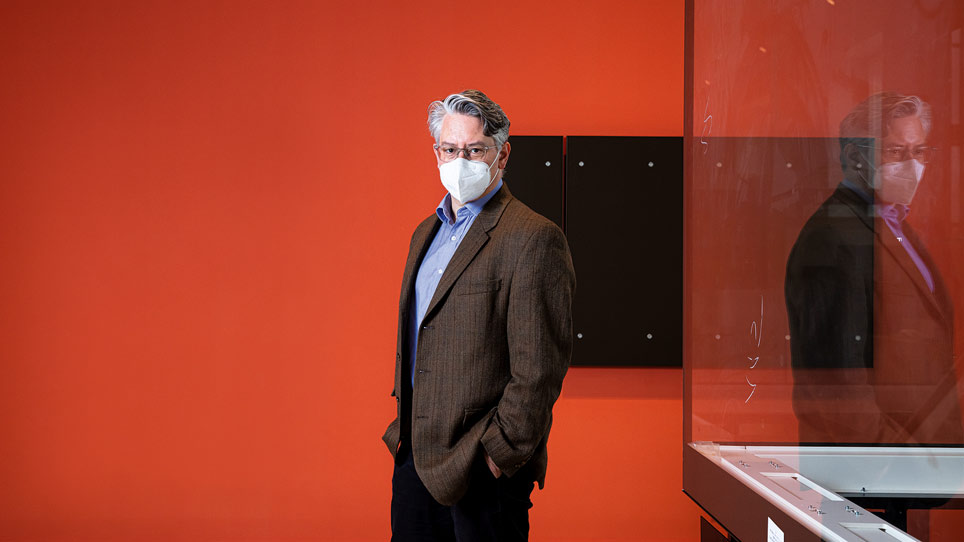
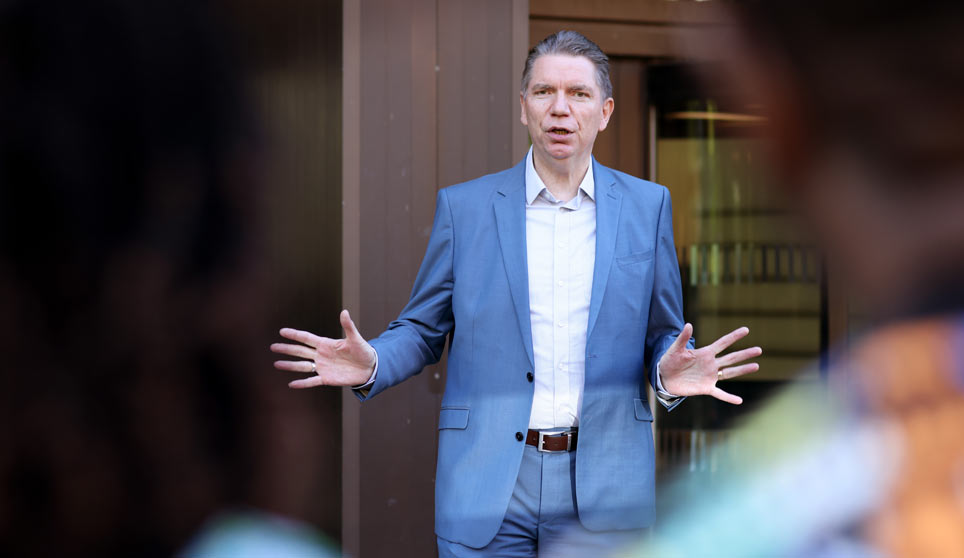
It wasn’t just members of the press and social media managers who were filming the loading and transport of the Luf-Boot on 28 May: the artist Theo Eshetu was also filming for his long-term project “The Moving Museum”, which is funded by the German Federal Cultural Foundation. In this project, he artistically and documentarily accompanies the process of moving the Dahlem Collections to the Humboldt Forum, partly to find answers to the question of what the Humboldt Forum project reveals about the future of our globalised world. Theo Eshetu had already been represented at a Humboldt Lab test stage in 2013 with an installation. In 2017, for “Atlas Fractured” at documenta, he used the former visitor banner of the Dahlem museums as a screen for his video art. We spoke briefly with him on the evening of the move.
Mr Eshetu, your art repeatedly engages with the collections of the Ethnological Museum in Berlin. Why is that? What interests you so much about them?
Hard to say. Perhaps it is simply the fact that it is an Ethnological Museum that interests me. An Ethnological Museum is the museum of other cultures. I find this relationship between the idea of the ‘other’ and that of the ‘self’ fascinating. These connections and dynamics interest me. After all, the Humboldt Forum, for example, is a German project, just as it is, at the same time, an international project.
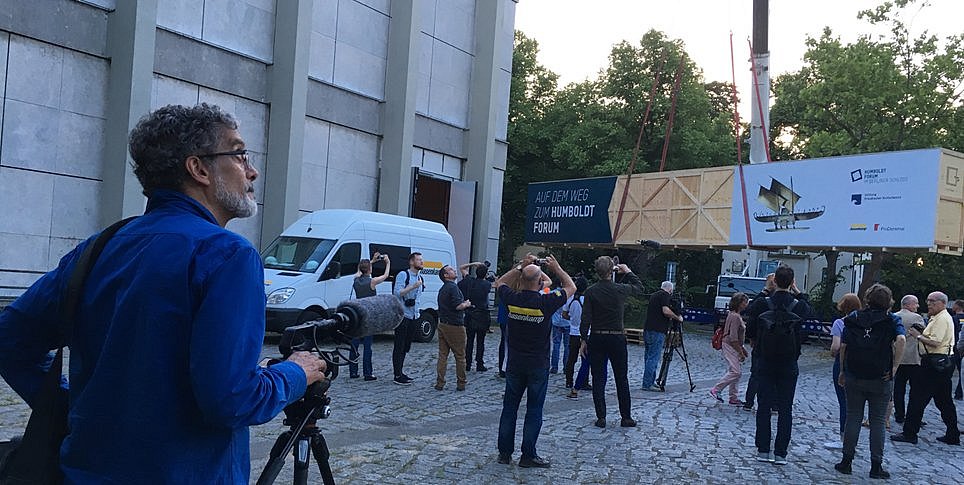
Theo Eshetu films the Luf-Boot being launched © SPK / Friederike Schmidt
The relocation of the boats is, after all, a major media event. Why do you think that is? Why do Berliners love their boats so much?
Because they are spectacular objects. And you don’t usually see so many objects like that. Part of the reason there is so much public attention tonight is that the Luf-Boot is the first large object to be moved, which is why it has become an event. It’s a kind of signal that this move is actually taking place. Besides, the Luf-Boot is a very large object and, in a way, a symbol of the Ethnological Museum in Dahlem. I think many Berliners remember playing on these boats as children. For many people, that links them to fond memories. I have those too, by the way, because a few years ago I created an installation in the boat room of the Ethnological Museum.
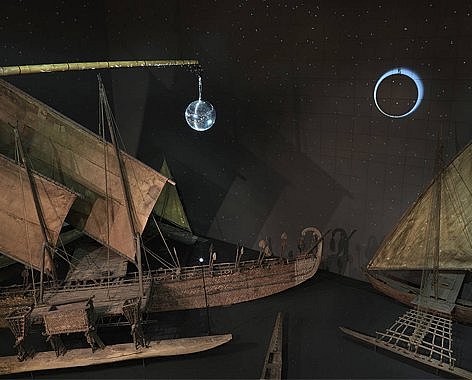
You’re referring to the 2013 installation “Springer: Mirror Ball” as part of the Humboldt Lab Dahlem, where experimental exhibition formats were tested for the Humboldt Forum. What was that about?
It was a simple project: I hung a disco ball in the museum. It was placed very deliberately in the South Sea Boats room, so that the light reflections produced by the disco ball looked like the stars that sailors used to navigate and thus discover new lands. So there was this connection between the playfulness of the disco ball – which is, after all, typical of Berlin – and the stars that were used for navigation.