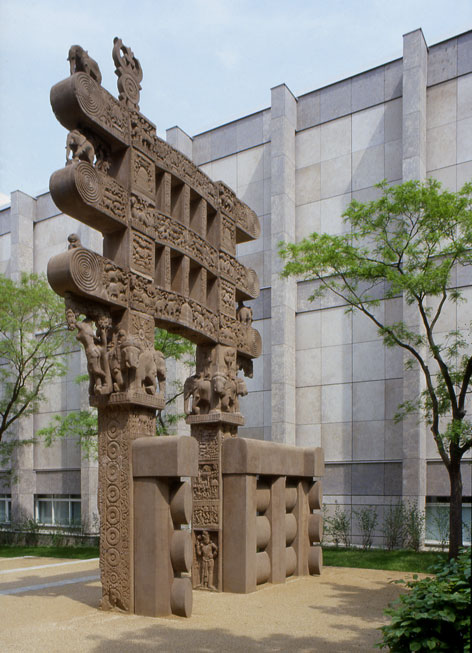
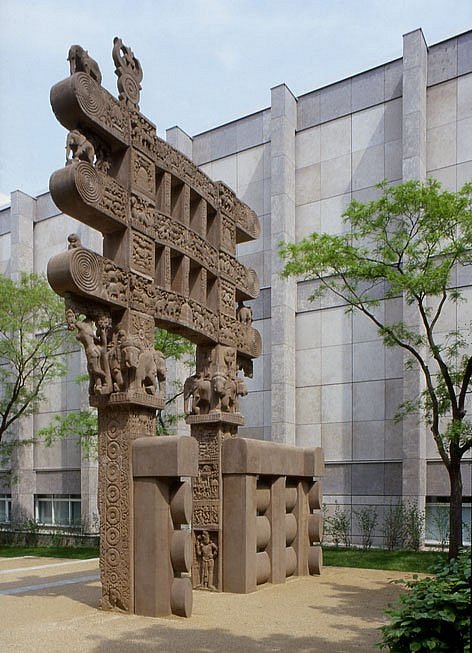
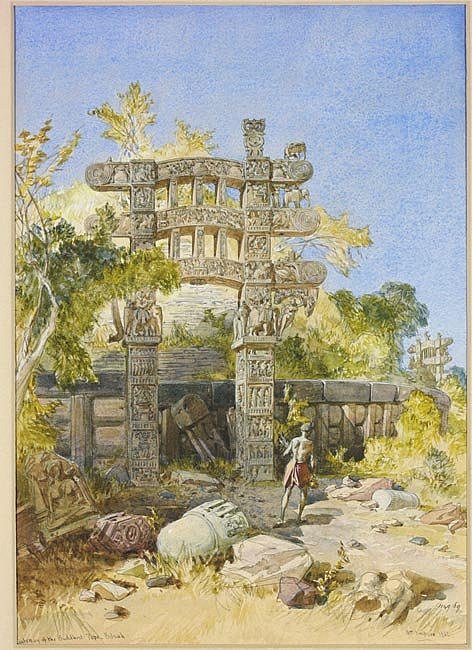
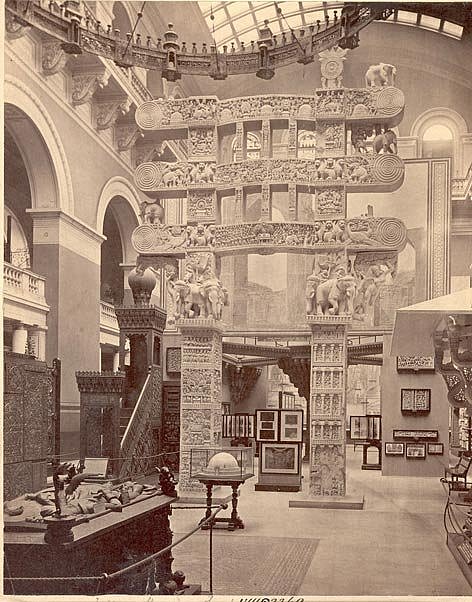
The Sanchi Gate has been part of the museum in one form or another for well over a century. An initial plaster cast of Sanchi’s east gate was acquired by what was then the Royal Museum of Ethnology in Stresemannstrasse in 1886 and was displayed in the atrium there until the start of World War II. In the early 1970s, a second replica made of artificial stone was installed on the grounds of the museum in Dahlem, in the cafeteria garden. In the interview below, Toralf Gabsch, chief conservator at the Ethnologisches Museum and the Museum für Asiatische Kunst, discusses happy accidents, the technical history of Berlin’s Sanchi gate, and some new acquisitions for the Humboldt Forum.
Has any of the first gate, the one displayed in Stresemannstrasse, survived?
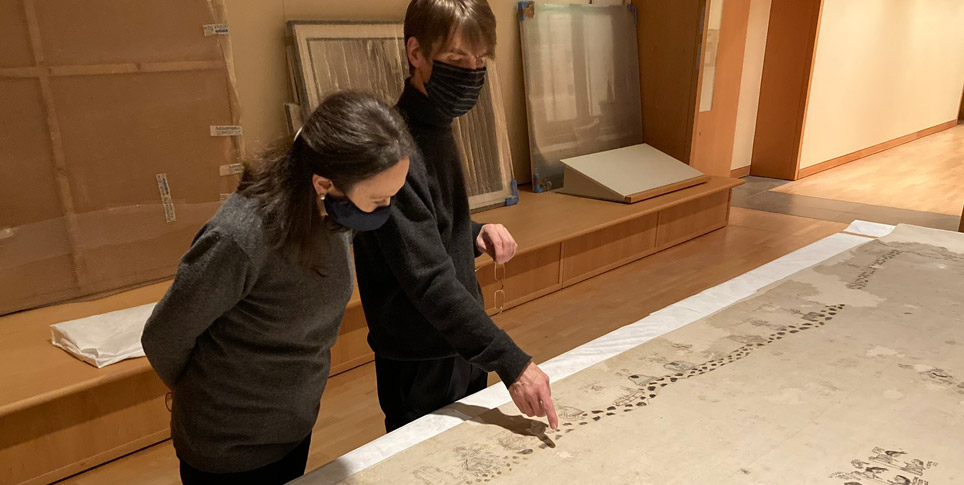
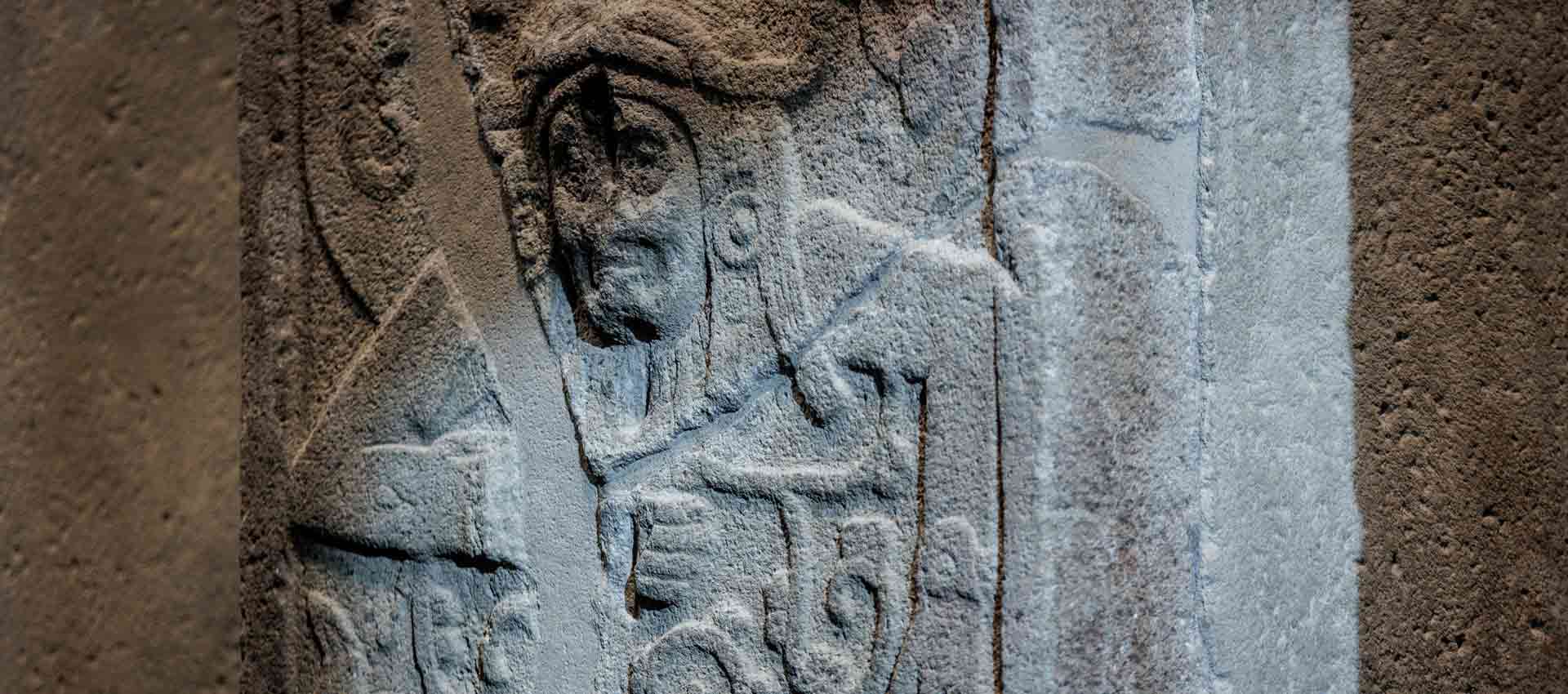
We still have the old casts. They survived World War II, were restored and are now located in our storerooms in Friedrichshagen. If they were assembled, these individual relief slabs would form a complete Sanchi gate. Because the museum still had the positives, it was able to create new molds for artificial stone casts when the Museum für Indische Kunst (Museum of Indian Art) was reopened in Dahlem in the 1970s. The molds were made of silicone with a hard plaster shell, and new positives were cast using a special cement. These positives, i.e., the individual relief slabs measuring about 2.5 centimeters in width, were assembled around a metal core. And so the original positives – the ones that were acquired in England in the nineteenth century and then displayed in the Royal Museum of Ethnology in Berlin – were the basis for creating the gate in the museum garden in Dahlem. They were also used, thanks in part to a series of happy accidents, for the partial replica that was cast in 2021 for the exhibition in the Humboldt Forum.
How were you able to make this new replica for the Asian Art Museum exhibition in the Humboldt Forum?
In 1996, I came across the entire collection of plaster casts in the museum basement and found, among other things, the original positives of the Sanchi gate. Over the next few years, a coworker and I restored the collection. It was painstaking work, but in the end, the pieces were usable again. There have been periods when plaster casts were not very highly valued and not many were preserved. Fortunately, the silicone molds with plaster shells that had been made in the late 1960s were still around. We were able to use them one last time to cast the part of the gate that is displayed in the exhibition on the fourth floor of the Humboldt Forum. Silicone naturally degrades over time and this most recent casting brought the molds to the end of their useful life. But that’s not a problem, as we still have the original positives. They can be used repeatedly to produce molds and these in turn can be used to create additional gates.
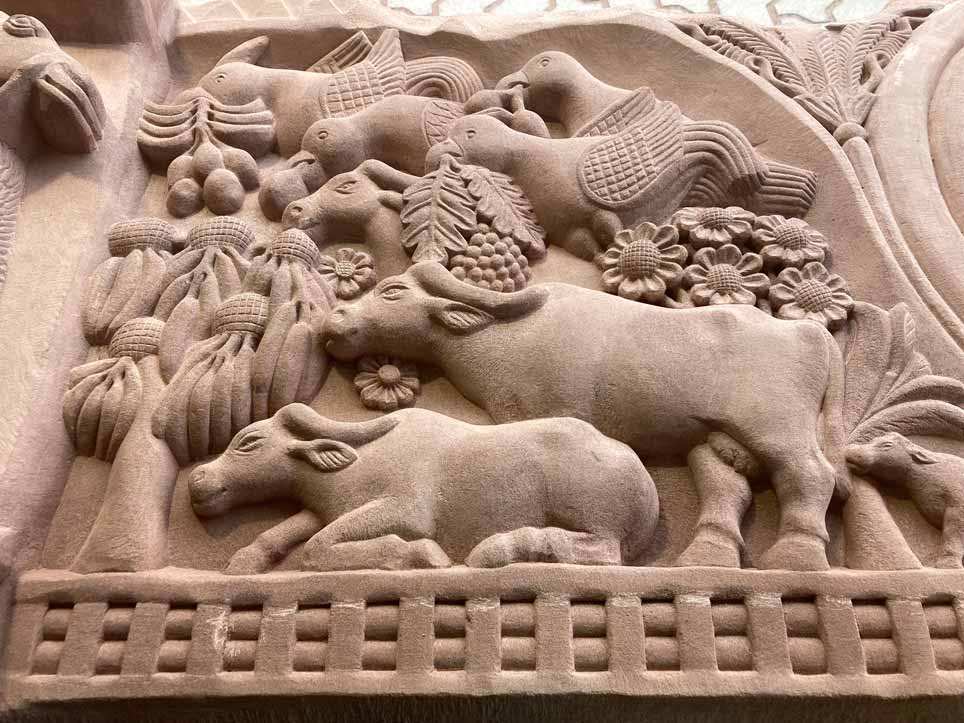
For the indoor display, the casts were made using a new, lighter material called acystal. The casts were then modified to resemble the color and structure of the original sandstone finds. You really have to get very close to detect any difference from the original stone in Sanchi that we based our work on. A different material has been used for the Sanchi gate that will be displayed outside of the Humboldt Forum: a red sandstone from the area around the Main River. The great advantage of sandstone is, of course, its longevity – especially when it’s being used outside, as here. The Stiftung Humboldt Forum (Humboldt Forum Foundation) commissioned a company in Bamberg to carve this gate, which, if you count the partial replica displayed at the Humboldt Forum in the Asiatische Kunst exhibition, makes it gate number four for the city of Berlin and its visitors.
Do any other historical casts of the Sanchi gate exist?
As far as I know, we have in our collection the last surviving positives of the historical casts. For one reason or another, these were not preserved in other European museums. The positives that we have are, by now, far more detailed than the originals in Sanchi. This is not surprising considering that natural weathering processes always eat away at architectural works like these. Our replica documents the state of the gate in Sanchi as it would have looked about 150 years ago. The original positives are kept in the storage facility of the Stiftung Preussischer Kulturbesitz (Prussian Cultural Heritage Foundation) in Friedrichshagen, Berlin, where they are available for research purposes.