What actually inspires artists? Bauhaus artist Anni Albers’ enthusiasm for Andean textile art was sparked at the Ethnological Museum in Berlin. That is why an item on loan from the Ethnological Museum of the Berlin State Museums is currently on display in an exhibition at the Bauhaus Dessau.
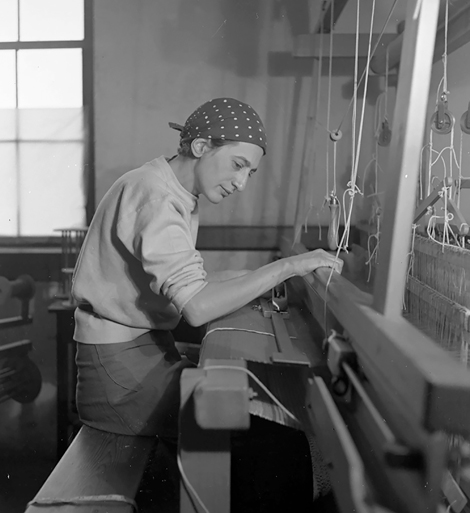
Weaving like the Peruvians: Anni Albers dedicated her book ‘On Weaving’, published in the USA in 1965, to her ‘Great teachers, the weavers of ancient Peru’. The Bauhaus student of Jewish origin was forced to leave Germany as early as 1934 and, together with her husband Josef Albers, found a new home at Black Mountain College in the forests of North Carolina. From there, the couple undertook annual trips to Mexico and Peru, fascinated by the artistic quality and “timelessness” of the “ancient craft”.
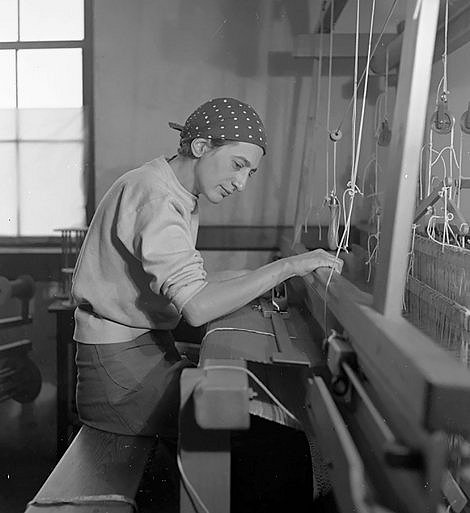
Anni Albers in her studio at Black Mountain College, 1937 © Courtesy of the Western Regional Archives, State Archives of North Carolina / Helen Post
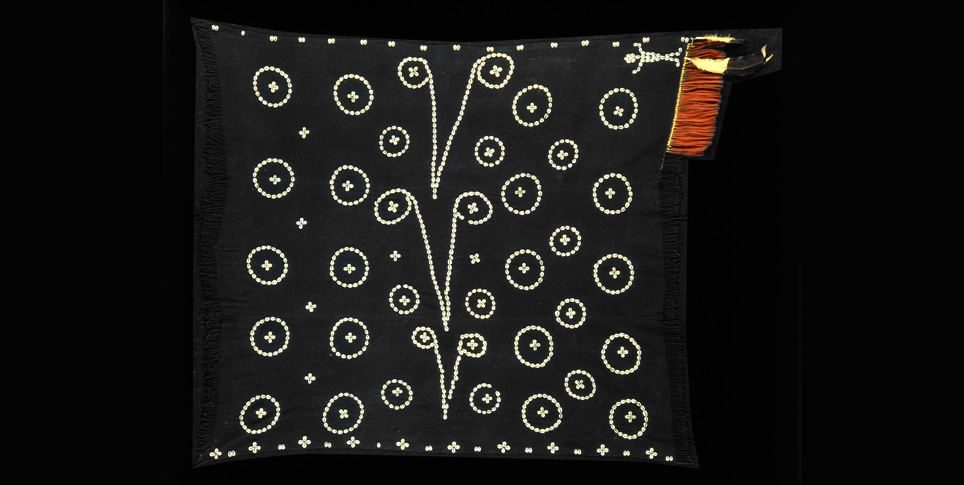
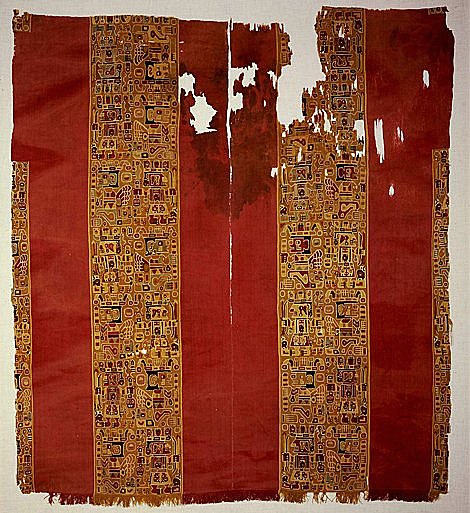
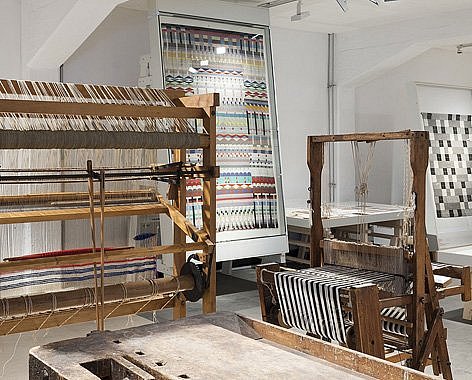
What Anni Albers brought back from these travels is currently on display at the Dessau Bauhaus in the rooms of the historic weaving workshop. The exhibition “Craft Becomes Modern. Making at the Bauhaus” (until 7 January 2018) brings together for the first time the textile fragments collected by Anni Albers on her travels, placing them in dialogue with her 1927 tapestry “Black White Grey” and a Huari men’s shirt from Peru, on loan from the Ethnological Museum of the Berlin State Museums. A dialogue between fabrics whose production and design not only span continents and millennia, but also forge intellectual affinities.
Imaginary journeys in the Ethnological Museum
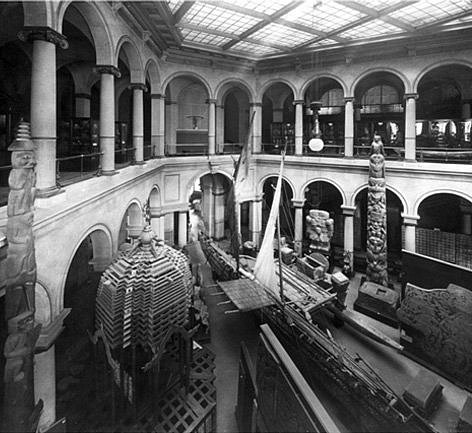
One might interpret the Albers’ enthusiasm for the Andean weaving traditions of South America as evidence of the cultural references and projections of Western avant-gardes onto non-European cultures at the beginning of the 20th century, grouped under the concept of “primitivism”. Global traffic had already gained momentum by the turn of the 19th to the 20th century: colonialism and world trade, along with modern transport and communication technologies, had also contributed to the dissemination of cultural artefacts across the globe. Museums, collections and major exhibitions became showcases for this global cultural exchange. Ethnographic museums, in particular, offered imaginary journeys to non-European regions. What Western artists and intellectuals sought in the ‘tropics’ of ethnographic collections was cultural orientation and sensory inspiration in the face of a present perceived as ‘soulless’ due to industrialisation and rationalisation.
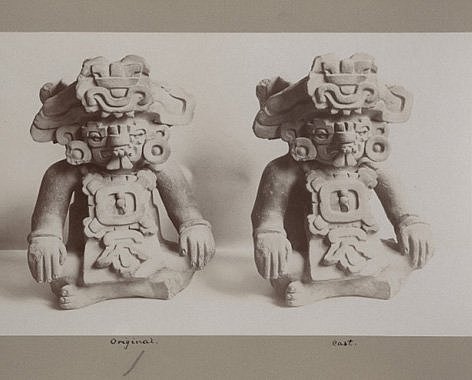
Without delving here in detail into the debates, movements and positions on cultural renewal at the turn of the century: what united them was the discovery of abstraction in ‘primitive’ cultural artefacts – textiles, ceramics, small sculptures – which, in their abstract formal language, promised the timeless validity of artistic expressiveness. Wilhelm Worringer’s theory of art ultimately linked abstraction with the hope that art would thus find its way back to its spiritual foundations, and in his argument he referred explicitly to ‘primitive’ cultures.
And finally, in the eyes of Western observers, the organic unity of craftsmanship and artistic expression visible in the objects of non-European cultures seemed to recall what had been lost in their own material culture since industrialisation, and what reform movements from Arts & Crafts through Art Nouveau to the Werkbund and Bauhaus had strived to achieve. It was no coincidence that exhibitions of collections of Andean artefacts, presented in dialogue with the works of the avant-garde, featured in the programmes of art and cultural figures during the first decades of the twentieth century.
The Berlin Museum of Ethnology, founded in 1873, had specialised in the collection of Andean textile artefacts from an early stage. In addition to acquisitions, it was a series of archaeological discoveries around the turn of the century that made the museum a magnet for international artists and intellectuals. The excavations in Ancon by Wilhelm Reiss and Alphons Stübel and their subsequent publications were just as much a part of the Bauhaus artists’ library as Walter Lehmann’s *Art History of Ancient Peru*. Anni Fleischmann (Albers), even before her time at the Bauhaus, had visited the collections of the Museum of Ethnology on several occasions as a Berliner, finding herself in the best of company with artists such as Paul Klee, August Macke and Wassily Kandinsky.
Back to the material
When she arrived at the Bauhaus in Weimar in 1923, a shift had already begun in the college’s programme and curriculum. Her essay on the Bauhaus weaving workshop, published in 1924 in the journal “Junge Menschen. Monatsheft für Politik, Kunst und Literatur”, reads like a statement of the textile workshop’s position: she sees the work of the weaving workshop as rooted in “ancient culture” and emphasises the importance of the craft’s direct contact with the material. She viewed critically the increasing division of labour within the textile industry between design and craftsmanship: “Today, the weaver has only a loose connection with the loom. He has only mechanical tasks to perform. The fabric is produced independently of the weaver.” The pattern draughtsman, acting as an “isolated intellectual” with no contact with practice, had taken over the weaver’s actual creative work. The aim of the Bauhaus workshop was “to re-establish general contact with the material. […] Work today must be experimental. We must re-explore craft and technical possibilities. This makes manual work possible […] We can then understand industry and mechanical craftsmanship and work for them because we grasp their essence.”
The return to the material is understood not as an alternative, but rather as a prerequisite for engagement with the textile industry. If mechanisation has fostered alienation from the material, then the task of modern Bauhaus weaving must be to respond to this technical world through experimental work on the handloom, utilising new materials and creative contributions.
Textile art as a form of expression in modern society
In contrast to the early days of weaving at the Bauhaus, she was not interested in borrowing motifs from ‘primitive’ models: rather, ‘capturing the essence’ aimed at understanding the characteristics and structure of weaving. She drew inspiration for such an approach from the “constructive systems” taught in Klee’s form classes and her understanding of Andean textiles: for, as Anni Albers emphasises in her later publications such as “On Weaving”, textiles in Andean cultures served as a medium of communication. The enormous wealth of pictograms and ideograms points to the role of weaving in societies that had not yet developed writing. Alongside oral communication, textiles played a vital role in the preservation and transmission of information, communal norms and guidelines. And due to its central position within Andean cultures, weaving was a communal activity.
For Anni Albers, this opened up a perspective for redefining the art of weaving in the modern era: ‘capturing the essence’ meant, above all, liberating textile art from the straitjacket of European traditions and conventions of applied art or the arts and crafts. Andean weavers held a central position within their society. In Europe, by contrast, textile art had increasingly become a mere imitation of models from the fine arts; a subordinate applied genre in the shadow of the fine arts. Anni Albers took a critical view of the European tradition and discovered in Andean weaving cultures the potential for a cultural redefinition of textile art as a medium of communication and a form of expression for modern society.
Making and thinking in material terms transcends boundaries
In this respect, the collapse of time and space brought about by the convergence of material artefacts in the Dessau exhibition not only offers insights into the material and formal interconnections between the textile designs at the Bauhaus and their pre-Columbian models – but is also an invitation to re-evaluate cultural textile production. For why, particularly in the 21st century, given the availability of enormous technological innovations, are knitting, weaving and sewing experiencing such a renaissance? Digitalisation, depleted material resources and an environment almost entirely shaped by humans have evoked a renewed interest in handmade items, in traditional manufacturing methods and in new models of small-scale production. In the contemporary section of the exhibition in Dessau, Sarah Ouhaddou from Morocco presents her work with young embroiderers who still master the traditional Tetouan embroidery and are developing it further together with the artist. It is a project that weaves the thread of local craft traditions into the globalised present: not as a folkloric representation but as the living, dynamic culture of a community.
Thus, in the seemingly impossible juxtaposition of 21st-century Moroccan silk embroidery with Anni Albers’ Bauhaus textiles from 1927 and the 1,500-year-old Huari men’s shirt from Peru, a dialogue transcending time and space emerges concerning making and thinking in the material realm—as a unique medium that allows us to overcome the traditional boundaries between human and object, subject and object.
Bibliography
- Virginia Gardner Troy: Anni Albers and Ancient American Textiles. From Bauhaus to Black Mountain, 2002
- Anni Fleischmann: Bauhaus Weaving. In: Junge Menschen. Monthly Journal of Politics, Art and Literature, 1924
- Paulina Brugnoli and Soledad Hocess de la Guardia: Anni Albers and her great teachers, the Andean weavers. In: Heinz Liesbrock, Brenda Danilowitz (eds.), 2007
- Tài Smith: The Bauhaus Was Never Modern. In: Regina Bittner/Renee Padt (eds.): Craft Becomes Modern. On Making at the Bauhaus, 2017