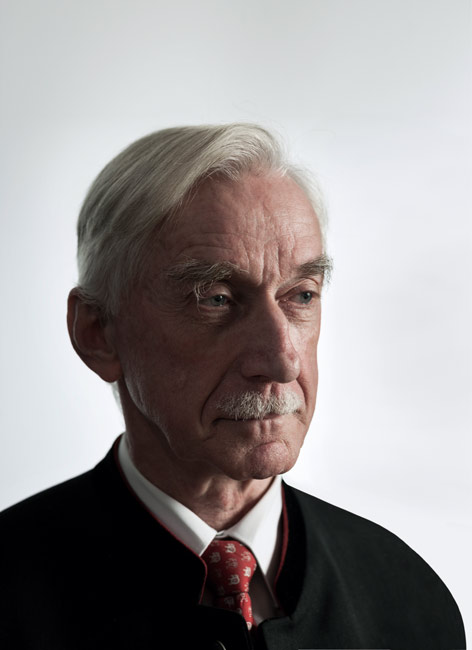
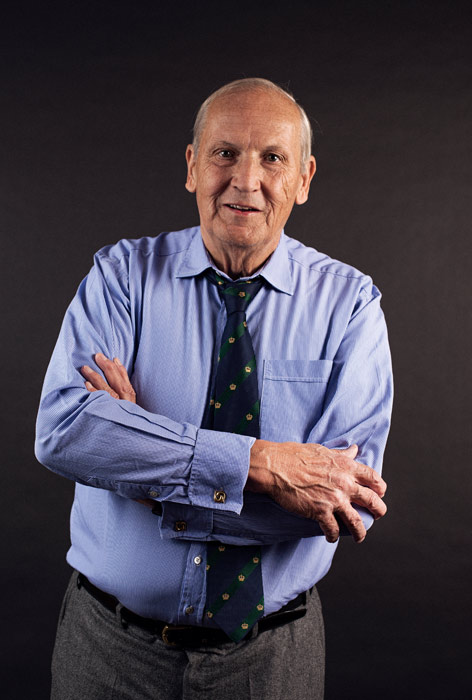
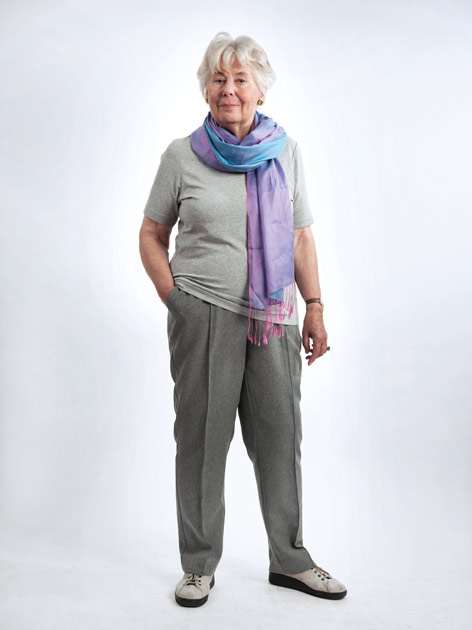
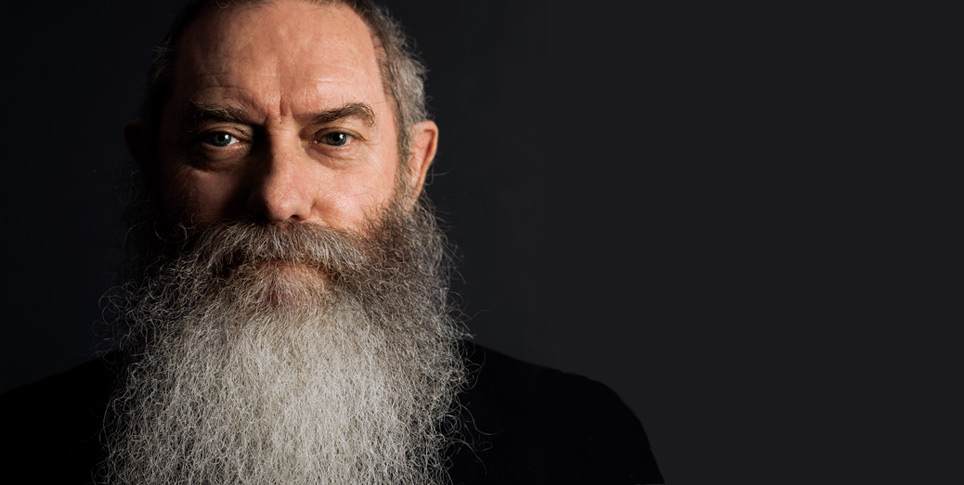
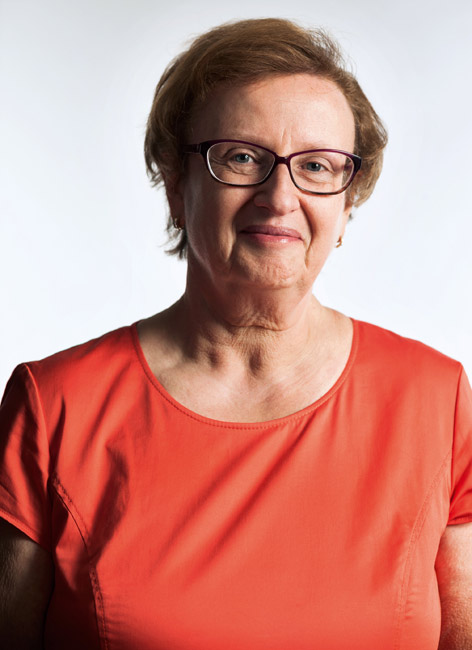
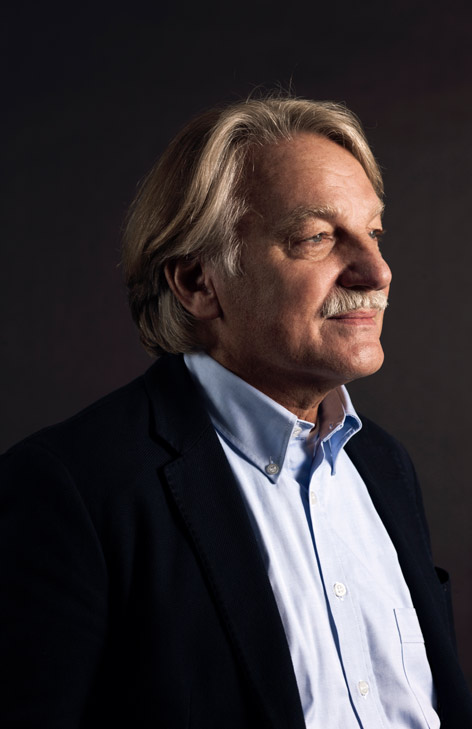
Conservator Bodo Buczynski recalls how, with the fall of the Wall, the status of his colleagues also declined.
No sooner had the Wall come down than Wolf-Dieter Dube came up to me and said: “Right! You’re going over there now. You can do it.” Until then, I’d had very little contact with the Bode Museum. I’d had some with the City Museum and in Dresden – but things had been more difficult with the State Museums. As I’d only become head of the restoration workshop in Dahlem a year earlier myself, I’d actually envisaged a partnership with the workshop manager from the East, but Dube wouldn’t have it. There was to be just one head. And so I tried to foster a collegial working relationship between the colleagues and not come across as a know-it-all West German.
One thing was immediately clear to me: I wouldn’t ask who had been in the Party. Did I know how I would have behaved in the GDR? My father was Polish; I was born in Germany but didn’t acquire German citizenship until I was ten. As a so-called ‘Polack’ in a small town on the Lower Rhine – I know what prejudice is.
Naturally, I then had to contend with prejudices myself when I became head of the merged restoration workshop. The staff in the East were worried that I might question their working methods and patronise them. Some perhaps didn’t like me because I drove a convertible and had a tennis racket in my back seat.
And there was something else: the conservators in the East had all gone to university, whereas I’d been trained by independent conservators and in heritage agencies. So they were suddenly faced with a boss without a university degree.
I soon realised that the theoretical knowledge of the material was actually better in the East. And as far as conservation and restoration were concerned, the work was carried out in the same way on both sides. This is very clearly evident in the Naumburg group. Due to the division of the collection, the statue of Mary had ended up in West Berlin and the crucifix had remained in the eastern part. In the late 1960s, both sculptures were restored without the colleagues having communicated with one another. The methods were identical, and both now stand side by side as equals.
Soon after we moved from Dahlem to Museum Island, we set about fitting out new studios. I didn’t want to move into the basement of the Bode Museum, but rather to the main floor, and fortunately we were given the rooms we’d asked for. The staff were pleased with this: here was someone who stood up for the restorers’ interests and was converting an exhibition space into a workshop.
We also managed to house all the storage areas within the Bode Museum, enabling a direct academic dialogue between conservators and art historians. That was another difference compared to the West – in the GDR, conservators and art historians worked side by side as equals. In the West, by contrast, the academic was held in higher regard, and probably still is today.
For conservators in the East, the merger with the Prussian Cultural Heritage Foundation meant, in a sense, a devaluation of their status. Even today, I am grateful to my colleagues in the East that we tried together to raise the status of conservators. For a long time, I was the spokesperson for the conservators within the Foundation, and in this role I suggested to Director-General Dube that a conservators’ conference be established, comparable to the directors’ conference for academics, at which problems and concerns could be discussed.
Dube liked the idea, and these regular meetings still take place today. However, the Foundation still struggles with achieving financial equality for conservators. But I hope that the new collective agreement will bring about positive changes for conservators in this regard.
The comprehensive renovation of the building finally brought the staff from East and West together – and their joint resistance to the Viennese architect Heinz Tesar. Since the 1950s, the Bode Museum had been very carefully restored in the GDR. Particular care was taken to preserve the rooms in their original structures. The architect Tesar now wanted a much more modern look.
To this day, I remain grateful to my colleagues from the East for the fact that we worked together to raise the profile of conservators.
He wanted openings cut into the large dome to let more light in. He wanted to lower the windows and make major alterations to the building, but he was unable to persuade Arne Effenberger, the director of the sculpture collection, and me, the building contractor, to agree to this. Instead, we completed the work that had been started in the GDR. The ceilings that had been removed were reinstalled, and the slate roofing of the domes was replaced with copper.
In fact, everyone pulled together during the general renovation. The collaboration between art historians and conservators was close and professionally competent, and Professor Effenberger regarded the conservators as equals to the academics and treated them as such.
In conclusion, I would say today: during the merger, we could have adopted more of the structures from the eastern section, particularly the equal status of restorers alongside art historians and their remuneration.
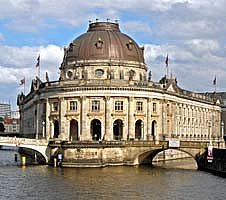
Bode Museum
The Bode Museum, part of the Berlin State Museums, crowns the northern tip of Museum Island. Completed in 1904, the building now houses the Sculpture Collection, the Museum of Byzantine Art and the Numismatic Collection. It also displays around 150 paintings from the Picture Gallery.
The design of the building, originally constructed as the Kaiser Friedrich Museum, was based on ideas put forward by Crown Princess Victoria in the early 1880s, which Wilhelm von Bode brought to fruition. In 1956, it was renamed after its spiritual creator, a name it retains to this day: the Bode Museum.