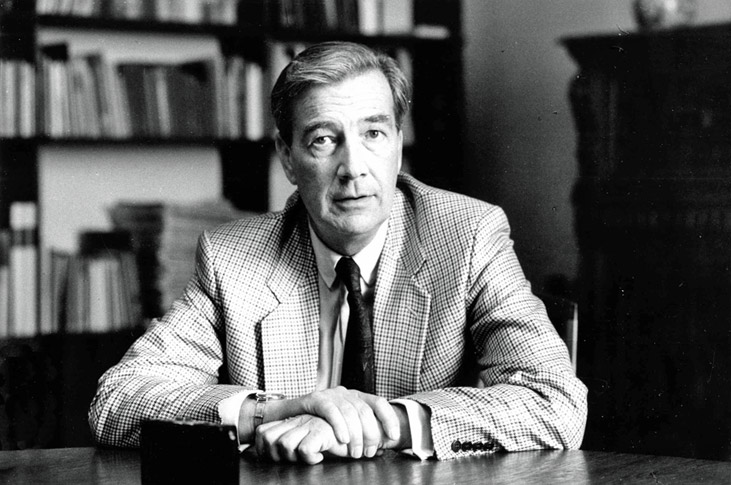
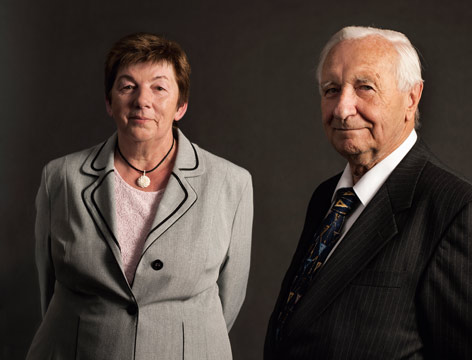
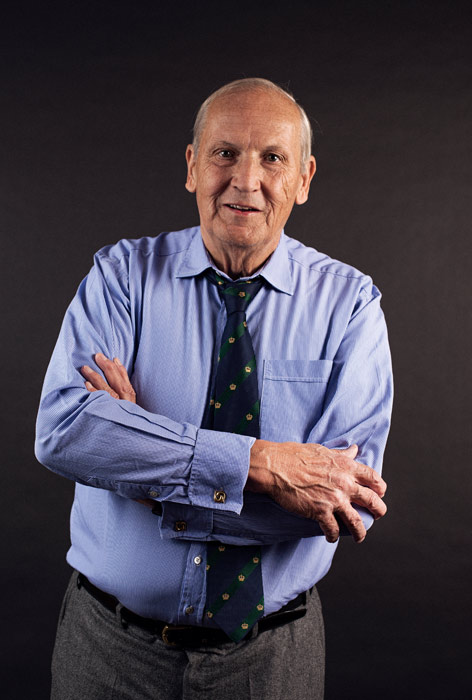
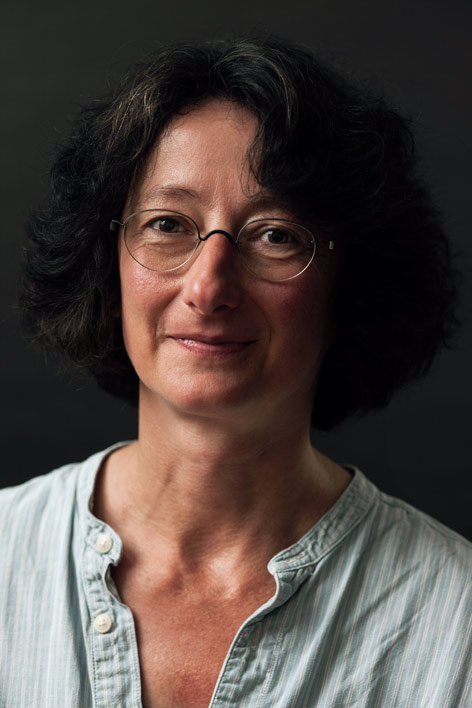
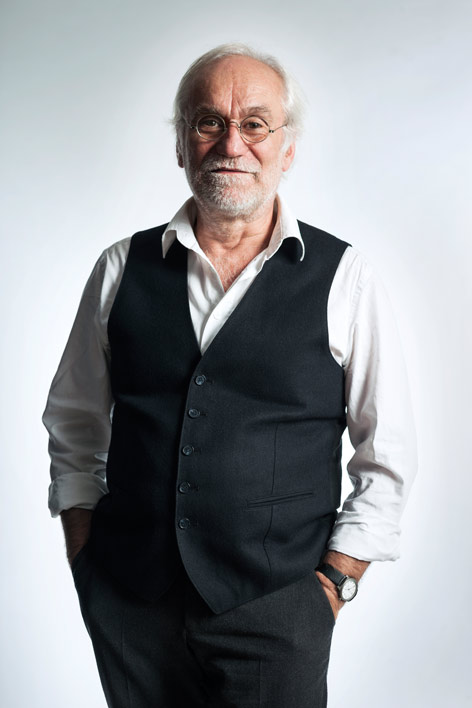
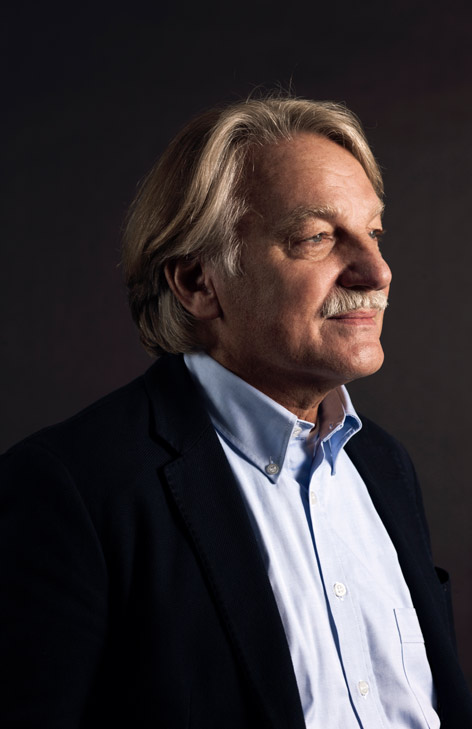
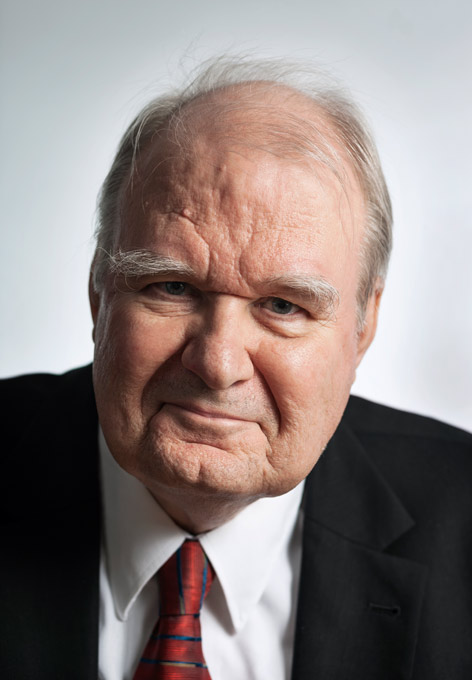
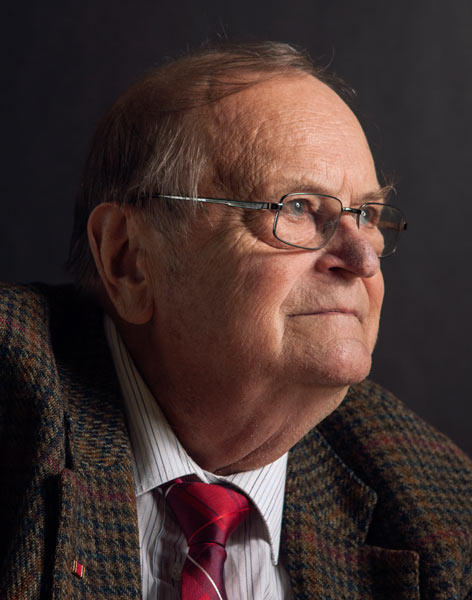
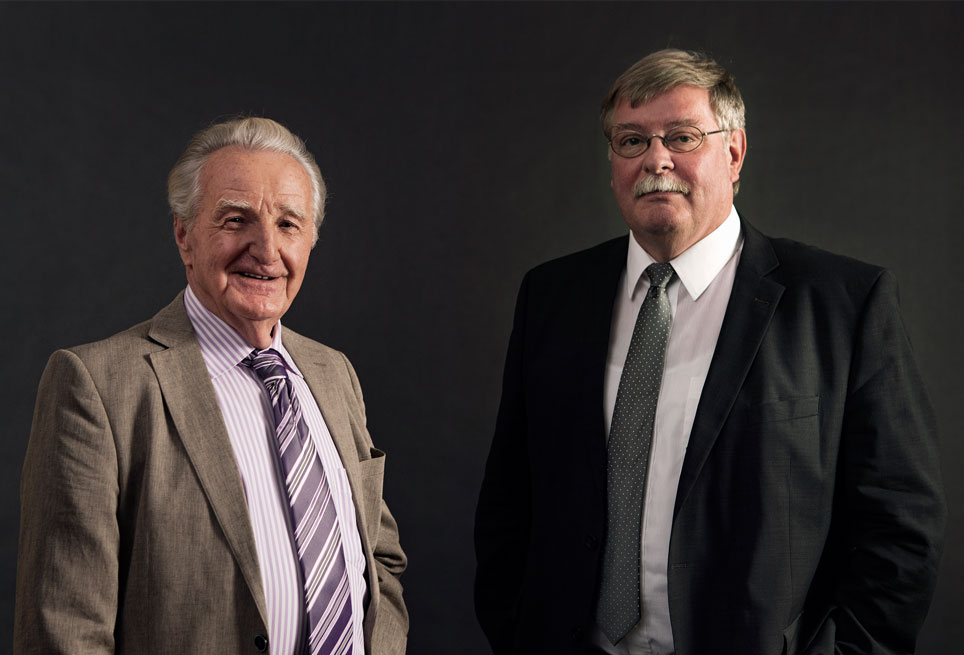
Eugen Blume, speaking at the Kupferstichkabinett (OST) in 1990 on the convergence of art from East and West.
After completing my studies, I had held a post as a research assistant at the Kupferstichkabinett since 1981, but I would have preferred to work in the National Gallery’s famous collection of drawings. But I wasn’t allowed to do so at first for political reasons. It was only in 1990, during the period of upheaval, that I was able to switch. And it was only after the fall of the Wall that I completed my PhD. Before that, in order to write a doctoral thesis, I would have had to take compulsory subjects such as political economy or scientific communism, and I didn’t want to do that.
So immediately after the end of the GDR, I wrote my dissertation on the history of the National Gallery, focusing on Ludwig Justi, who was its director from 1909 to 1933 and established the first collection of modern art at the Kronprinzenpalais, featuring all the major, mostly German, names of the time.
Abstract art was an exception, which Justi rejected. He did not acquire Kandinsky because he was Russian. For him, abstract art was also associated with a lack of artistry. He focused on Expressionists and individual figures such as Ernst Ludwig Kirchner and later Max Beckmann.
In 1933, Justi was dismissed, but after the war, as a man of advanced years, he was appointed Director-General of the State Museums in East Berlin. He had to compensate for the immense loss of works caused by the ‘Degenerate Art’ campaign in the museum galleries with drawings, as the paintings no longer existed.
In West Berlin, there was no building for the newly founded National Gallery after the war – until Mies van der Rohe’s Neue Nationalgalerie was built in 1968. As an enclave, West Berlin was anything but a stronghold of the art movement. For the Federal Republic of Germany, that was more the Rhineland. West Berlin was politically supported, but was almost written off.
In contrast, the National Gallery of the GDR was, of course, heavily politically infiltrated and had to exhibit state-sponsored artists such as Willi Sitte or Werner Tübke; nevertheless, the staff acted subversively and predominantly collected art that was independent of the state.
Dieter Honisch, on the other hand, the director of the Neue Nationalgalerie in the West, was very attached to colour-field painting, and one of his great achievements was that he acquired works by Barnett Newman, Mark Rothko and others from the first generation of American abstract artists. By uniting the collections, it was finally possible to demonstrate just how misguided Cold War propaganda was: that the abstract artists were the free ones, whilst the figurative, realistic artists were the ideologically bound ones.
Shortly after reunification, Dieter Honisch exhibited works by state-sponsored artists from the GDR at the Neue Nationalgalerie. Works by Willi Sitte and Bernhard Heisig were displayed in the large foyer, and naturally there was a huge outcry. In the first few years following the dissolution of the GDR, the political debate was, naturally, very tense. People were beginning to grasp the omnipotence of the Stasi. There was a veritable hunt for informers; it was – as is usual during periods of historical upheaval – a time of reckoning.
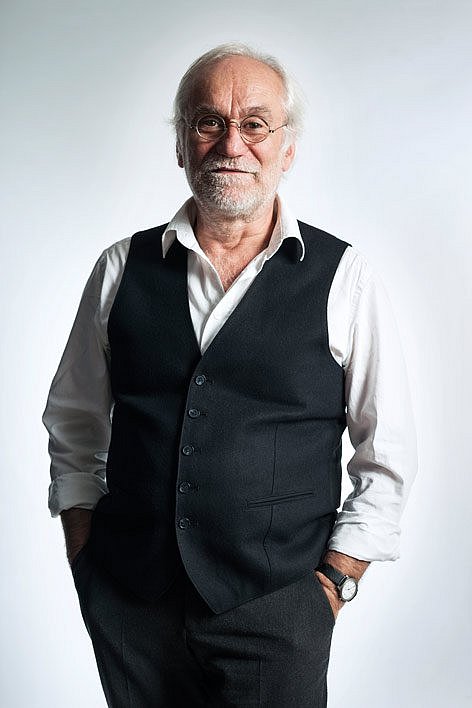
The artists exhibited by Honisch had been directly involved in the state apparatus and, in some cases, had been members of the People’s Chamber and officials; many considered it problematic to now exhibit them ‘merely’ as artists. For this meant they were recognised as a part of late 20th-century art history worthy of a museum. I understood what Honisch wanted, but I still thought it was wrong.
I would not have exhibited them in such a limited context, but would have tried to take stock of the situation in an exhibition – which is what I later did with my colleague Roland März at the National Gallery. In the exhibition ‘Art in the GDR’, we drew our first conclusions and showed the art that we considered to be art. Not political propaganda imagery, but genuine art.
There was, after all, this verdict—still alive today—that GDR art was, by definition, not art, because it was created in a lack of freedom and not within the context of contemporary Western discourse. In the GDR, entire communities of painters still drew on Cézanne, and this was and is viewed with contempt as an anachronism. On this point, I believe we made a correction by making it clear that it is legitimate to draw on any point in art history if one produces something of one’s own from it.
Werner Tübke was perhaps the most extreme example of this. He considered himself a reincarnation of Pontormo, and that was, of course, an exaggerated stance. But Tübke was essentially a postmodern artist who became interesting to me again, particularly through his absurd Peasants’ War panorama—the largest canvas painting in Europe—which he created in Bad Frankenhausen on a state commission during the final year of the GDR.
Honecker officially opened this painting and its consecrated temple, and Tübke signed it in the presence of the Central Committee of the SED. It was as absurd as a surrealist performance by Dalí. This panoramic painting was intended to demonstrate the inner logic of history: a line stretching from the so-called early bourgeois revolution to communism, in the course of which the oppressed classes lawfully seize power.
Yet this painting shows the opposite – if one reads it closely. It is fatalistic, historically pessimistic, devoid of any hope; it has nothing to do with what the state actually wanted to see there. But they went into it blindly and failed to understand the Mannerist Tübke, their comrade!
After the end of the GDR, a political debate naturally took place within the museums. This was not about art, but about the question of whether the old management had perhaps worked too closely with the system. It must be said that the Western foundation acted very moderately; there were no dismissals, only so-called ‘kw’ (can go) posts, but looking critically at what reprisals had taken place during the GDR era – that was something they did not want.
Following the collapse of the GDR, there was, of course, a political debate within the museums.
An atmosphere of openness quickly developed between colleagues from the East and the West, fuelled by a shared interest in the cause. Yet I was surprised at how little my colleagues from the West wanted to know about the East. For example, as soon as the Wall came down, I travelled constantly to West German cities to get to know the museums and the cultural landscape. But very few people from the West made the effort to visit East German cities. For a long time, resentment played a part in this, and it has not been completely overcome even today. That still amazes me.
Hamburger Bahnhof – Museum of Contemporary Art – Berlin
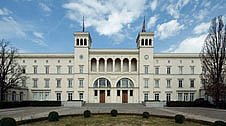
The Hamburger Bahnhof – Museum of Contemporary Art – Berlin houses extensive collections of contemporary art. It is the largest building of the National Gallery, whose holdings can also be found in the Alte Nationalgalerie, the Neue Nationalgalerie, the Museum Berggruen and the Scharf-Gerstenberg Collection.
As the name suggests, the Hamburger Bahnhof once served a completely different purpose. Opened as a railway station in 1846, it had to close again as early as 1884. Since 1996, the renovated and now expanded building has provided a home for contemporary art.
Website of the Hamburger Bahnhof – Museum of Contemporary Art – Berlin