Veronika Kellndorfer is “a painter who works with photography”. She transfers her photographic paintings onto large, often multi-panel glass panels that deliberately play with transparency, reflections, mirroring and visual distortions. The Neue Nationalgalerie brought her exhibition “Screens and Sieves” to the Landhaus Lemke. A conversation about Mies to the power of three, architecture as a horizon of friction, and the touch of a ray of light.
Ludwig Mies van der Rohe’s Neue Nationalgalerie is a temple of modernism, one of the most important buildings of the 20th century. An icon. So far, so clear. You encountered the building in 2015, shortly after it closed and before the renovation. Various works for the exhibition “Screens and Sieves” at the Mies van der Rohe House were created there. How would you describe the Neue Nationalgalerie as a work of art?
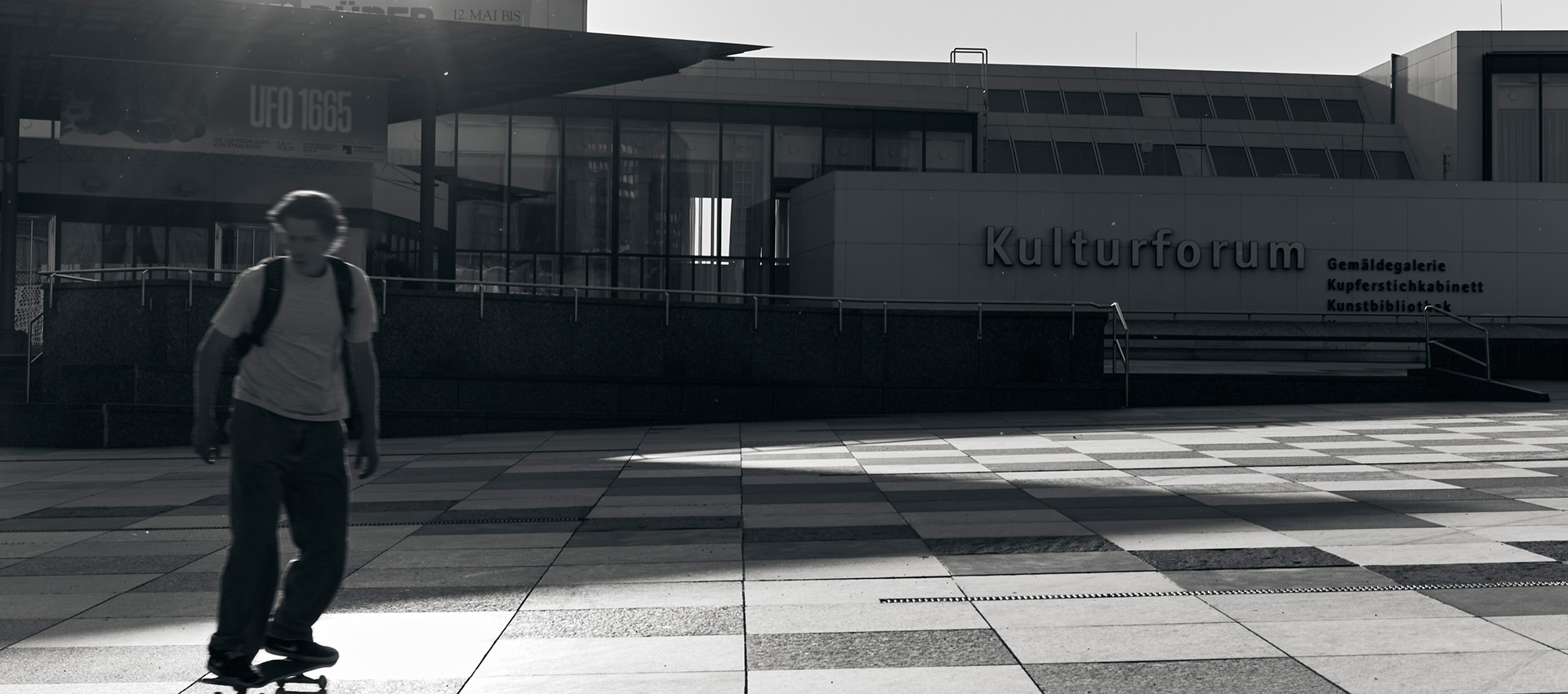
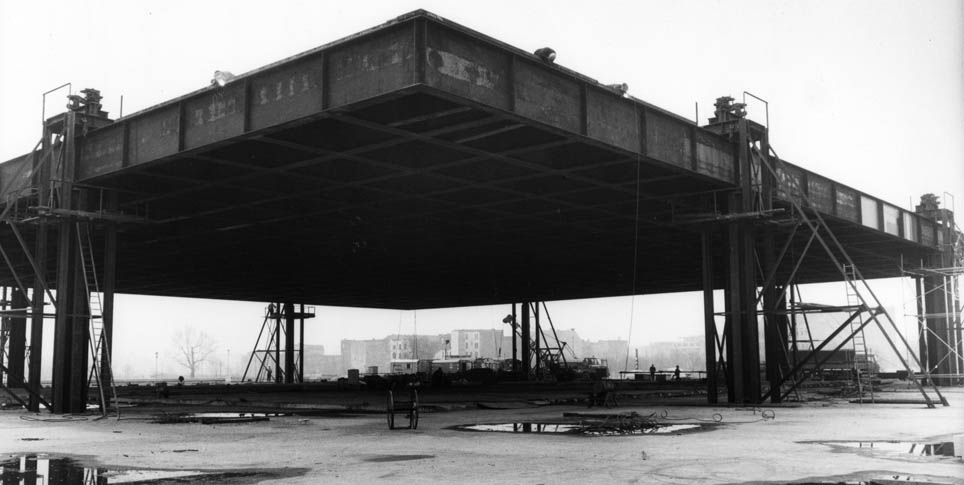
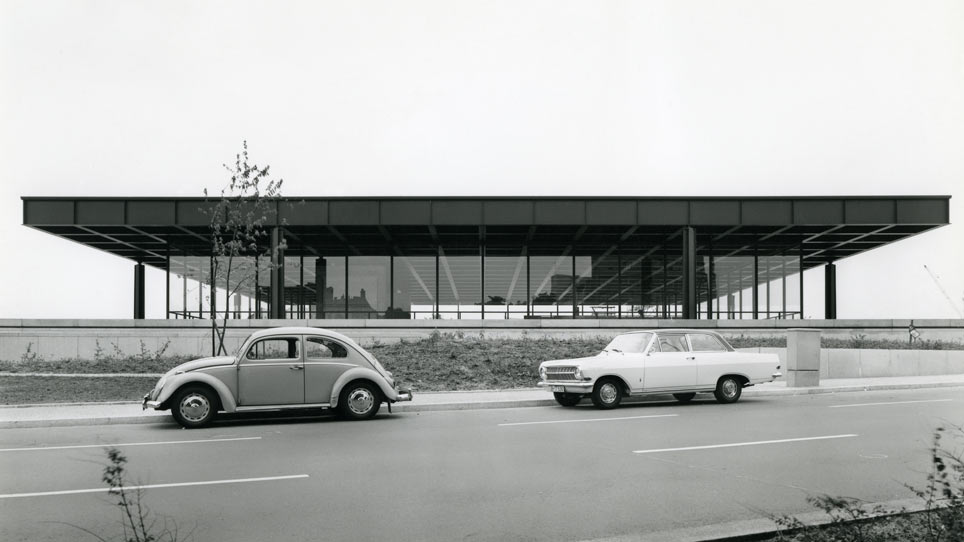
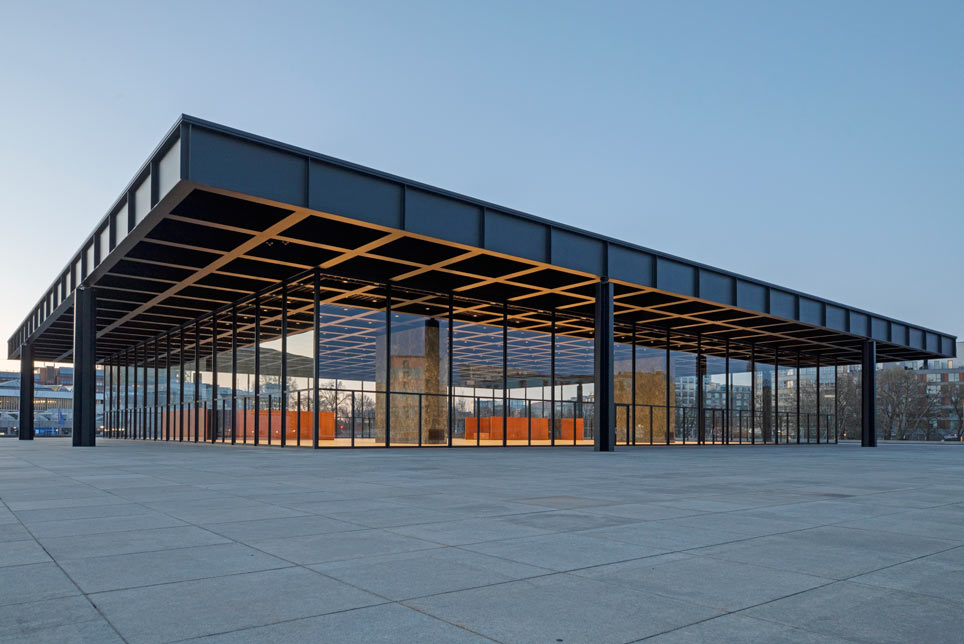
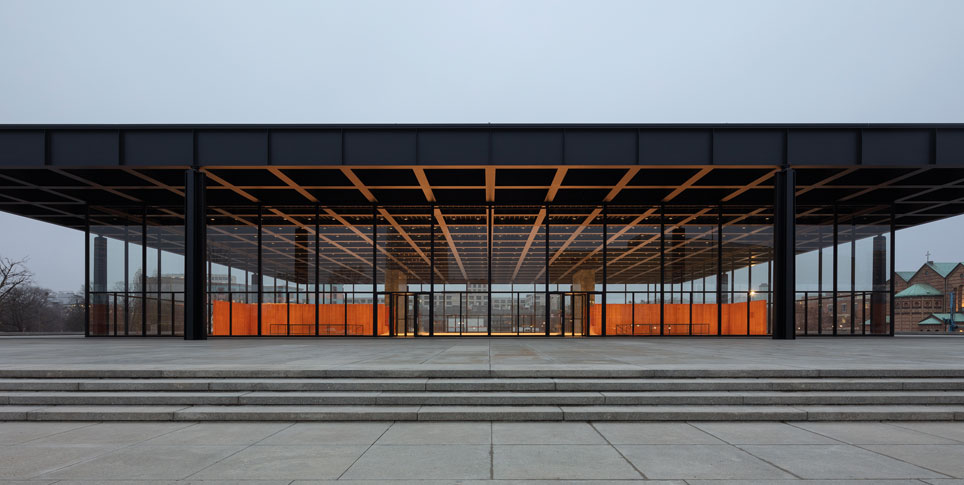
Veronika Kellndorfer: First and foremost, I see it simply as architecture. Because if I were to describe how one feels as an artist in the Neue Nationalgalerie, I would also have to speak of the anger this building provokes. Many say that the upper hall is simply not suited to exhibitions. Great artists have already failed here. Jannis Kounellis, for example. There simply isn’t much that would work in the Glass Hall. At the same time, I know of no other museum building in the whole of Europe that inspires me in a similar way. No Gehry. No Sauerbruch. No Braunfels. I would love to exhibit here, to explore how my works interact with the building. One of my discoveries is that the building also detaches itself very strongly from its function, intervening in the urban fabric. Ludwig Mies van der Rohe simply creates territories. When you stand in the hall on a Sunday afternoon and watch the skaters outside, that famous flow from inside to outside really does emerge; then, to come back to your question, it truly tips over into a work of art. This ambivalence fascinates me greatly. I’m interested in this ‘tipping point’ where architecture becomes an image.
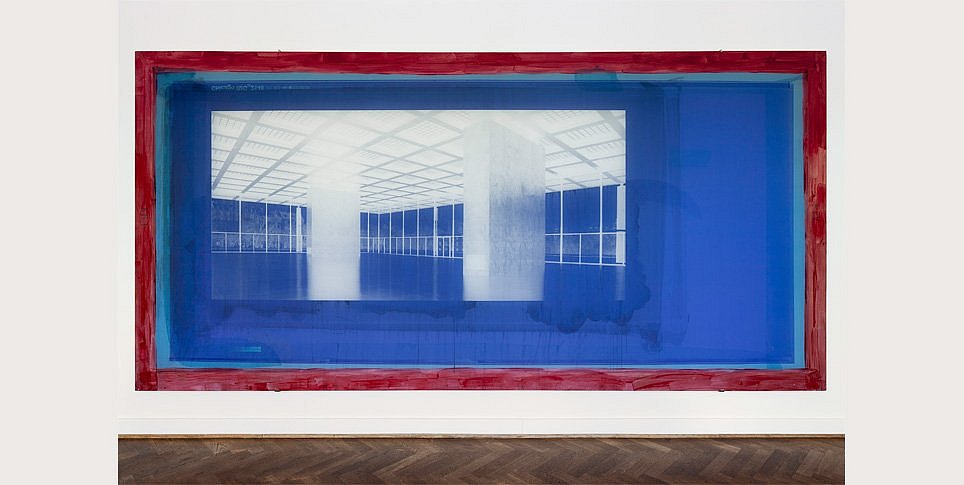
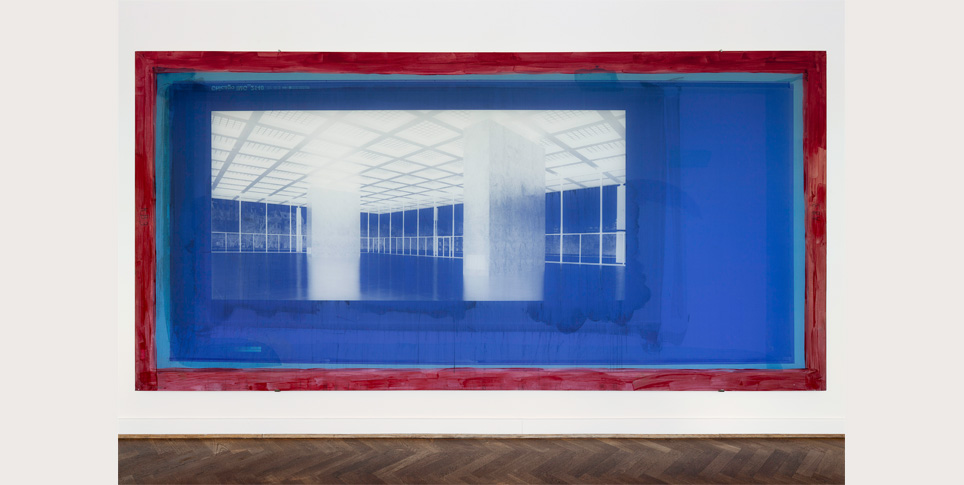
Veronika Kellndorfer: Ventilation Shaft, screen, textile fabric on aluminium frame, 200 x 410 cm. © 2020 Ulrich Schwarz, all rights reserved
To ask again: What artistic principles of Mies’s fascinate you? Is it perhaps this aesthetic of order?
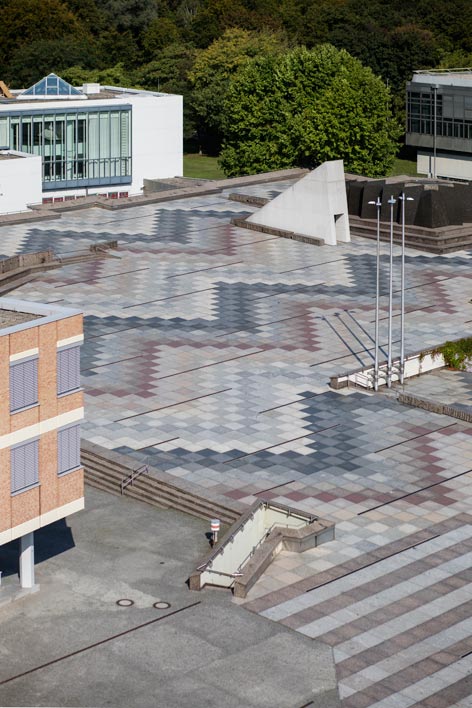
Kellndorfer: I studied painting, and I’ve always been fascinated by abstract colour-field painting. Naturally, that makes geometry incredibly interesting. The Neue Nationalgalerie is based on a grid module, after all. That’s something that’s also very important in my work. And then there are also very sculptural elements in Mies’s work. A heavy ceiling seems to float on the external supports alone, suggesting a suspension of gravity. At the same time, however, when you’re inside, you think the ventilation shafts are also supporting the roof, which they aren’t at all. They’re simply there to clad the service shafts with a marble texture.
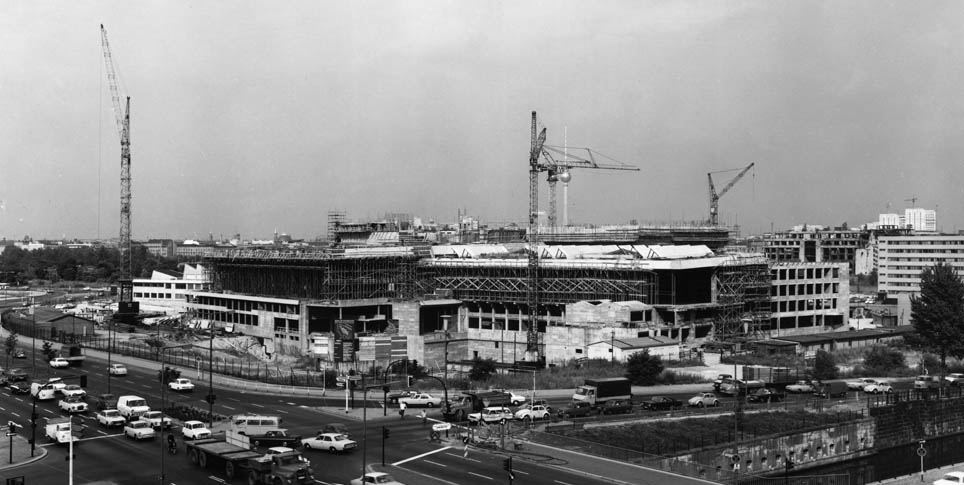
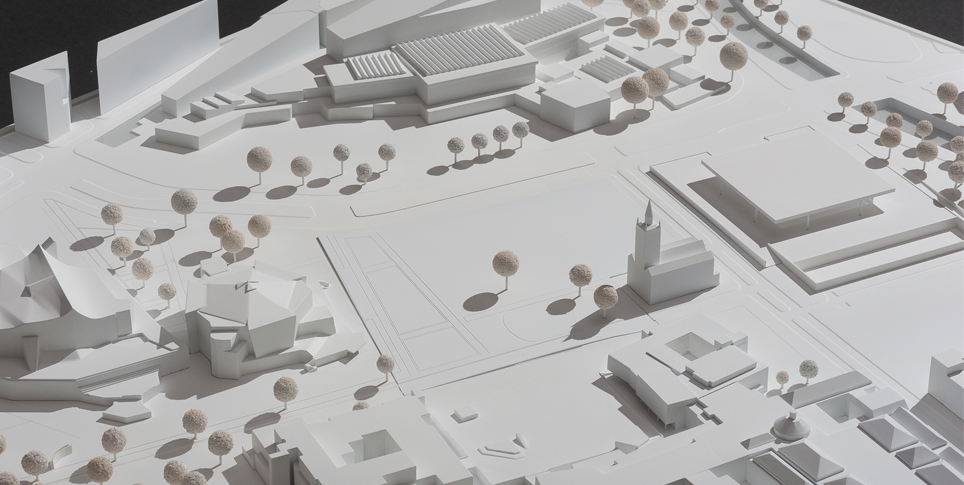
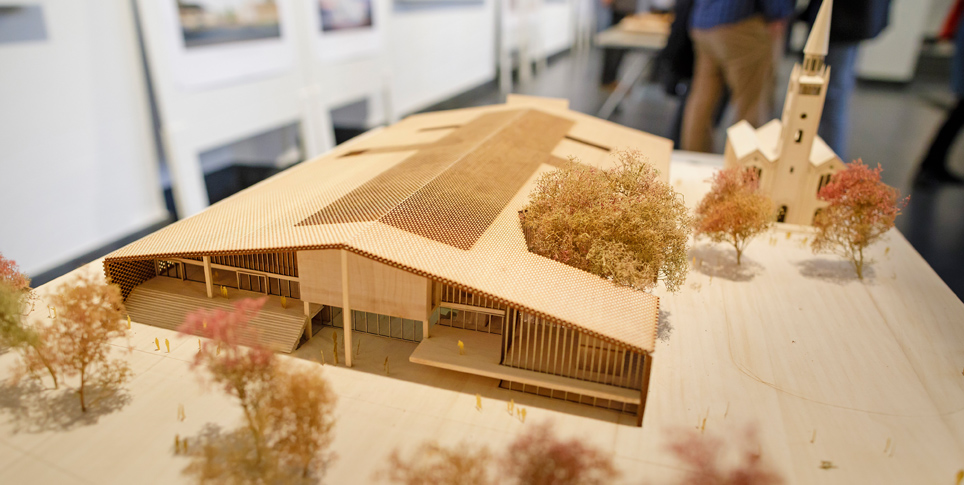
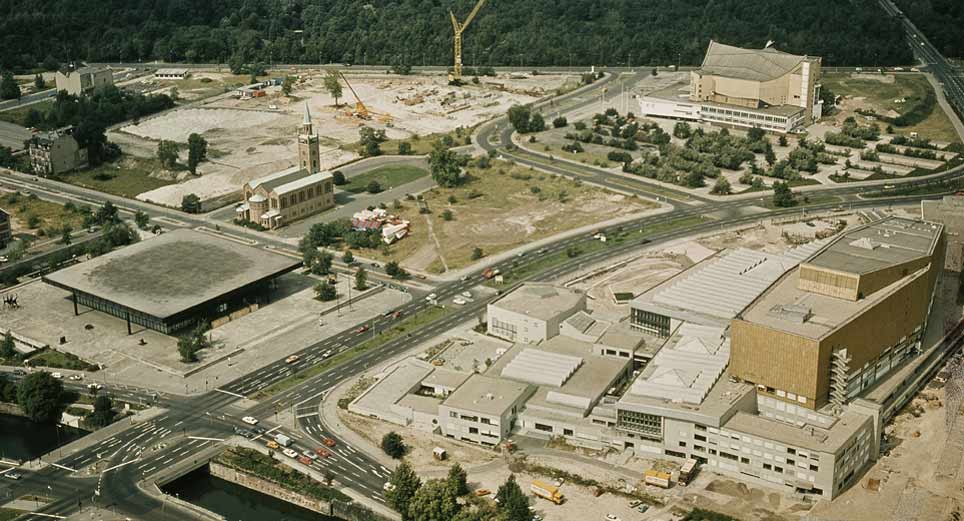
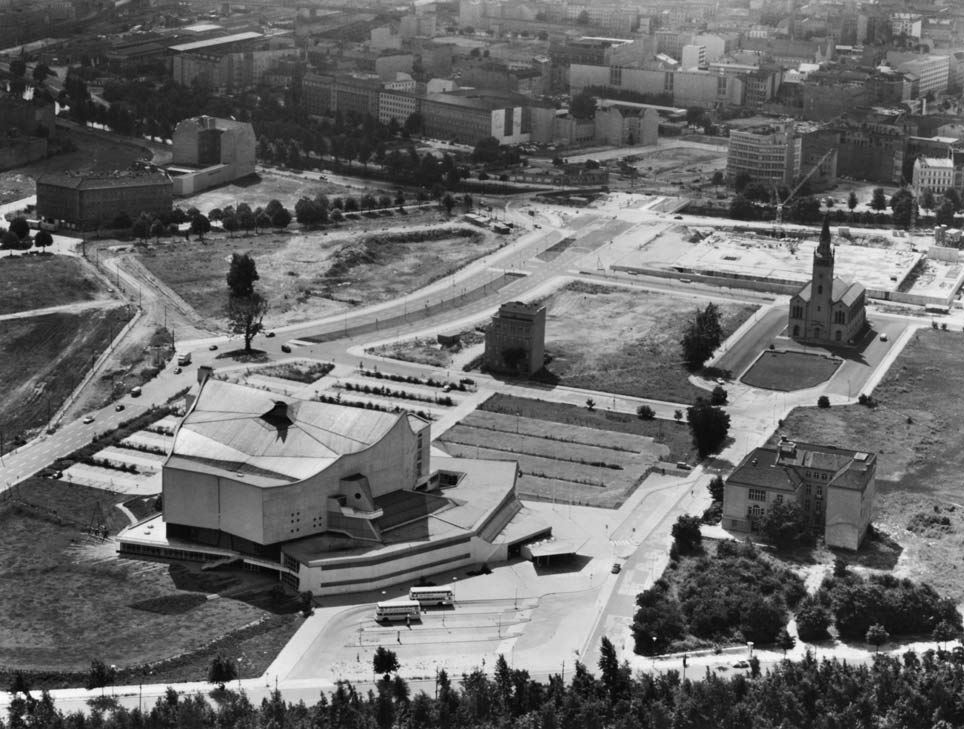
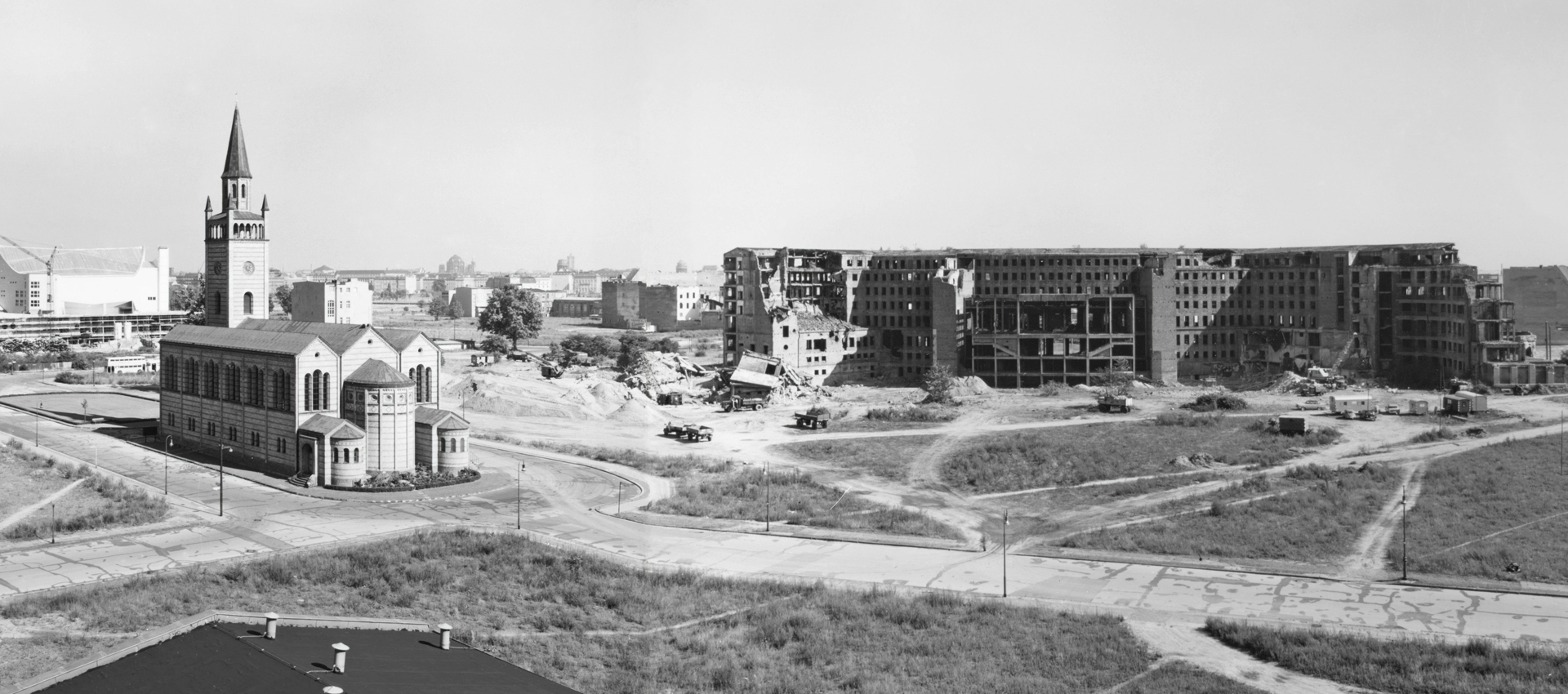
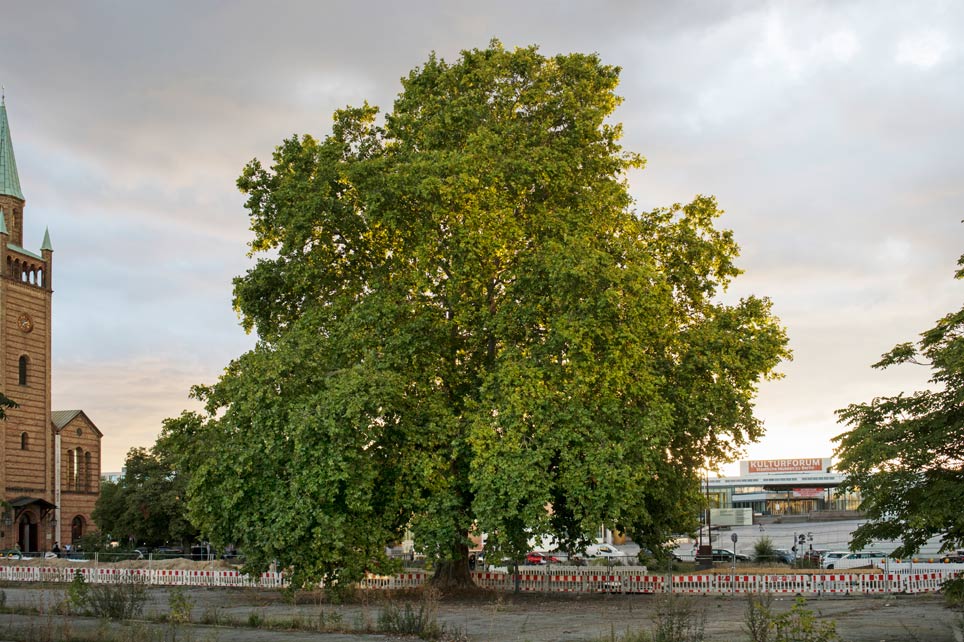
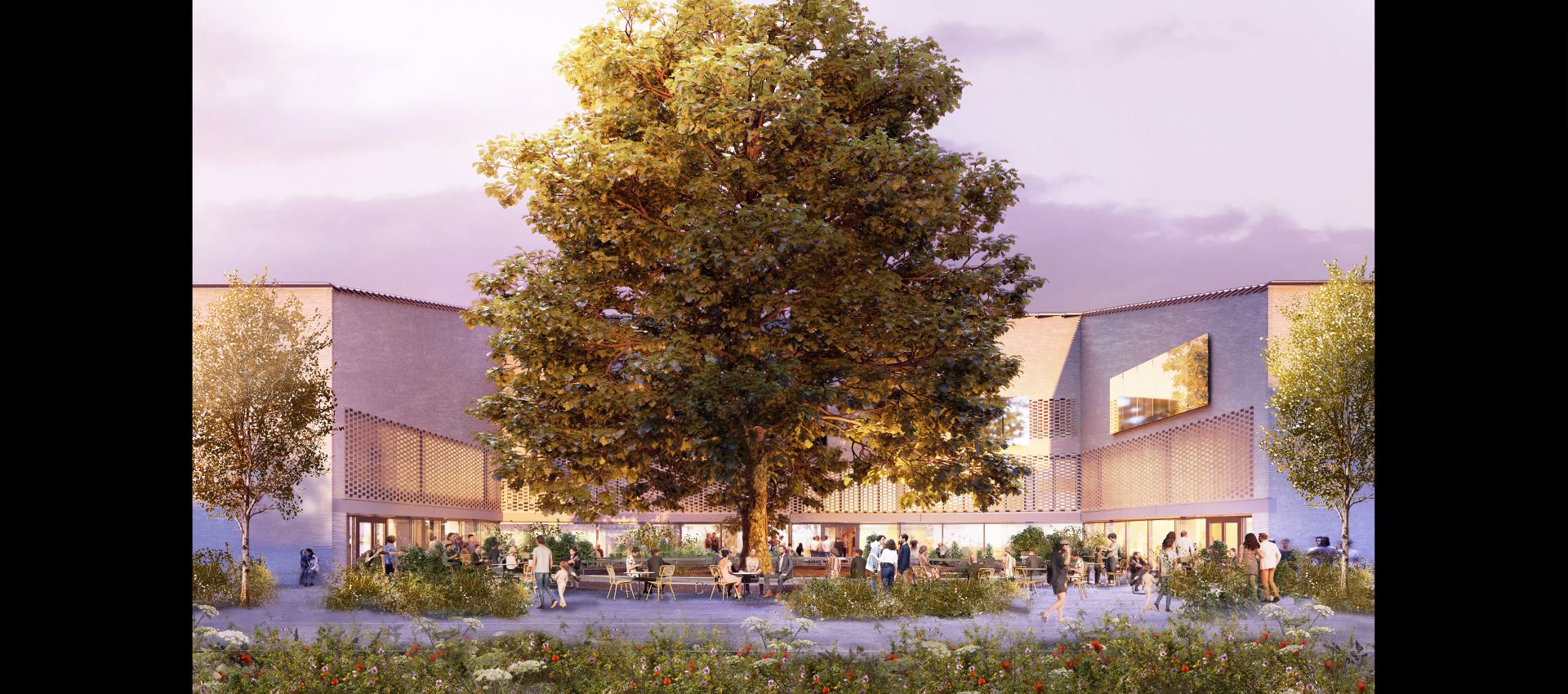
That is quite an absurd moment. And then the marble structure I mentioned suddenly continues outside with the outline of the trees. Mies has been photographed often; everything imaginable has been written about Mies. My aim is to release something that has not yet existed in this way in perception. When you stand in the Neue Nationalgalerie, you perceive the reflections that the eye actually filters out. The urban space with its traces of time, as it still exists today, will never be the same again, because everything is constantly in flux. The new building by Herzog & de Meuron will transform the site significantly. That is why it was such a brilliant moment for me to photograph the building in a moment of emptiness. Outside, only Stüler and Scharoun and the trees along the Landwehr Canal. All of this coalesces into an irretrievable conglomerate.
Could you have failed with this building too?
Kellndorfer: Yes, of course. When the director of the Neue Nationalgalerie, Joachim Jäger, asked me if I wanted to work on this building, I really didn’t know what more I could contribute. At the time, I was deeply immersed in an artistic exploration of Brazilian modernism – specifically Lina Bo Bardi. For me, the project for the Neue Nationalgalerie was a kind of flashback to my own past, as I had photographed the Barcelona Pavilion back in 2000. In 2015, I also received an invitation to the Architecture Biennial in Chicago. Sharon Johnston and Mark Lee curated the 2017 edition under the title ‘Make New History’. They were keen to bring the Neue Nationalgalerie to Chicago. And then there was another stop. Barry Bergdoll presented an exhibition on Mies’s McCormick House at the Elmhurst Museum. So the circle is now complete with the Lemke Country House.
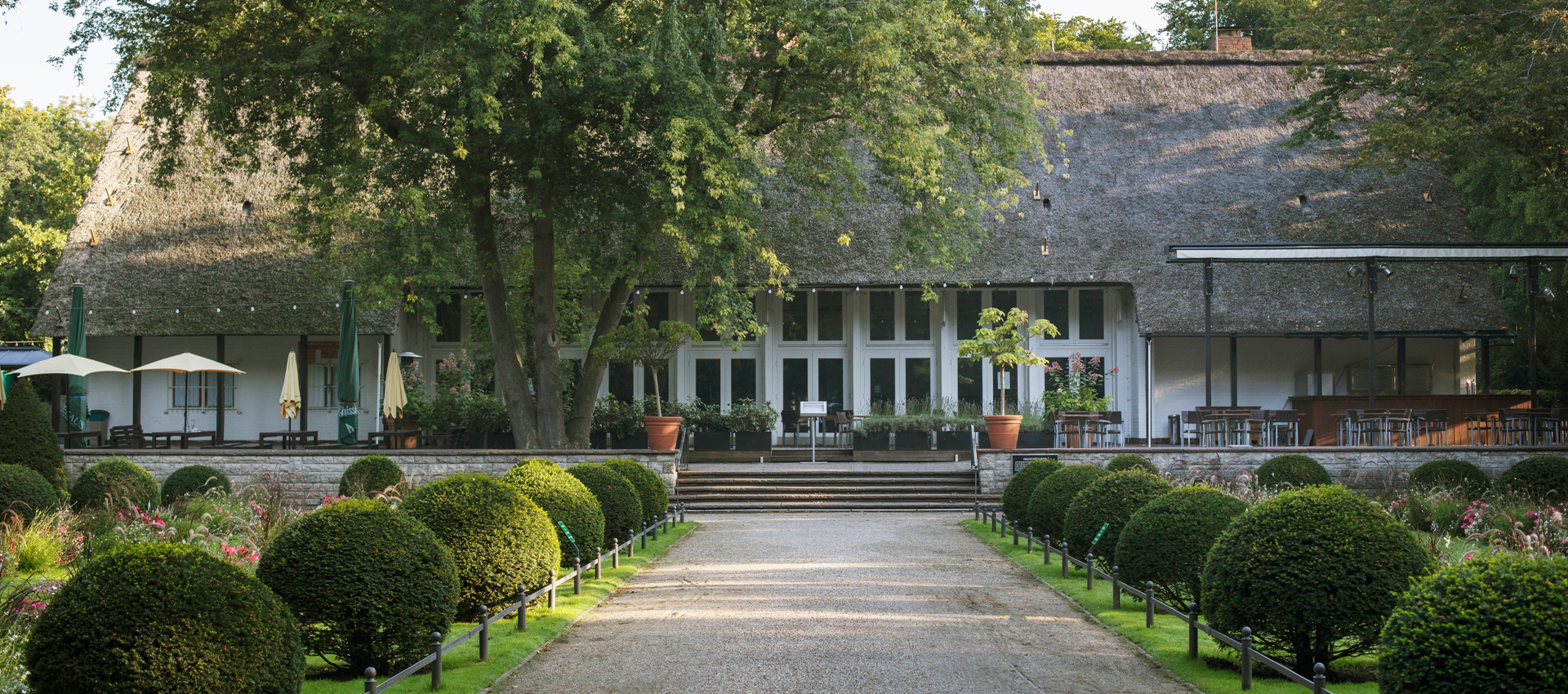
You exhibited at the Mies van der Rohe House, and it was actually a mixture of three different levels coming together here: there is Mies as the subject, then there is the Neue Nationalgalerie as a temple of modernism, and then there is the Lemke Country House as the actual exhibition venue. How did you experience this ‘Mies cubed’?
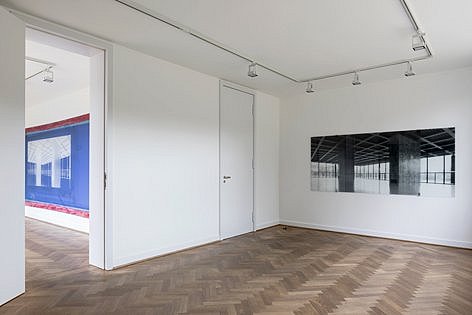
Kellndorfer: It could, of course, have been a bit over the top. But the exhibition cycle “Space-Time Odyssey” pointed in a different direction. For me, it was incredibly exciting to present the Neue Nationalgalerie within a house designed by Mies – with its traces of life, of time, of the inhabitants. So one work ended up in the bedroom, another in the living room, and so on. I don’t have this intertwining of temporal layers elsewhere. Something happens within this intertwining.
What exactly?
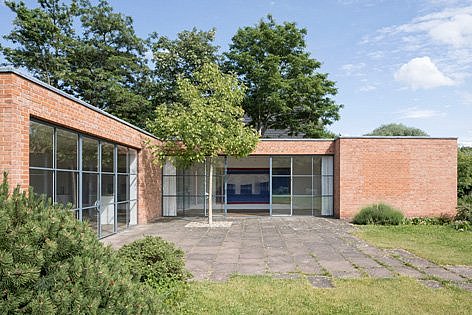
Kellndorfer: Here we have brick and glass. And the Neue Nationalgalerie is, aesthetically speaking, thirty years ahead. It is an archaeological site, modernism as our ruin, from which we too, as visual artists, draw inspiration. So I was looking for a break for the Mies van der Rohe House, and suddenly the screen from screen printing came into play – the textile, which always plays a role with Mies. That was also my starting point back then for the Barcelona Pavilion, where the large red velvet curtain joins the glass and the stone.
How important is glass as a material for your art?
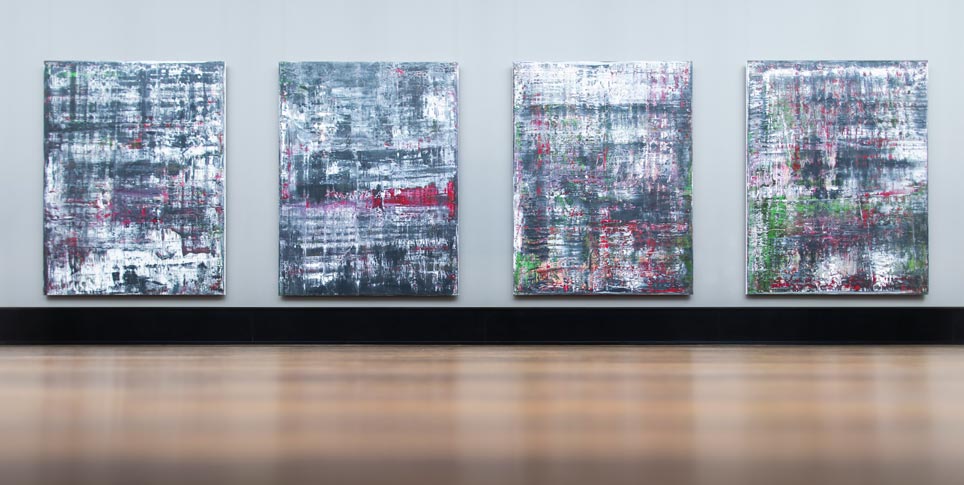
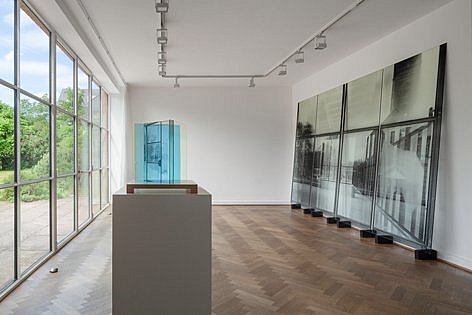
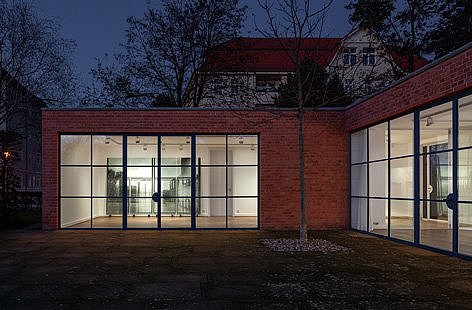
Kellndorfer: Simply essential. I’m not a photographer, but a painter who works with photography and then adds a transformative process in between. That’s why there are no photographs on display here, but screen prints. These are reductions in their own right. The object merges with the material. The glass absorbs the reflections and glare from the room. Not just the room, but the viewer too. In the case of the Lemke House, there is the added element that the real window structures here merge with those of the printed Neue Nationalgalerie. It was a gift to exhibit here. The place, the territory, is special because here the interior and exterior truly intertwine. Just the way the house sits on this plot, how it corresponds with the reflective surface of the lake. Of course, this works quite differently in an urban setting.
Through your works, you create space in a variety of ways. Sometimes emotional spaces emerge simply through the incidence of light, a ray of sunshine. These emotional moments of an intimate private home intertwined with the temple that is the Neue Nationalgalerie.
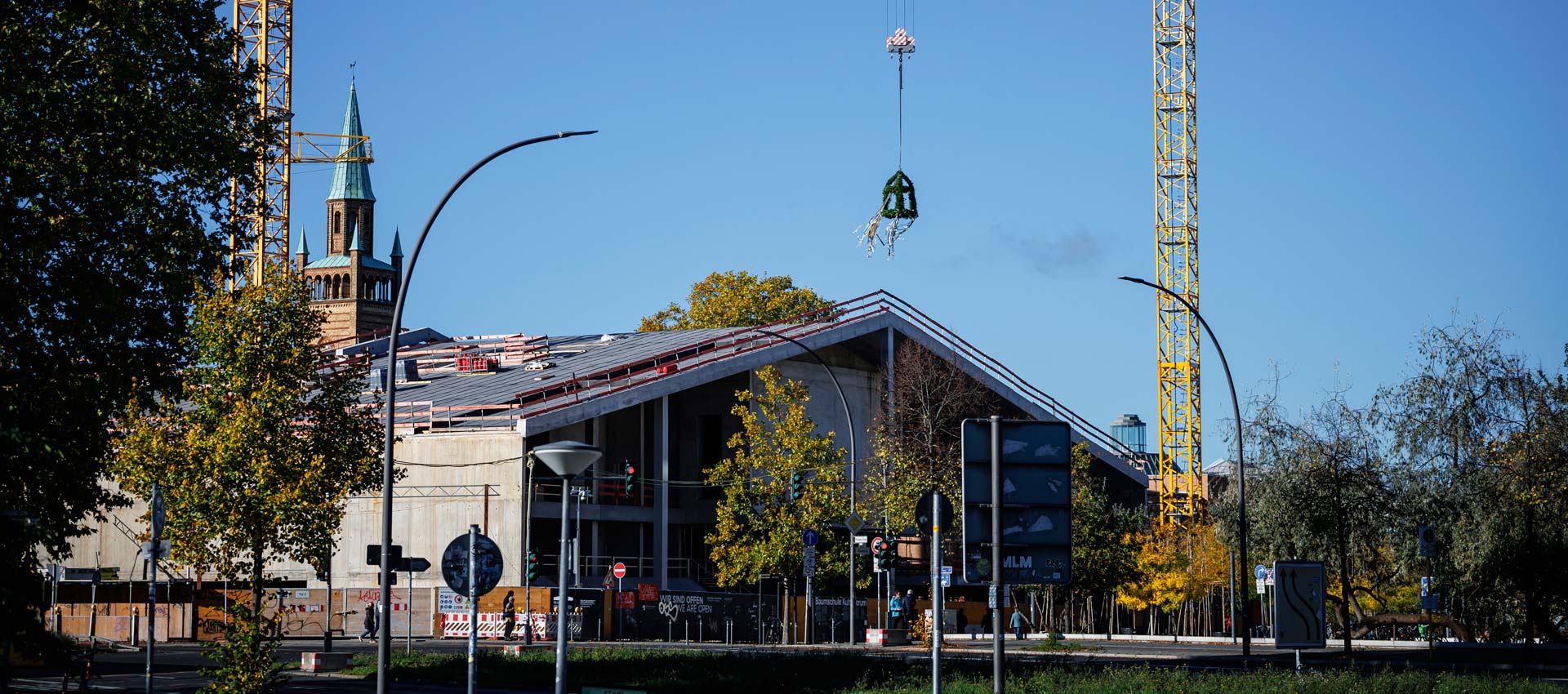
Kellndorfer: That’s a lovely observation. But I also perceived the art-less Neue Nationalgalerie as very intimate. Suddenly, memories of my student days in the 1980s in West Berlin came flooding back, where the Neue Nationalgalerie always radiated a sense of: if you’ve ended up there, then you’ve made it. Because this building has always held its own. It was, after all, a statement in itself to opt for this glass box, of all things, in the revolutionary year of 1968, when glass was shattering everywhere. That is a statement in itself. The dawn of modernism that emanated from this city has always moved me. But I am interested in the social utopia of architecture, which is also present here in the Lemke House. Modern architecture is for everyone. We are all familiar with the questions that Neutra and Schindler also posed and answered: How do we want to live, what scale do we need? It upsets me that this social utopia of architecture is currently being confronted with an economic, money-driven architectural property mess. This new money-driven narrow-mindedness almost brought down the Friedrichswerder Church as well. For me, architecture is also very political, and as a painter I find it interesting to work my way through the history of modern architecture. Art has something to do with radicalisation. One is allowed to have memories, but things must also be taken further. Architecture is my horizon of friction.
You also said that you were moved by the Lemke House. Two works emerged from this, much smaller ones that do not overwhelm, but force visitors to concentrate. They are more like sculptures. How important was this work to you?
Kellndorfer: I felt a strong need to connect with this place. I do that by taking photographs. It was a spring day and I really admired those shifting moods of light. It quickly became clear that they should be small glass works for the house. But ones for the space, not for the wall. They are the doors that connect with the large panes of glass, yet also stand on their own.
How important is colour to you, actually?
Kellndorfer: I remember my student days, when there were fellow students who would sit for days on end in front of grey colours, meditating on monochrome surfaces and pondering the right shade of grey for weeks on end. A kind of hypersensitivity was created. That was an impulse for me: I want what I see to be in the pictures. At the same time, this sensitivity, this sense of colour, has to be incorporated. This balancing act is a crucial process in screen printing. Black and white is brilliant, but colour and transparency are the essence for other motifs. I can also spend days meditating on colours and poring over colour charts. Then I have mixtures made at the factory until I’m satisfied. The transparency of screen printing requires the complementary contrast of the reflective colours created by the coating. Everything remains permeable and transparent. And then the light reflections in the room come into play. Painting as a projection surface – from the room onto the surface. That is absolutely central. Here in the exhibition hangs this pop-art-style red frame, which is nothing more than a screen coated with adhesive. That is the sign of a complex interplay between the craftsmen in the factory and myself. I cannot take total control of my works; I also relinquish some control. In the manufacturing process, there are always surprises. And the second moment of amazement occurs when I see the works in the space. It is about something processual. The screen is like a witness. I do not mean this didactically, but as a reference. The process itself also has an image-like quality.
It is this interaction that characterises your work – with Mies, with the space, with the layers of time, with modernism and with the material of glass. Mies’s buildings are, after all, image-making machines in themselves. You can leave them empty and they still produce images. Whatever the season, there are always images.
Kellndorfer: That is exactly what I felt here at the Mies van der Rohe House. The aim was for as many international artists as possible to work here. It is not an exhibition space like any other. One cannot help but reflect on the architecture as well. This house radiates outwards into the city.