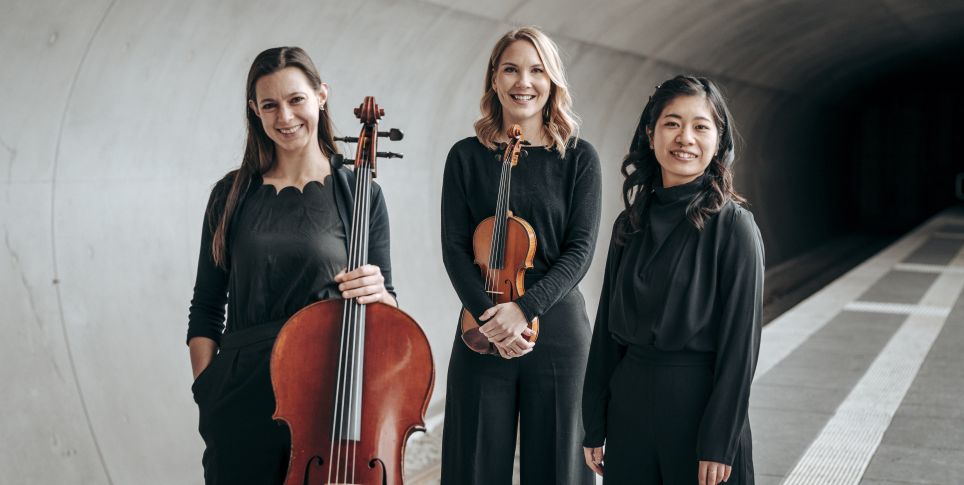
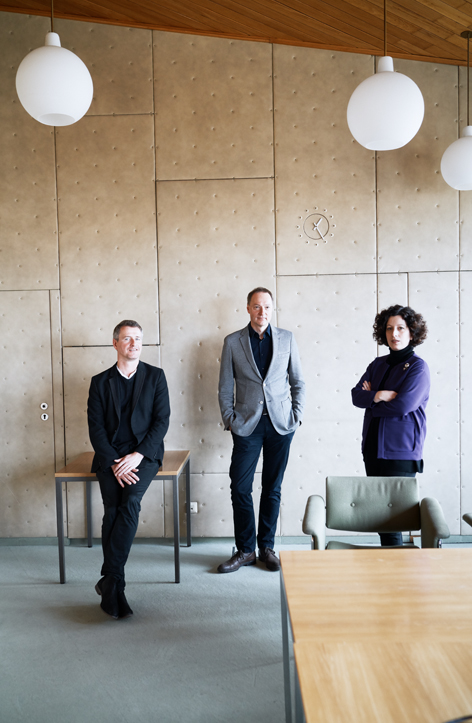
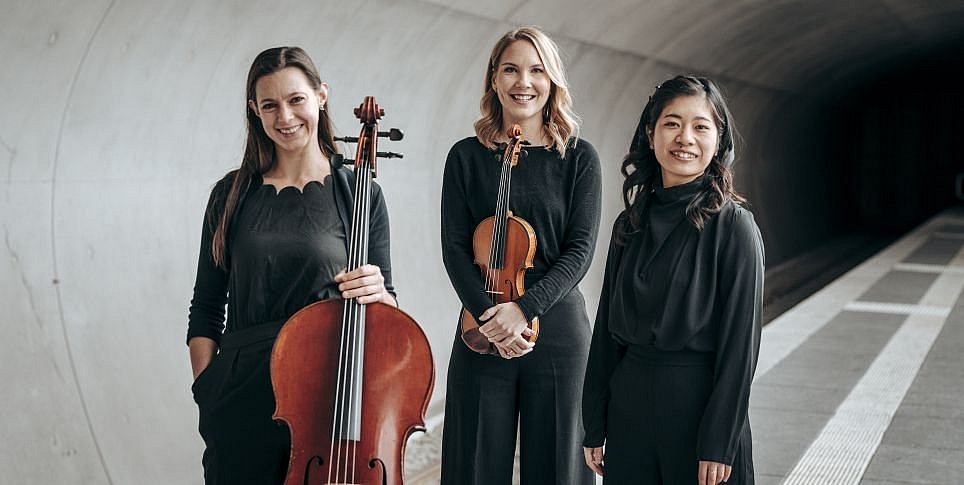
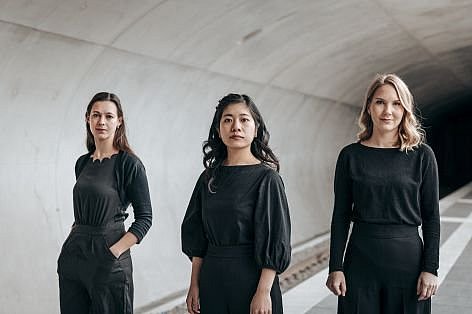
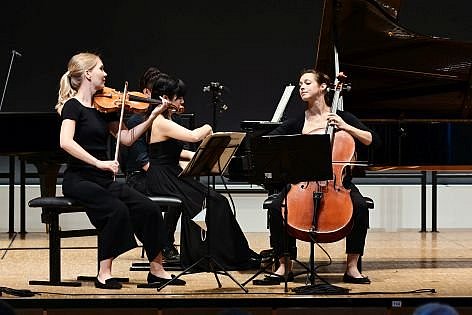
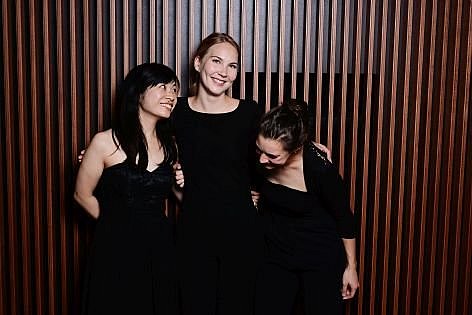
Hanna Ponkala-Nitsch (violin), Larissa Nagel (cello) and Rie Kibayashi (piano) make up the Hannari Trio. In 2021, they won the Felix Mendelssohn Bartholdy University Competition in the chamber music category.
You are the Hannari Trio and play chamber music together – how did you come together as a trio and what are your respective backgrounds?
Hanna Ponkala-Nitsch: We formed during the pandemic. We all studied chamber music at the Frankfurt University of Music and Performing Arts (HfMDK). None of us were part of a permanent ensemble and we wanted to change that. So it came about that Rie and I discussed starting a project together. We already knew each other from the Karlsruhe University of Music. Shortly afterwards, Larissa was recommended to us and we met for the first time in the summer of 2020.
Larissa Nagel: We first got in touch back in spring 2020, but because of the pandemic, it took a while before we actually met.
Hanna Ponkala-Nitsch: It was a crazy time – we wanted to get started as a trio and coordinate dates to get to know each other, but then the first lockdown hit and nothing was possible anymore. We put everything on hold for the time being; it was almost impossible to plan anything during that period. Everything came to a standstill; there was no student life either; it all only started up again in the autumn and winter.
Rie Kibayashi: Before that, Hanna and I had already been playing as a duo. In January 2021, we finally started playing as a trio. There were two competitions at our university at the time, and playing there was our first goal as a trio.
Larissa Nagel: The first of these competitions was also our very first public performance together.
That sounds like quite an adventure. Have you grown close as a trio since then?
Rie Kibayashi: Absolutely. We’d only just met and didn’t know yet whether it would work out. But we soon felt that we could trust each other on stage and enjoy playing together. That was lovely, and the juries probably picked up on it too.
How did the nomination process work? Did the university select you after you’d won the HfMDK’s internal Lenzewski Competition?
Larissa Nagel: Exactly. After the Lenzewski Competition, we were asked if we’d be interested in taking part. It was a huge challenge because everything happened at such short notice. We hadn’t been playing together for very long and, as a trio, we first had to gel. At the same time, we had to rehearse the entire repertoire from scratch. Nevertheless, the nomination was of course brilliant because it gave us a new goal straight away and we were really keen to take part.
Rie Kibayashi: It all happened in quick succession: we’d only just really started playing together, then in February came the first concert and the competition, and in the summer we immediately started preparing for the FMBHW in September.
How did you prepare?
Hanna Ponkala-Nitsch: In addition to our regular rehearsals and lessons, we regularly recorded ourselves playing and analysed the recordings. In the summer immediately before the competition, we also took part in the International Summer Academy in Frenswegen. That was very intensive and helpful; there were also several other trios there who were taking part in the FMBHW. So we were able to prepare and exchange ideas together whilst everyone was rehearsing the pieces for the competition.
Rie Kibayashi: That was really a very intensive period. We had two to three lessons a day, with lectures, workshop concerts and rehearsals in between.
So you were very well prepared. Were you still nervous before the competition?
Larissa Nagel: I’m actually always a bit nervous. I actually find that quite lovely, because it shows that what happens on stage matters to me, and it gives me a pleasant sense of tension and the necessary concentration and energy. As a chamber musician, it’s still easier on stage; you’re not alone, after all. There’s a great deal of trust between the three of us, and that’s something incredibly wonderful – because chamber music isn’t just about harmonising well in terms of tempo and timbre, but it’s also about feeling something together. Working that out can be very exhausting, because you have to constantly communicate and listen to yourself. But then standing on stage together at the end is very rewarding.
Hanna Ponkala-Nitsch: I think we were also really looking forward to the competition, because we’d worked very hard beforehand and it was a great feeling to be able to showcase the result on that stage. But the competitive situation, where you’re ultimately judged, is quite different from a normal concert. So yes, we were nervous.
What was your experience of the competition?
Hanna Ponkala-Nitsch: It was certainly a stressful time. We worked hard and were looking forward to showing what we could do – but at the same time, there were also high expectations of ourselves. No matter how well prepared you are, it’s still a huge challenge, especially mentally. I had to keep reminding myself to enjoy the moment and have a good time with the other ensembles. After all, it’s all about the music! It was also lovely to see Berlin and just let the city work its magic on me.
Larissa Nagel: The desire to enjoy the moment is at odds with the pressure to perform with the necessary perfectionism in the competition so that everything goes smoothly. But on the whole, it was a positive experience to be part of the FMBHW.
Rie Kibayashi: It was also good that we’d already got to know many of the people from other universities who were taking part in the competition beforehand. That meant we already had a good foundation for chatting and making the most of our time together.
Did you have any inkling during the competition that you might be the winners? Can you tell whilst playing how your performance is being received?
Larissa Nagel: We naturally went into the competition with the clear ambition of winning it. Beforehand, we’d even joked that I could buy myself a tablet with the prize money – up until then, I’d always played from paper scores, which sometimes got a bit chaotic when turning the pages for certain contemporary works... but we were completely surprised when we actually won. It was lovely, but we hadn’t expected it at all.
Hanna Ponkala-Nitsch: We had absolutely no contact with the jury during the competition, and there are no clues as to how they will judge. It’s also very difficult to anticipate their assessment, because once the technical standards – the craftsmanship of the music – have been met, that’s when the subjective evaluation begins, and then it depends entirely on the composition of the jury and the discussion within the jury. But that’s just the way it is with music – in the end, we were delighted that this jury understood us and thought highly of us.
The FMBHW is a very old and prestigious competition – did taking part, and above all winning, give your career a boost?
Larissa Nagel: Absolutely. Before the competition, we didn’t really have a career at all, as our trio had only been together for a few months. But as a result of the competition, we definitely received more bookings. We’ve played a lot since then and developed even further as a trio.
Is it a great honour for you to have represented your university there?
Larissa Nagel: It certainly is for me. I’ve been at the HfMDK for many years, having completed my junior studies here, followed by my Bachelor’s and Master’s degrees. In that respect, I’m naturally delighted for the university and, in particular, for our professor Angelika Merkle and the other lecturers such as Tim Vogler and Lucas Fels, who supported us during our preparations.
Hanna Ponkala-Nitsch: We were also given a very warm welcome here in Frankfurt after the competition. We feel very respected and valued here, which is a lovely feeling.
Do you perhaps have a few helpful tips for future participants?
Hanna Ponkala-Nitsch: If you’re competing there as part of an ensemble, I’d definitely recommend just enjoying the experience. Even if things don’t turn out as hoped, you’ll definitely return home a richer person. It’s worth using the time during the competition to make contacts with other musicians from all over Germany.
Larissa Nagel: You should try to take pleasure in playing for the people there, and not be too preoccupied with pleasing the jury. Every jury is different and it’s impossible to predict which criteria will ultimately be decisive. On the one hand, that can be frustrating because you can’t really prepare for it; on the other hand, it also takes the pressure off the situation and hopefully allows you to relax a little.
Hanna Ponkala-Nitsch: You should always remember that there are lots of other people there who want to hear you play, not just the jury. So you should also play for the other guests.