Cataloguing and digitisation of Claudio Abbado’s music library
Not only in Berlin, but all over the world, the name Claudio Abbado evokes the musical legacy of one of the most significant conductors of the late 20th and early 21st centuries. As Herbert von Karajan’s successor, he took over his legacy in 1989 as the long-standing chief conductor of the Berlin Philharmonic and held this post until 2002. Following his death in 2014, his estate was initially transferred to the Fondazione Claudio Abbado, established by his heirs. After being examined and sorted into the various types of material, the estate then found its way into the Music Department of the Berlin State Library via a deed of donation. It is now the fourth estate of a chief conductor of the Berlin Philharmonic to be held there, as alongside the Abbado estate, the Berlin State Library also holds the estates of Hans von Bülow, Arthur Nickisch and Wilhelm Furtwängler. But Claudio Abbado is also being honoured in a very public way: since the reopening of the building on Unter den Linden in February 2021, there is now a Claudio Abbado Hall on the floor above the music reading room. It is therefore to be expected that the name Claudio Abbado will once again be mentioned frequently in future, particularly among users of the Berlin State Library, once the construction work there has been completed.
Undeterred by pandemic-related restrictions and with the support of project funding from the Federal Government Commissioner for Culture and the Media and the Ernst von Siemens Music Foundation, the music library from the estate has been catalogued since September 2020 and, where copyright permits, digitised as well. In addition to the music library, comprising some 2,000 volumes, Abbado’s estate also contains approximately 400 volumes of musicological literature, 2,500 sound recordings and more than 20,000 letters.

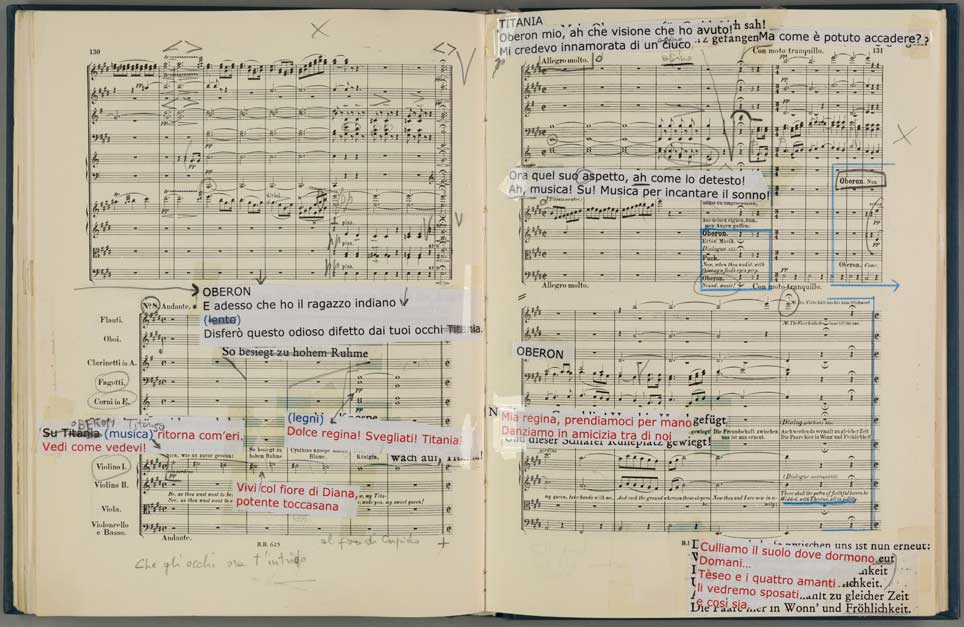
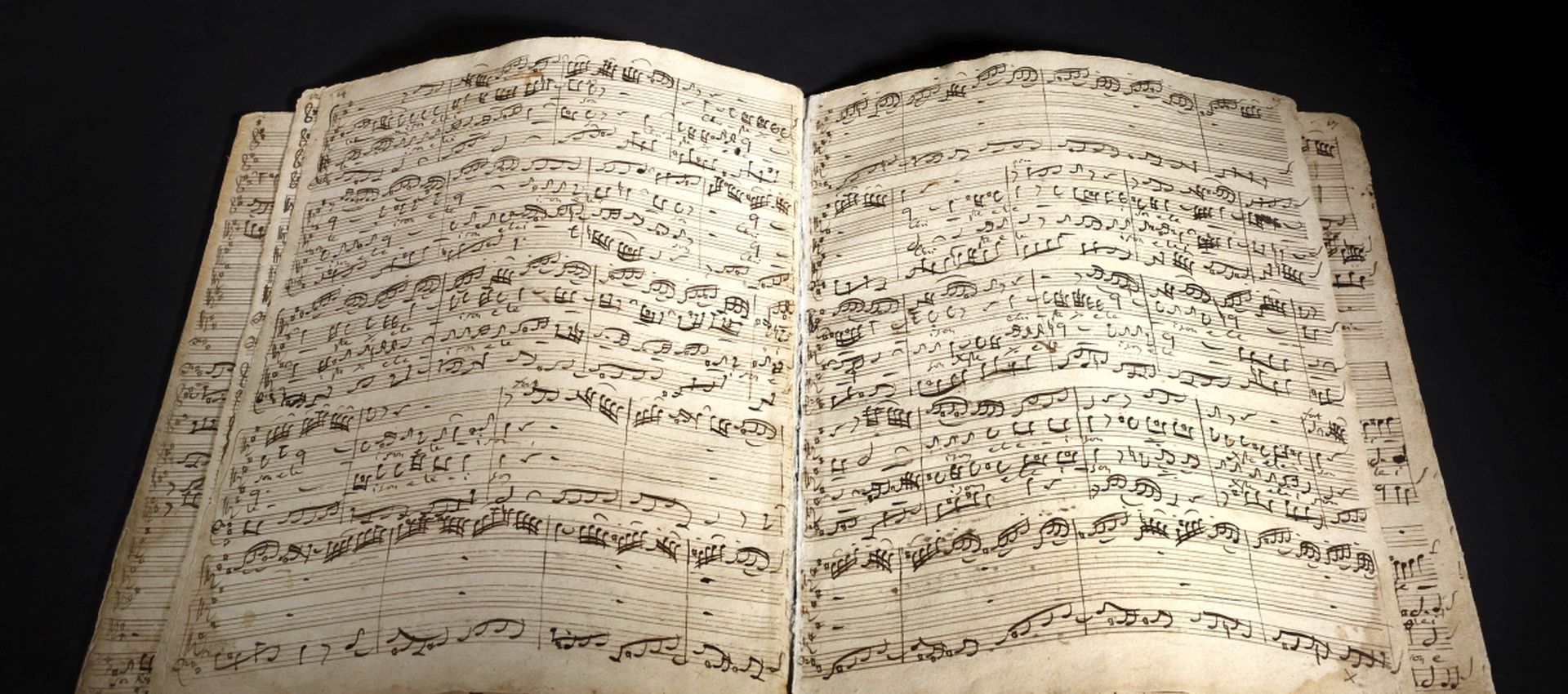
Score of the incidental music to ‘A Midsummer Night’s Dream’ by Felix Mendelssohn-Bartholdy. In addition to the numerous handwritten notes, passages of text in German and Italian have been pasted in at a later date (55 Nachl 110 B3-09, pp. 130–131)
The 2,000 volumes in the music library cover a wide range of composers and periods. Scores by Wolfgang Amadeus Mozart (with 179 volumes) and Franz Schubert (with 90 volumes) are particularly well represented here, and works by composers such as Arnold Schönberg and Wolfgang Rihm are also present in Abbado’s music library, with around 20 to 30 volumes each. By contrast, there is only a single score each by the composers Frédéric Chopin and Aleksandr Scriabin. One could, of course, draw conclusions from this as to which works Abbado rehearsed and worked on most frequently, and indeed Mozart is among the composers most frequently performed by Abbado. However, Abbado’s handwritten annotations, which are present in the majority of the scores, provide deep insights here and make it clear that the mere number of scores by a particular composer should not be the sole indicator of the intensity and frequency of Abbado’s work with these pieces.
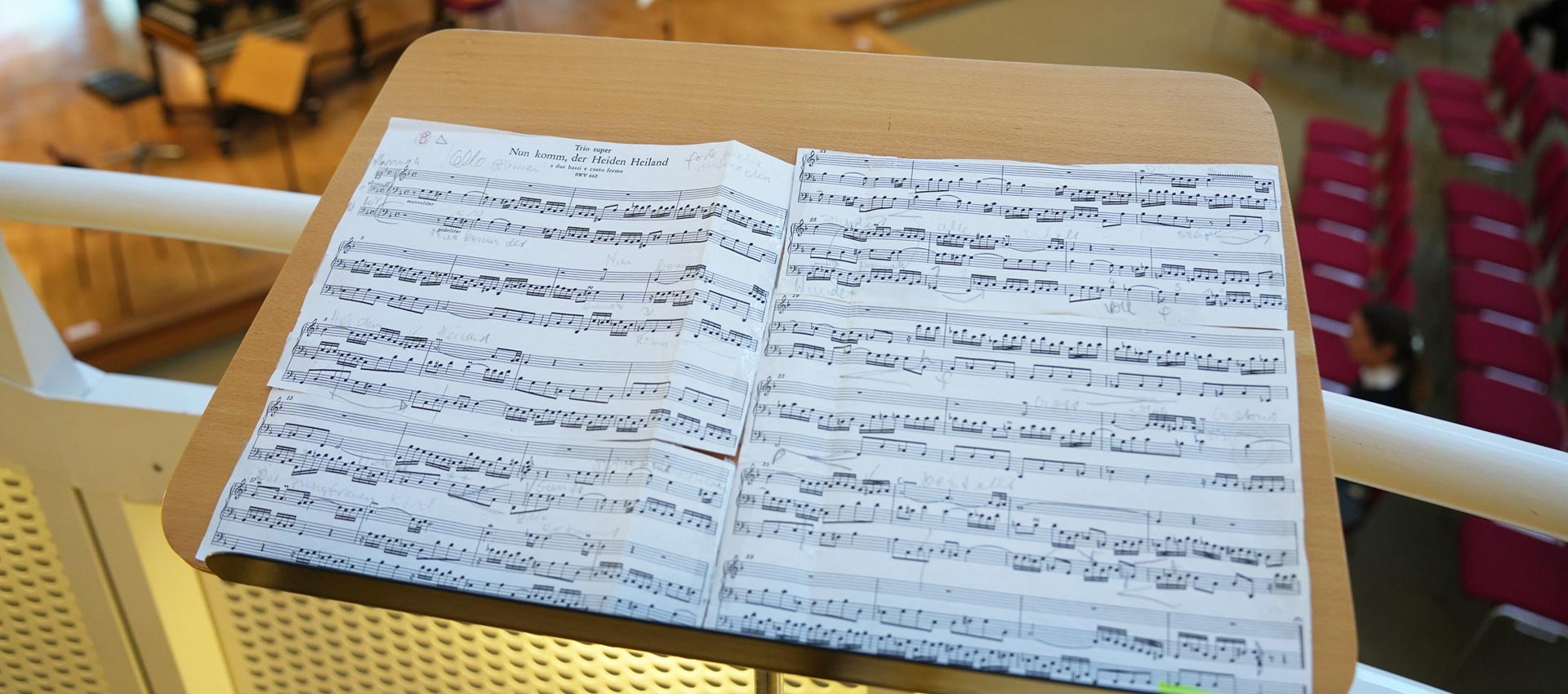
Whilst the handwritten notes in the musical text are of an interpretative nature (i.e. concerning tempo, dynamics and articulation), his notes on the title pages of the scores document organisational details such as performance venues, years, orchestras or ensembles, and, where applicable, soloists. Maurice Ravel’s Shéhérazade, for example, was performed by Abbado on two occasions: in 1989 with the soprano Margaret Price and the London Symphony Orchestra, and in 2008 with the mezzo-soprano Elīna Garanča and the Lucerne Festival Orchestra. Like the score of Ravel’s Shéhérazade, the score of Gustav Mahler’s First Symphony is also present only once in Abbado’s music library. However, this does not mean that he rarely performed this work. On the contrary!
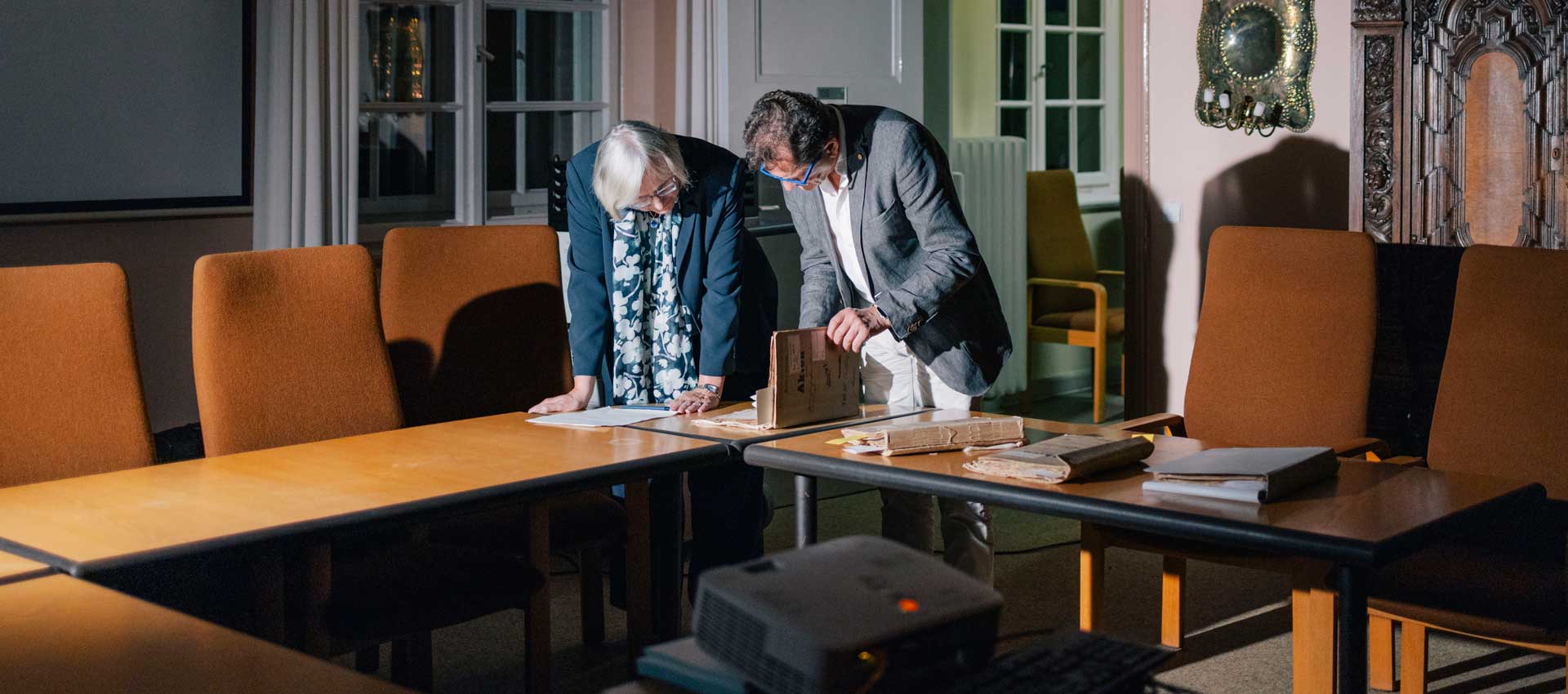
In addition to the entries in the volumes themselves, there are also numerous supplements of all kinds. Abbado’s conducting scores will likely be of particular interest to aspiring conductors, though they may seem rather cryptic to those who are not absolute Abbado connoisseurs. Even after months of cataloguing the scores and conductor’s scores, it is difficult to fathom the structures into which Abbado organised the works in his own particular way! Less cryptic, and all the more revealing, are the reverse sides of these baton notes, for Abbado was often a pragmatist here, making use of notepads from hotels, rehearsal schedules and timetables for concerts and recordings, or even old travel tickets. This sometimes allows us to reconstruct very precisely when Abbado rehearsed which work with which orchestra, and possibly even how he got there and where he was staying. Furthermore, the ownership stamps of various opera houses and concert halls (such as those of La Scala in Milan or the Berlin Philharmonie) on various scores also reveal the status Abbado had achieved in the music world. At first glance, it might appear as though Abbado ‘took the scores home with him’. However, the materials were made available to Abbado for the respective productions at the venues and were subsequently left in his care. They thus became his property and were ultimately included in his estate.
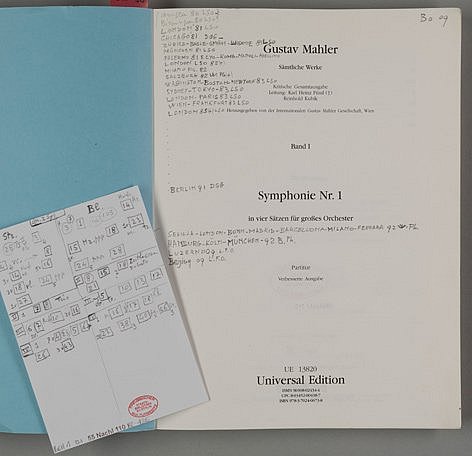
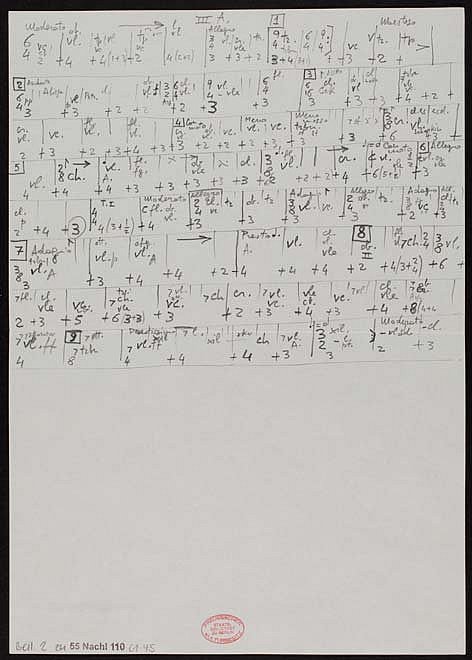
What makes cataloguing this estate so fascinating is its diversity. It contains both standard editions of well-known works and old, rare editions – such as piano arrangements of various works bearing the handwritten ownership note of Abbado’s father, Michelangelo. Sometimes the cataloguing process is quite swift, for example when dealing with a work by Arnold Schönberg in the Universal Edition, where the copyright year, catalogue number, order number and page numbers are clearly stated. This makes the research, cross-referencing in the library catalogue and creating a new record for this copy quite straightforward. In contrast, however, there are also frequent cases where, for Claudio Abbado for example, a selection of songs by Franz Schubert has been compiled from different arrangers, different editions and different publishers. In such cases, one cannot rely on consistent page references and record numbers. Consequently, cataloguing these more complex volumes takes considerably longer, yet the entries – which, incidentally, also make even the most modern and common editions unique – and what one can deduce from them make the work all the more interesting. One’s attention is particularly piqued when, during research, one comes across records for sound recordings that feature precisely this combination of composers, works, arrangers, orchestras, soloists and the conductor Abbado. In such cases, it is not unlikely that the score one has in front of one is the basis for the CD production described by that sound recording record. In any case, it is easy to lose sight of the valuable material one actually has before one’s eyes whilst immersed in the detailed work of cataloguing these scores. Occasionally listening to an Abbado recording of the work whose score one is currently cataloguing helps in this regard, is a pleasure, and broadens one’s perspective on the ‘big picture’ once more.
It is easy to imagine that musicologists and other interested parties will do the same when they access the digitised material from all over the world and gain insight into the conductor’s interpretative processes and musical-aesthetic interpretations. However, for work and research involving the volumes and supplements that cannot be made available digitally for data protection or copyright reasons, a visit to the newly refurbished Haus Unter den Linden building of the Berlin State Library is more than worthwhile!
Felicia Stockmann is a librarian in the Music Department of the Berlin State Library and works on the project to catalogue and digitise Claudio Abbado’s music library. This text first appeared in Bibliotheksmagazin 2/21 (pp. 83–87).