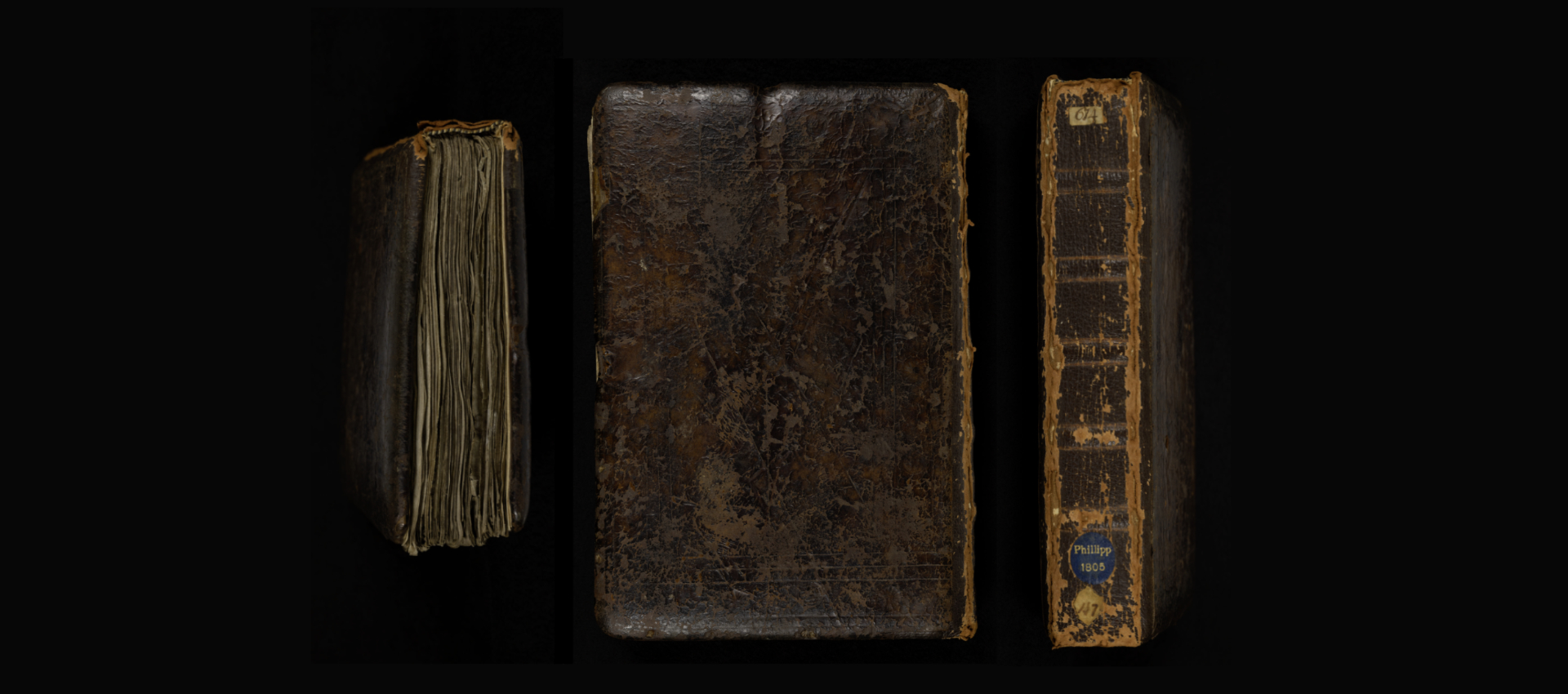
Books that had been forgotten for more than half a century are at the heart of the work of the German-Russian Library Dialogue, which brings together leading representatives from libraries in Russia and Germany.
Mr Hamann, you have been Head of the Eastern Europe Department at the Berlin State Library for 14 years and are therefore a specialist in German-Russian relations. Why does the German-Russian Library Dialogue exist and what role does the Berlin State Library play in it?
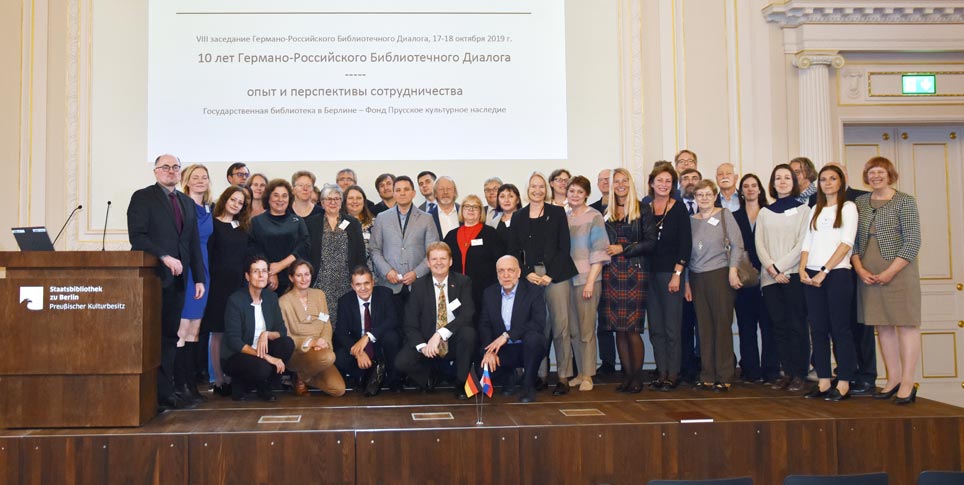
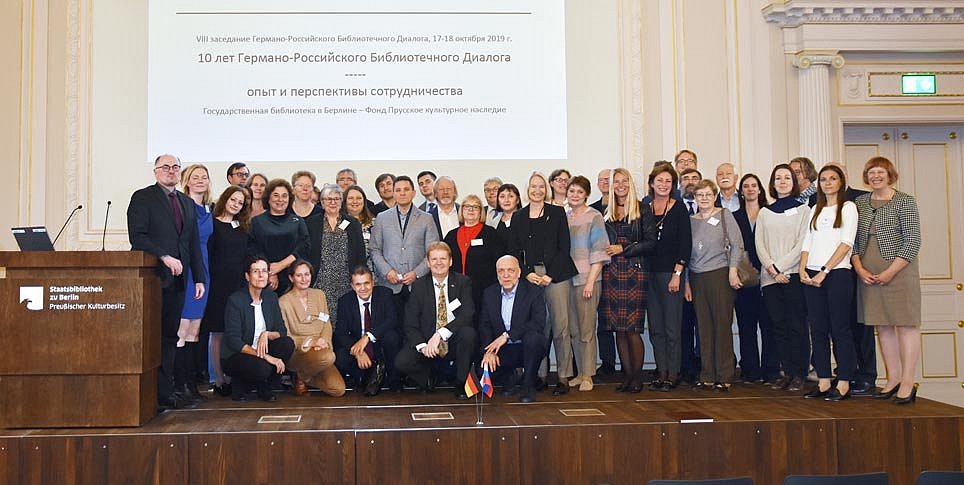
Olaf Hamann: Since 2009, the German-Russian Library Dialogue (DRBD) has provided a framework for discussions between representatives from libraries in both countries; it arose from an initiative by the Berlin State Library (SBB), the Cultural Foundation of the German States and the All-Russian State M.I. Rudomino Library for Foreign Literature in Moscow. The focus is on exchanging information about the impact of the Second World War on libraries in Germany and Russia, identifying book collections relocated due to the war in the libraries of both countries, and the joint work of German and Russian librarians on projects.
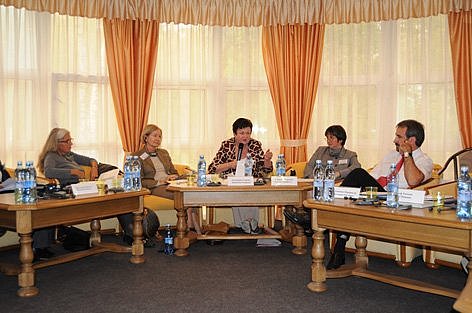
The first DRBD meeting in Valentinovka near Moscow (from left to right): I. Pfeiffer-Poensgen (Cultural Foundation of the German States), B. Schneider-Kempf (SBB PK), J. Genijewa (Library of Foreign Literature, Moscow), T. Manilowa (Russian Ministry of Culture), H. Parzinger (SPK). © SBB PK / Olaf Hamann
The predecessor of today’s State Library, the Prussian State Library (PSB), was one of the country’s leading libraries and, during the Second World War, was involved in shaping occupation policy, exerting influence over libraries and their collections in the occupied territories. Due to the evacuation of its own collections, the PSB itself suffered significant losses: of more than three million volumes at the start of the war, almost 730,000 are now listed in the State Library’s catalogue as war losses, whilst the current location of a further 30,000 titles is known to be in libraries in Russia or Poland.
Dealing with the relocated book collections involves both a technical and a political aspect. Librarians in Germany and Russia had already laid the groundwork for a professional exchange on these issues as early as 1992. Politicians have also addressed the matter, but have failed to find common ground. As the relocated books were to be made available for use, the aforementioned institutions sought in 2009, together with the DRBD, to reorganise the professional discussion and engagement and thereby promote the processing of the books. The SBB has taken on a coordinating role on the German side and is liaising closely with the relevant institutions in Germany and the Russian partner libraries. The former Director General of the SBB, Barbara Schneider-Kempf, had previously also held the co-chairmanship of the DRBD on the German side. The new Director General, Achim Bonte, has agreed to continue in this role.
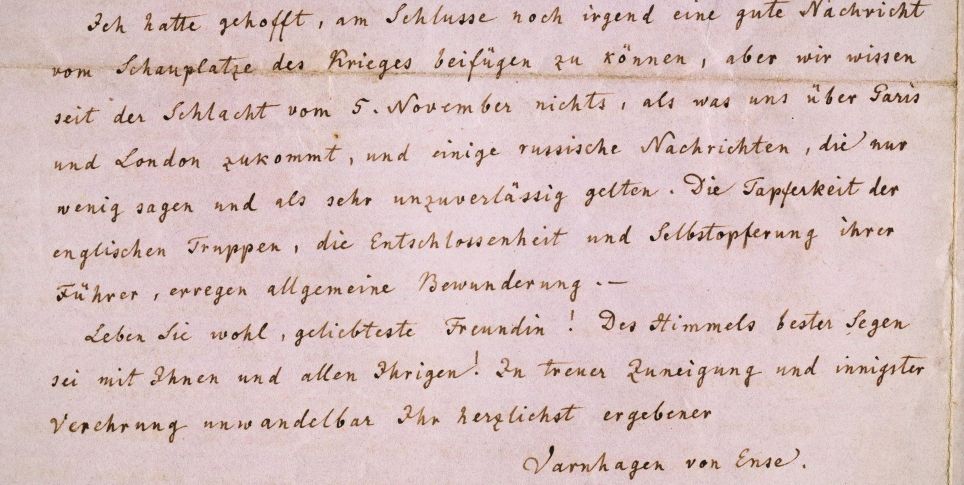
The encounter with Charlotte must also have made a deep impression on Varnhagen. His reply to Charlotte’s first letter marked the beginning of a witty correspondence. In his letters, Varnhagen expresses his affection for his correspondent, and later his love for her. He also provides Charlotte with a wealth of information about political, social and cultural life in the capital, including newly published books, concerts, exhibitions, state visits and other political events. The Bonhams auction catalogue features lengthy excerpts from Varnhagen’s letters, which clearly demonstrate their significance as historical documents. These letters also reveal that Varnhagen had truly fallen in love with Charlotte. After their first meeting in Wiesbaden, they met in person on several further occasions. In 1839, Varnhagen asked Charlotte to become his wife, but she declined this request, evidently without the warm and deep written relationship between the two suffering as a result of this refusal.
Not only Bonhams auction house, but also the English owner of Varnhagen’s letters, Charles Harvey—a descendant of the Williams-Wynn family who had consigned the letters to Bonhams—contacted me to ask whether the Berlin State Library was interested in acquiring them. I replied immediately in the affirmative, but added that this wish could not be fulfilled without sufficient funds for acquisition.
An excellent article on Varnhagen and his insightful letters to Charlotte appeared in the Frankfurter Allgemeine Zeitung on 29 November 2019, concluding with the hope that the Berlin State Library might indeed acquire these letters. This article, including its final sentence, was read attentively by the Berlin entrepreneur Hans-Jürgen Thiedig. Mr Thiedig subsequently contacted me with an offer to support the Berlin State Library in its efforts to acquire the Varnhagen letters. During a telephone conversation, Mr Thiedig spontaneously pledged a five-figure sum as a donation. I gratefully accepted this wonderful offer on behalf of the library. The week before, I had already made contact with the Bernd H. Breslauer Foundation and enquired whether this foundation could assist the library. When Felix de Marez Oyens, President of the Breslauer Foundation, also held out the prospect of a five-figure sum and the Berlin State Library contributed a comparable amount from its acquisitions budget, I was able to take part in the bidding process by telephone on 4 December 2020. I was delighted when I gradually outbid the other bidders and was able to acquire Varnhagen’s letters for the Berlin State Library. Shortly afterwards, a brief email from the previous owner, Charles Harvey, landed in my inbox: “Dear Professor Overgaauw: Was it you?”. My reply was even shorter.
When the Varnhagen letters arrived at the library in mid-January 2020, I was able to confirm the relevance of the new acquisition after reading several dozen letters. Varnhagen possessed what we nowadays call insider knowledge. Like few others, he was connected to the political and cultural elite of his time. His knowledge of Berlin society can be seen today not only in his rich diaries, but also in his letters to Charlotte. Peter Sprengel, Professor Emeritus of German Studies at the Free University of Berlin, was also impressed by the quality of these letters. He is currently preparing a monograph on Varnhagen and Charlotte, in which numerous letters by Varnhagen are to be published for the first time.
Many a beautiful story has a sad ending, but not this one.
On 10 February 2020, Charles Harvey contacted me again, this time to inform me that he had found a box in the attic of his country house in South Wales containing an envelope with numerous letters. These are the letters from Charlotte Williams-Wynn to Varnhagen that were thought to have been lost – in other words, the counterparts to Varnhagen’s letters to Charlotte, which the State Library had just acquired at auction in London. After Mr Harvey had opened the envelope and sorted through the contents, it turned out that 133 letters from Charlotte to Varnhagen dating from the period 1836–1858 had survived. The correspondence is most frequent in the period 1842–1846. Letters from the period 1848–1850 are evidently missing.
Apart from Charlotte’s residences in London and the countryside, the list of places where Charlotte’s letters were written reads like a list of holiday destinations for the European upper classes in the second quarter of the 19th century: Wiesbaden, Nice, Paris, Heidelberg, Basel, Lucerne, Bath, Rome and Bad Kreuznach. Varnhagen’s long-standing correspondence with Charlotte came to an end in 1858 with Varnhagen’s death. Charlotte Williams-Wynn spent the last ten years of her life mainly in London and the south of France. She died unmarried in 1869.
The highly educated Charlotte, as her letters reveal, was by no means averse to Varnhagen. She reciprocated his affection and kept him informed of what moved her, of the fate of her relatives, and of her views on political and religious matters. Why she nevertheless declined Varnhagen’s request to become his wife may be revealed by a close reading of the letters – or perhaps not. Was it religion? Charlotte was a devout member of the Church of England, whilst Varnhagen was a non-practising Catholic. Was it the class difference, which was significant at the time? Charlotte was undoubtedly of noble birth, whilst Varnhagen, despite the addition of ‘von Ense’ to his name, had to prove his status as a nobleman. Whilst Varnhagen was, at best, well-off, Charlotte’s family was wealthy.
Varnhagen’s letters to Charlotte were kept by her heirs following her death. Charlotte’s letters to Varnhagen were handed over by his heirs, after Varnhagen’s death, either to Charlotte or to her heirs. This explains why not only the letters but also their counterparts came into the possession of Charles Harvey through inheritance. The number of letters from Charlotte to Varnhagen (133) is considerably lower than the number of letters from Varnhagen to Charlotte (350). There is as yet no satisfactory explanation for this difference. Did Varnhagen write more frequently than his pen pal? Did Charlotte’s heirs weed out unwelcome letters? Did Varnhagen’s heirs fail to return all the letters? The latter appears to be the case: the Berlin collection in Kraków contains letters from Charlotte to Varnhagen dating from 1836–1839, as well as several copies of Varnhagen’s letters to Charlotte. The fact that Charlotte apparently never visited her pen pal in Berlin, and that the letters between the two have hitherto been inaccessible to the public, or only to a limited extent, explains why Charlotte plays hardly any role in Varnhagen’s biographies. Charlotte has not been visible until now.
In the spring of 2020, I was able to agree with Charles Harvey on a price for the 133 letters from Charlotte to Varnhagen in his possession that was acceptable to both him and the library. For Peter Sprengel, these replies constitute an invaluable source for his book on Varnhagen and his beloved Charlotte. With the cataloguing of this significant new acquisition and the publication of at least some of these letters between Varnhagen and Charlotte, a long chapter of Varnhagen’s biography will be rewritten.
Everardus Overgaauw is Head of the Manuscripts Department at the Berlin State Library. This text first appeared in Bibliotheksmagazin 2/21 (pp. 50–57).