The exhibition “Läuft” at the MEK examines menstruation as a cultural phenomenon. Writer Julia Völcker visited the exhibition – and was surprised by the taboos and stigmas that persist to this day.
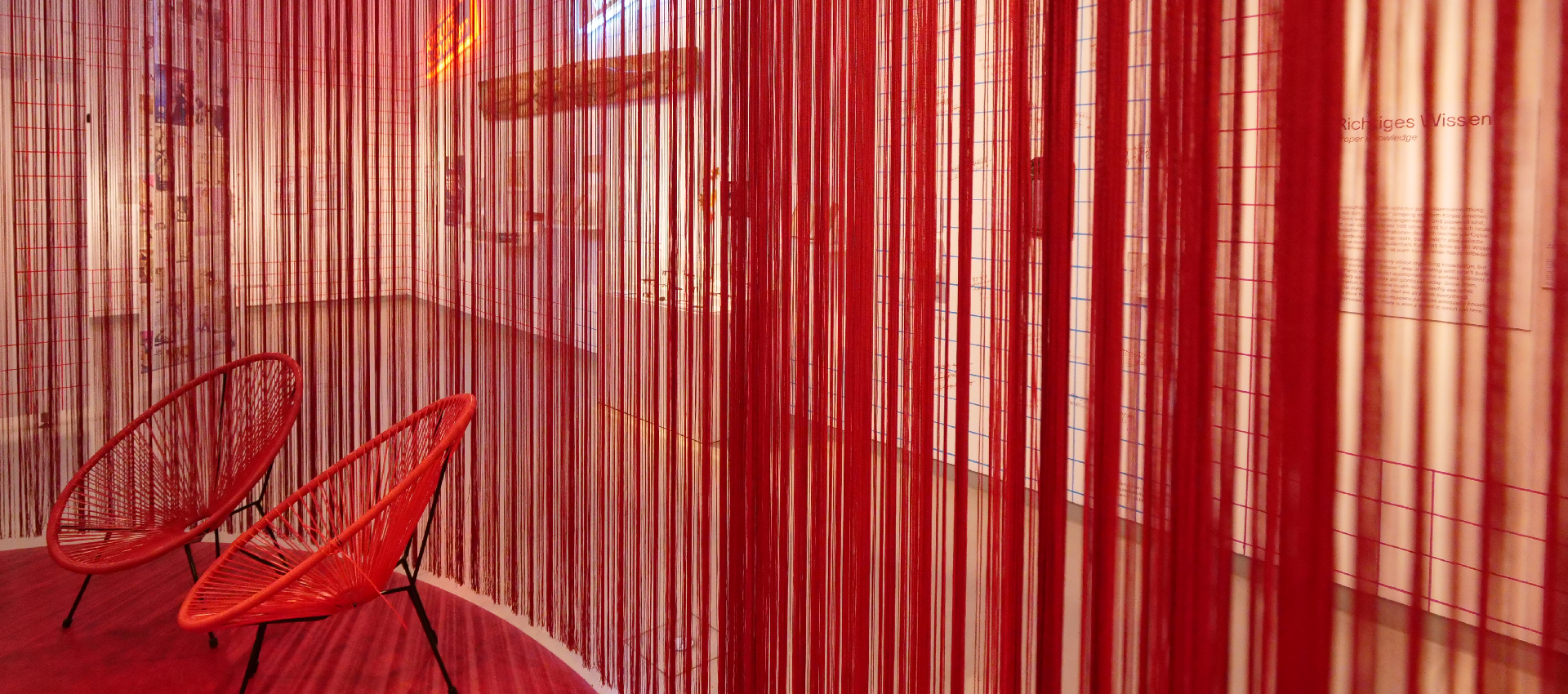
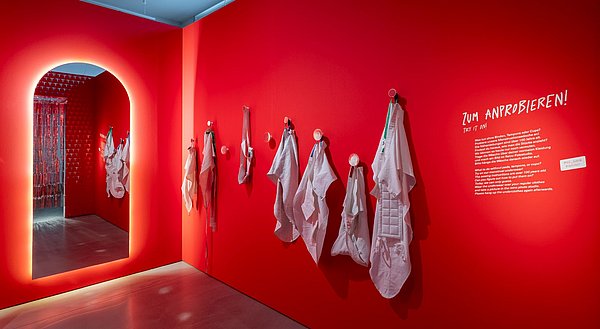
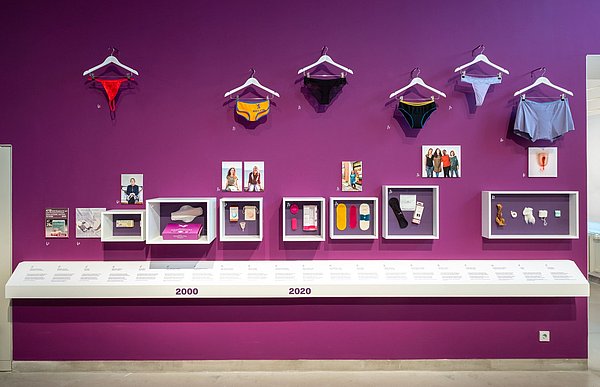
“Hey, you, where on earth have we ended up?” Three teenage boys stroll through the exhibition rooms – some of which are decorated in blood red – at the Museum of European Cultures in Berlin-Dahlem, putting on an air of nonchalance. They walk past giant posters illustrating the womb, menstrual blood and the menstrual cycle. Past walls displaying long shirts, wide petticoats and skimpy thongs – namely underwear and period products from 1880 to the present day. Past tampons, sanitary towels and menstrual cups in various sizes, shapes and colours – all available to touch. Then on to an impressive gallery of everyday objects, photos, film clips and artworks that tell stories of menstruating people, period poverty, activism or waste. A menstruation blockbuster is playing here, which seems to magically attract the boys who, during their museum visit, probably just wanted to slip away from their classmates for a moment. They glance at the rooms as they pass by. Then their courage fails them: “Pussy, let’s get out of here quick!” says one. They all leave. And they impressively demonstrate the atmosphere surrounding engagement with the topic of menstruation, which is taboo in many places: hello, sense of shame!
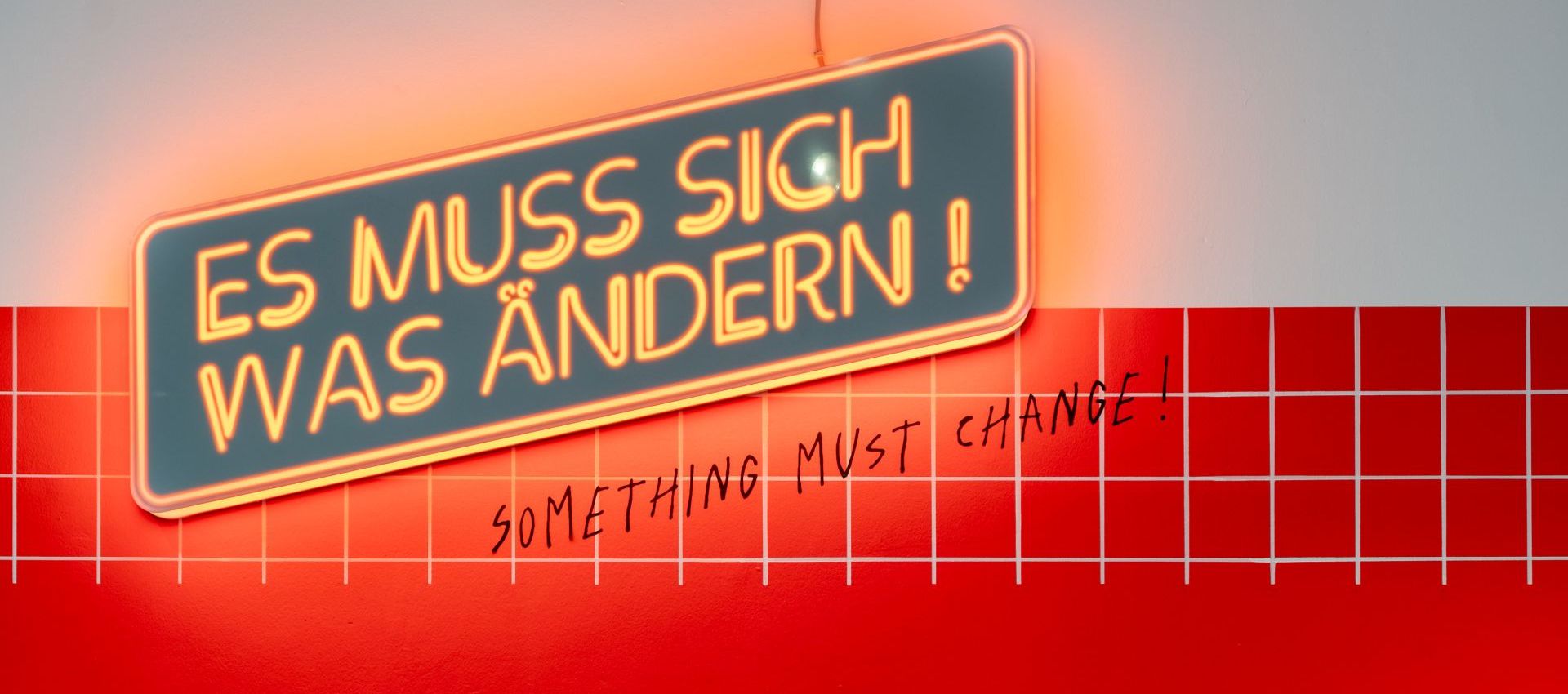
This seems absurd in the 21st century, given that around half of humanity menstruates. A menstruating woman bleeds around 450 to 500 times in her lifetime. Trans* men and non-binary people can also have periods. They all experience the bleeding physically and emotionally, sometimes as pain. Menstruation influences our thoughts and actions, our daily lives and our social interactions. It shapes language and spaces. Without it, there would be no new generations. Yet, across all societies worldwide, menstruating people and the discourse surrounding them are associated with weakness and shame, and relegated to the realm of private matters. This is a situation that the exhibition on menstruation, “Läuft”, organised by curator Jana Wittenzellner and her team, aims to change. The exhibition, which attracted an above-average number of visitors with its pop-inspired, interactive design and is now being extended until early March 2025, sees itself as a space for discourse, offering knowledge-sharing and the exchange of experiences, and inviting conversation.
A space for discourse against stigmatisation
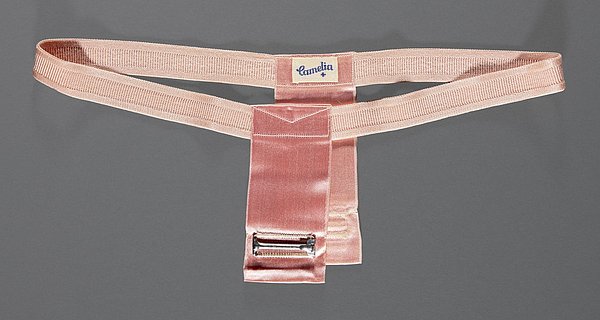
This is sorely needed, for once you have worked your way through the many layers of shirts and underpants with leg tubes, flaps and elastic bands in the Underwear Gallery from 1880 to the present day, and learnt how degrading it was for women around 1900 to menstruate in roughly six layers of underwear weighing 2.5 kilograms; once you have realised how much the eyelets of the so-called sanitary belt must have chafed against a woman’s body around 1893, or how rock-hard the Alba Zell sanitary pad – which the GDR supplied to the USSR as reparations until 1953 – must have felt between the legs; one is ultimately struck by the ingenuity of the women who found relief with homemade sanitary towels (around 1900) or newly developed menstrual cups (around 1937), and ultimately feel relieved to be a child of the self-adhesive disposable pad or the tampon made from organically grown cotton – then that fleeting sense of euphoria at the achievements of civilisation quickly evaporates again. It quickly becomes clear that, whilst much has been achieved in the discourse surrounding menstruation, too little has actually been accomplished.
Misogynistic gaffes in the election campaign
The reason lies in misogynistic gaffes such as that made by the 47th President-elect of the United States of America. When Donald Trump was questioned critically by Fox News presenter Megyn Kelly during a TV debate in the 2015 primaries, he attributed this to Kelly’s period. “You could see blood coming out of her eyes, blood coming out of her wherever,” said Trump. Challenged by this sexist comment, Sarah Levy, an artist from Portland, painted a portrait of the US politician using her own menstrual blood.
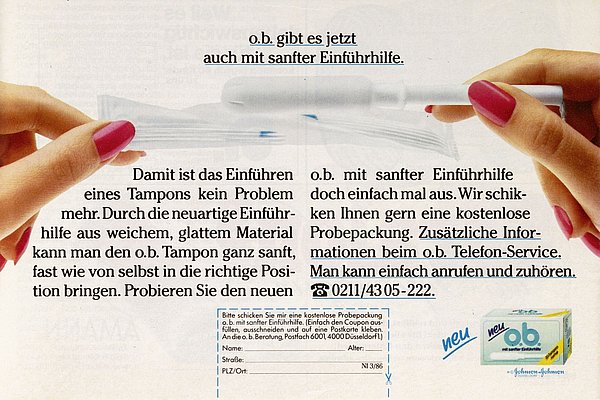
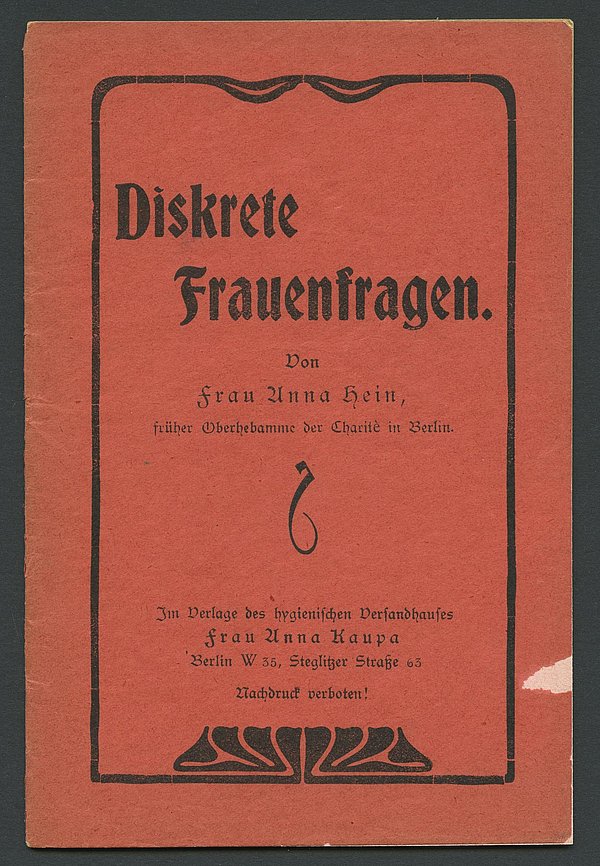
In the exhibition at the Museum of European Cultures, the artwork “Bloody Trump” is displayed side by side with a 1937 issue of the Nazi propaganda magazine “Die Arbeitsmaid”. At the time, the magazine promoted the Reich Labour Service for the healthy and fertile “young woman”, even though studies showed that the Reich Labour Service led to disrupted menstrual cycles. What is briefly summarised here in the exhibition under the heading “Weakness and Performance” is nothing less than the ideology-driven interpretative authority of a predominantly male-dominated society over the performance of the menstruating body, which is frequently accompanied by the demand to exclude women from political, economic and social life. As is so often the case, it is about power. And so the theme of the exclusion of women, to the point of their complete invisibility, runs like a thread through the exhibition.
Museum of European Cultures / Michael Mohr
Discretion as a defence against the supposed worst-case scenario of embarrassment
This ties in with the ‘silent shopping’ coupons featured in the exhibition, invented by the sanitary product manufacturers Camelia and Modess, which women would still be sliding across the counter in the early 1950s so as not to have to ask for sanitary towels out loud. That all seems a long time ago, doesn’t it? Surprisingly, these inventions for discreetly managing menstruation extend right up to 2021. On the TV show “Höhle der Löwen”, two founders convinced the investors of their business idea “Pinky Gloves” – namely, pink disposable gloves with adhesive strips for the “hygienic removal” and odourless disposal of tampons. However, the product was quickly withdrawn from the market as it triggered a social media storm. Visible blood or – worse still – a visible stain on jeans is widely regarded as the ultimate embarrassment. Behind this lies a desire for discretion and, even more so, a feeling shared by many people that periods are “unclean” and “disgusting”.
It stands for the empowerment of women who are both fascinated and proud of the complex processes taking place within their bodies
One of the exhibition’s highlights illustrates how this revulsion can sometimes take on grotesque forms: the sanitary towel incinerator. A massive metal box, fitted with a lever, hangs on the back of a wall. It demonstrates that the need to keep menstrual blood out of public view led to astonishing inventions. The principle is remarkably simple: pull the lever, flap opens, insert the blood-soaked sanitary towel, ashes come out. Developed around the 1910s by British entrepreneurs, the sanitary towel incinerator shown here was part of the initial equipment at a girls’ grammar school in southern Germany, where it remained until 2014. Whether it was actually in use for that long remains questionable, as its operation caused a racket, it stank and posed a fire hazard.
From the 1950s onwards, going to the toilet became far less exciting for women, as the widespread use of disposable sanitary products led to the introduction of waste bins in ladies’ toilets. Today, it comes as standard with a hinged lid (don’t peek inside!) and a foot pedal (don’t touch it!), whilst newer models, fitted with a sensor and treated with disinfectant agents, offer a ‘discreet all-round service’.
Facing shame with courage
There is much more fascinating information to share about a visit to the ‘Läuft’ exhibition at the Museum of European Cultures, such as the ‘Diary of Anne Frank’, in which the young girl wrote so enthusiastically about her period that the book unexpectedly became sex education literature in Japan during the 1950s and 1960s. Or about the activists of the West Berlin women’s health movement who, in 1974, disillusioned by medical arbitrariness and political paternalism, founded a women’s health centre that still exists today. One could also mention the ingenuity of young feminists chanting “We are not ovary-acting!” during their protests. Or one might think back to the three teenagers who – had they been able to bear the sight of the exhibits – could have learnt a great deal in the final room, entitled “Art and Pop Culture”.
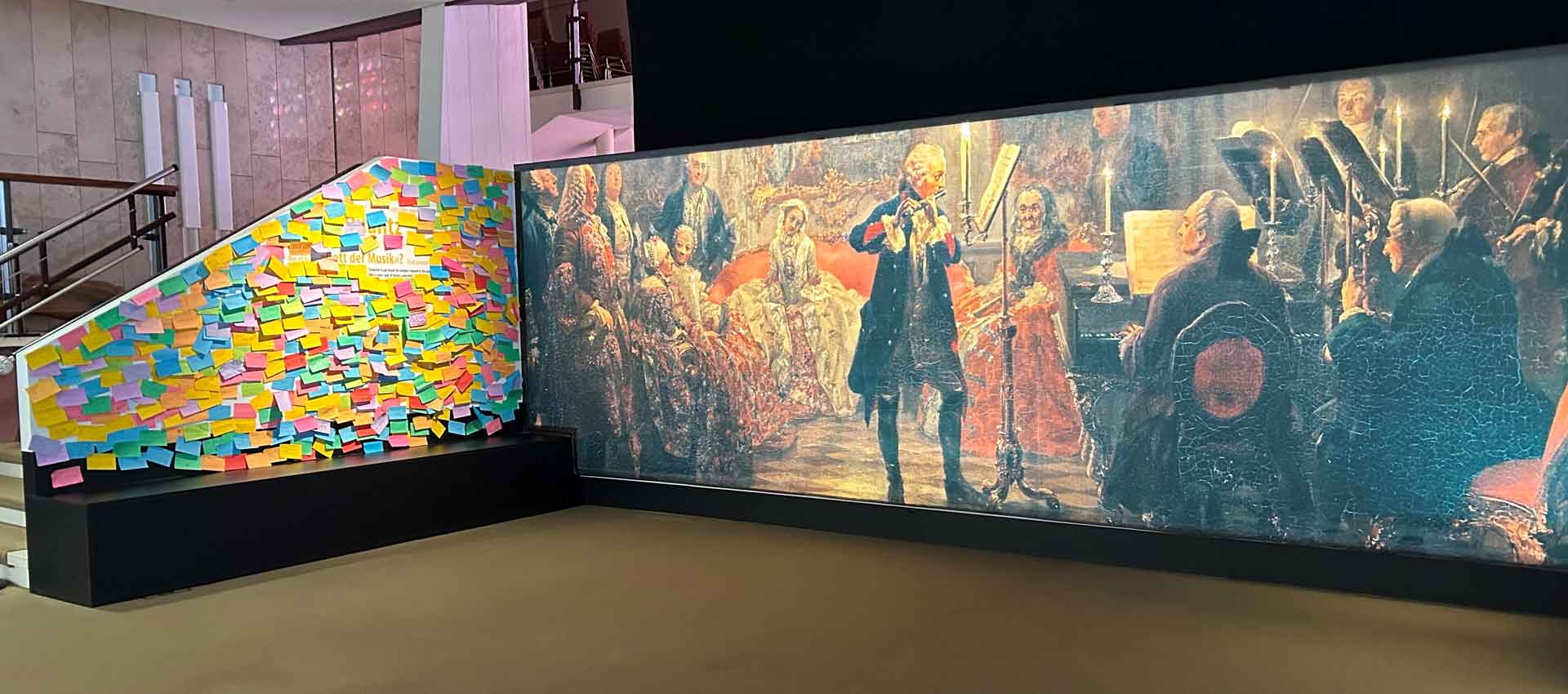
Visitors are invited to write down stories about their periods on cards to share with other visitors. Many of the cards are filled to the brim with writing; some are painted. Women speak very openly and courageously about the shame they felt when they got their first period, about mood swings caused by premenstrual syndrome, and about contraception. It is a veritable babble of voices that can now be heard here. It bears witness to the need to express oneself – against all odds – and stands for the self-empowerment of women who are both fascinated and proud of the complex processes taking place within their bodies. True to the motto: I bleed, therefore I am.
It’s on. The exhibition on menstruation
- Runs until 9 March 2025
- Museum of European Cultures, Arnimallee 25, 14195 Berlin
- Information about the exhibition
- Exhibition catalogue